• XIX. The Emerald Edge 

    April 12th, 2025

    The cabin lights dimmed. Engines screamed. I felt the plane lift, heavy wheels leaving earth, and just like that — I was gone again. Into my unknown.

    When we reached altitude, I pressed my forehead against the window. Below me, through breaks in the clouds, the Big Sur coastline slid by, those same ridges and trails I’d been running just days before, now reduced to memory. The sky burned molten orange as the sun fell, then swallowed itself in darkness. Outside the tiny oval window, the world was nothing but blackness, broken only by the occasional scatter of lights, little constellations of human life, flickering in the void.  

    I spent the night in an airport, a liminal world of fluorescent light and restless bodies. Shops pushed trinkets, travelers pushed past each other, everyone rushing toward somewhere. I just sat and watched, still as stone, while chaos circled me. It felt like molting skin — like I was leaving behind a shell of the person I’d been, stepping toward something unformed.

    April 13th, 2025 

    Another plane. Smaller now. Again the cabin lights dimmed, engines howled, and we lifted into daybreak. Outside was nothing but a white sea of clouds. I drifted off, then jolted awake as the plane shuddered. The seatbelt light flashed. We dropped, broke through the clouds.

    Rain streaked across the window, blurring the world. Through the haze I made out ocean, then a narrow channel between two mountainous islands, both blanketed in endless evergreen forest that fell abruptly into the sea. The plane descended, tires slamming into wet pavement, skidding before they caught. Across the water I saw it: a small town glittering against the grey. My home for the next six months. Ketchikan, Alaska.

    The ferry from the airport cut across the narrows under a sky the color of steel. Rain fell in sheets, blurring the outline of the forested hills ahead until they looked less like land and more like a dream taking shape. I squinted against the rain. Ketchikan. Alaska. The new edge of my map.

    For months I had told myself this would be it — the clean break, the fresh start. Santa Barbara was long behind me, Death Valley, Zion, the West, all of it. Every place I had run to, every party I’d stumbled through, every joint and cigarette lit beneath a different set of stars — none of it had stuck. But this? A town carved into rainforest, where mountains tumbled straight into the sea, where floatplanes buzzed overhead and the forest looms dark and brooding, yet strangely inviting. Surely this was where I could shed the weight I’d been carrying.

    The ferry horn bellowed, low and mournful, as we approached the dock. The water churned gray-green beneath us, kelp swaying in the current. Beyond the pier, the town clung to the hillsides, houses painted in reds and blues and yellows, stacked crooked against the mist. It looked like something out of a dream.
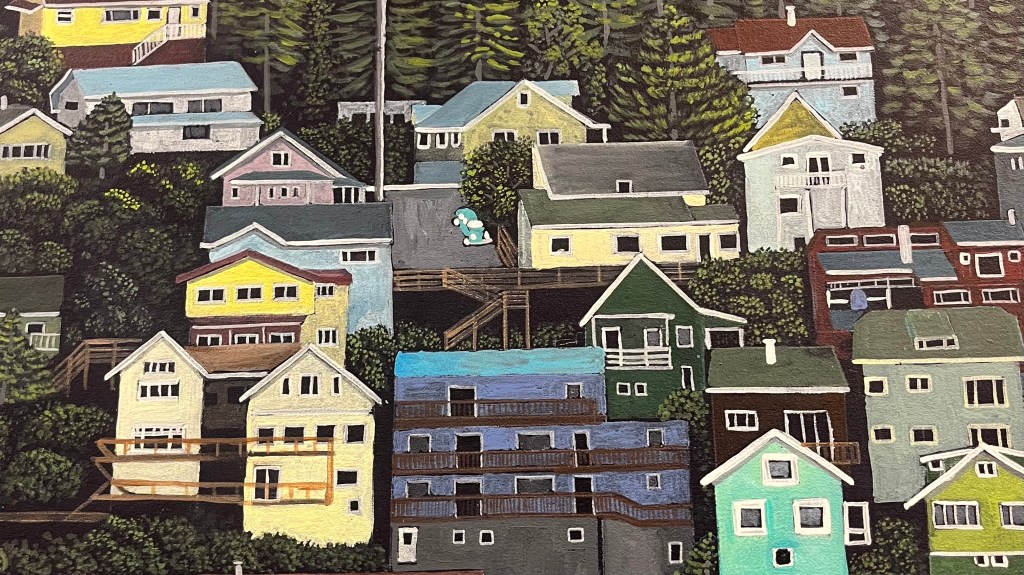
    I shouldered my pack and stepped out into the rain. Cold drops stung my face, plastered my hair to my forehead, beaded and fell from my jacket. I didn’t care. The air smelled like cedar and salt and something raw, something alive. I told myself, right then, that this was the place. 

    An email had promised someone would pick me up, but no one came. I waited. Checked my phone. Nothing. Forty minutes slipped by in the storm until finally a cab rolled by, headlights smeared by rain. I flagged it down. The driver, an older man, weather-creased and grizzled, gave me a look.

    “Seasonal worker, huh?”

    I laughed. “That obvious?”

    As we drove, he pointed out the essentials — grocery stores, gear shops, cruise berths — while I soaked it all in with wide, eager eyes. He dropped me at the address I’d been given: a windowless building with peeling blue paint, pressed tight amongst other houses on the narrow street. I knocked. No answer.

    Shit.
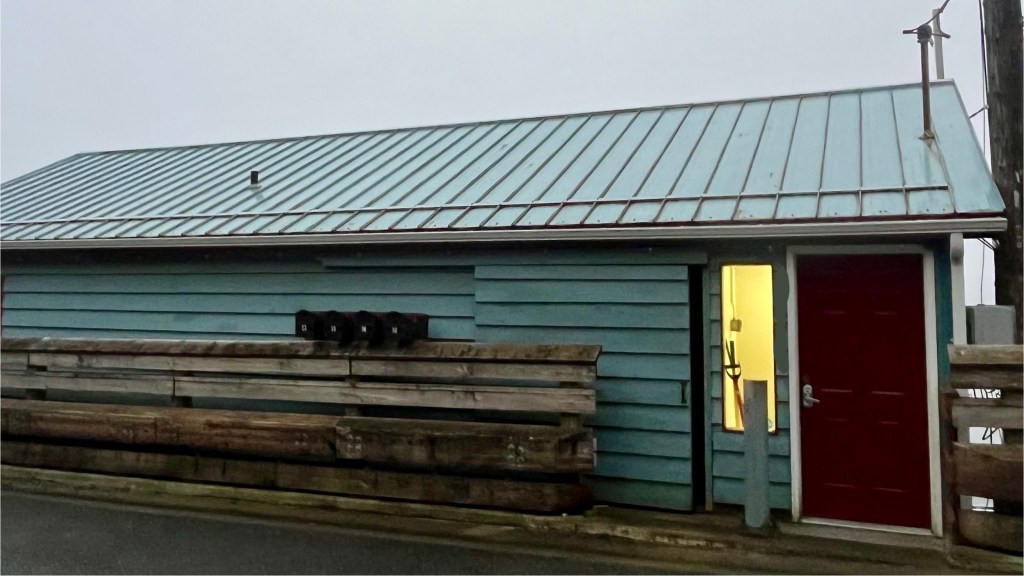
    Other addresses were listed in the company email, so I shouldered my pack and started walking. The town was dead. Boarded storefronts. Empty streets. Rain pounding pavement. I knocked on one door after another — silence. With every failed attempt the rain seemed to fall harder. I thought about finding a hotel, but every one I passed was shuttered. In the email there was one address listed that I hadn’t tried, I plugged it into the map, a forty–minute hike up into the hills that cradled the town. It was my only shot.

    I climbed through the neighborhoods, sweating under my soaked layers, hair dripping into my eyes, my breath steaming in the cold. By the time I reached the house I was running on the fumes of hope. I knocked. Silence. Then — the sound of shuffling.

    The door opened to a woman with kind eyes, warmth spilling out behind her.

    “Please tell me you work for Alaskan Travel Adventures,” I stammered.

    She smiled, waved me inside. Another woman behind her, nodding. “We do. Come in.”

    Relief crashed over me. “Thank god.”

    Inside, I peeled off my drenched layers, dripping, creating a puddle on the floor. I told them my story — stranded at the airport, wandering town in the storm. They laughed softly, then pointed out what I’d missed: the manager’s phone number, buried halfway through a long email. My face flushed, but I laughed too. Embarrassed, I dialed. The manager told me she would come.

    Not long after, I was loaded into a jeep and driven back through the rain — to the very same windowless building where I had been left by the taxi a few hours before. Only this time, I was led inside. Downstairs. Through a door marked “B.”

    It opened into an apartment with real character — a corner kitchen, hideous wallpaper, a table ringed by camp chairs, a small TV next to a stack of a few DVDs. But what stopped me in my tracks was the balcony: it looked straight out over the narrows, where green mountains dropped into the sea and mist shifted like breath.
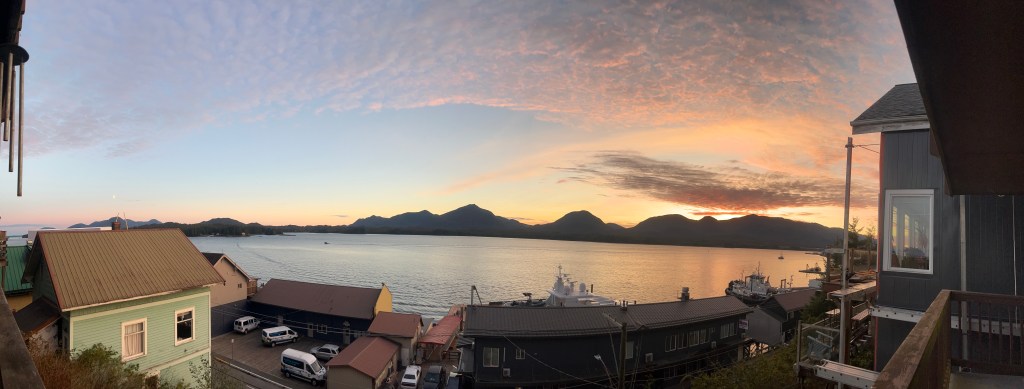
    View from the balcony on a stunning day near the end of the season.

    The manager wrote the door pin on a scrap of paper. “It’ll be a while before your roommates show. Work starts soon. Now that you’ve got my number, I’ll text you the details.”

    And just like that, I was alone again.

    I dropped my pack, peeled off my jacket, collapsed onto the straw-colored couch, and stared up at the popcorn ceiling. This place? All to myself? At least for a little while.

    Bitchin’.

    April 15th, 2025

    A couple days later, I was picked up in an old rattling green van — The Pickle. I’d come to learn it would only get more tired and broken down as the season went on. Inside was what would become my family for the next six months: a mismatched crew ranging from eighteen to nearly fifty, all with the same wide-eyed, unsuspecting look — green.

    It was mid-April. Rain beat aggressively against the windows as The Pickle chattered down the Tongass Highway. Conversation was sparse, mostly introductions mumbled over the hum of the tires. Everyone was still tucked inside their shells.

    Brooklyn went first — mid-twenties, from Chicago. I’d met her after my rainy walk from the airport a few days before. Sweet, socially sharp, with big eyes that hid some chaos behind them.

    Cat from Virginia — twenty-one, quiet, watching the forest slide past the glass with a resting face that said back off.

    Kyler and Karlie — nineteen and eighteen, a newlywed Mormon couple from Idaho.

    Mikey — early thirties, from everywhere and nowhere, a musician with that old-soul weariness around the eyes.

    Meg — mid-forties from the PNW, the woman I’d crossed paths with after that drenched walk days before. She’d lived a full life: career, school, structure. Then she’d decided she was ready for something new.

    And finally, Dallas and Kait — mid-twenties, a couple from the East Coast who’d fallen in love at a ski resort in Colorado and hadn’t stopped moving since.

    A ragtag crew if there ever was one. On that rainy day in April, I had no idea how close we’d grow through the coming highs and lows, the endless hours, the excitement of the Alaskan tour season.

    The van pulled off the highway and lurched into a dirt lot, tires sinking into potholes. Someone slid open the side door, and we all tumbled out into the rain, ducking through the downpour into the open door of a cream-colored tin warehouse.

    Inside the warehouse, we gathered in a loose ring of tired plastic chairs, setting our packs down with that quiet, apprehensive air of strangers about to become coworkers. The space smelled faintly of cedar and rain, the concrete floor still damp where puddles followed us in. A red canoe sat perched on a couple of 2x4s like it had been waiting all winter to touch water again.

    Tulip — the manager who’d dropped me off a few days earlier — stood before us. Late twenties, bright face, and a bounce in her step that felt like sunshine breaking through the clouds, her energetic cadence was almost concerning given the dreary conditions outside. She welcomed us to the 2025 season with the kind of optimism only the first day can hold.

    Then there were the bus drivers: Brandon, Ed, and Ron.

    Ed, from Arizona, lived on a boat in Ketchikan and had clearly lived his life hard and fast — his motto, as I’d soon learn, was “I don’t give a fuck.”

    Brandon, a local, spoke and moved with the gruff weight of a bear, years of Alaskan winters etched into his tone.

    And Ron, from Oklahoma, was quiet and kind, with the soft steadiness of someone’s grandpa, always wearing a subtly mischievous look beneath a fluffy mustache.

    We sat in near-silence while everyone shuffled to get comfortable, cold air wrapping around us. Unlike other seasonal jobs where I was the new kid walking into an established crew, this time everyone was the new kid — and it showed. For many, this was the biggest leap they’d ever taken. None of us knew exactly what we’d signed up for, but bailing didn’t feel like much of an option.

    Still, the thought made me smile. Different corners of the map, different ages, different lives — and yet, here we were, gathered in a tin warehouse on a rainy April day in Southeast Alaska. With the promise of the kind of summer you one day tell your kids about, maybe even your grandkids. Some were hired to guide jeep tours, others to lead lake tours in big Tlingit replica canoes. As for me? I’d landed the island hiking-guide gig, and damn, that lit me up.

    Tulip kicked off the day with quick intros, icebreakers, and a crash course in what to expect from the season. The hours dragged on — a flood of logistics, safety briefings, and information. It was clear this would be the most demanding job I’d ever worked, and hopefully the most rewarding.

    The following weeks blurred together.

    First came the days where we learned what we’d need to be experts in — everything from local flora and fauna to Tlingit legends, from banana slugs to the tides. Then came the setup: dropping docks into the lake for canoe tours, checking the jeeps, hauling the big yellow banana boats out of storage and into the waters of Clover Pass. Those boats would spend the summer ferrying guests to and from Betton Island — my island, my tour.
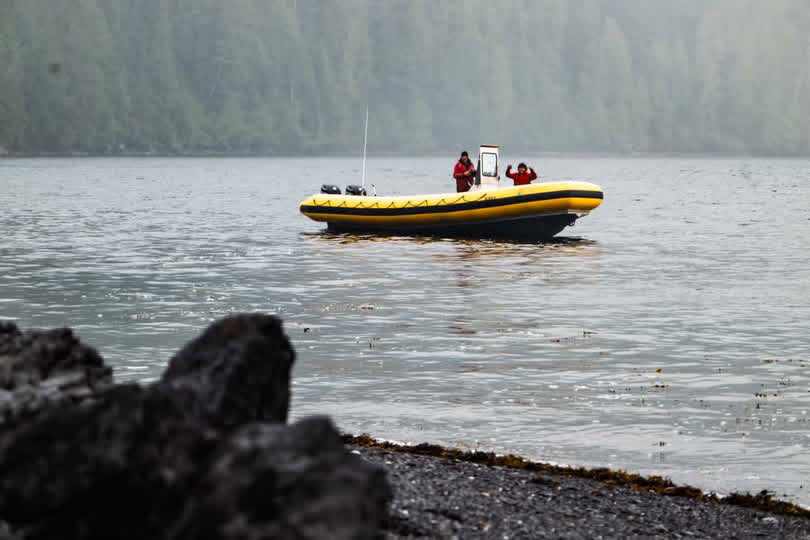
    A photo from Betton beach – June.

    The first wave of 2025 guides got close fast. The first deep connection I made was with Brooklyn — spiritual, grounded. A somatic practitioner chasing a change of pace. We found comfort in each other’s presence, an ease to skip the small talk and get to what was real.

    April 22nd, 2025

    After a long, cold day dropping docks into the lake, we rode in the back of The Pickle, rumbling down the eight-mile pothole road that stretched from the lake to the warehouse — swapping stories about past situationships. That’s when she showed me a text thread that had cut her deep. It was eerily similar to the way things ended with Dani. The same hard drop — casual messages one day, radio silence the next.

    Naturally, I pulled up my own thread with Dani, the one still buried in my messages app. That’s when I saw it — a small note at the bottom of our conversation. She’d kept the last audio message I sent before leaving for Alaska. Just seeing that… it did something to me. A small jolt of peace. Solace, even. Proof that she’d heard me — that some part of her had listened.

    I hadn’t thought much about her since the season began, buried under the rhythm of work and new faces. But that glimpse reopened something. A thread to grasp. Maybe there was still a chance. Another part of me fought it — this was supposed to be a new chapter. Coming north was meant to rebuild, not to chase fading taillights again.

    That night I walked up the hill to Brooklyn’s place. We stayed up late, talking through the ghosts of people who’d drifted from our orbits. There was more pent up inside me than I’d realized. I laid everything out — all the tangled emotion I’d carried for months — and by the time I walked home through the dark, wet streets, a sense of lightness followed me. The air was cold and clean, and it felt like I’d finally let go.

    April 23rd, 2025

    Brooklyn and I grew closer after that — two souls syncing at the right time. The next morning I woke with a pep in my step. The team spent the day launching 800-pound Tlingit canoe replicas into the lake — long, heavy, carved like relics of another world — and even under gray skies, I felt alive again.

    That night she came over with a bottle of wine. We sat on the old couch wrapped in quilts left by guides from seasons past, peeling back more layers of ourselves. When a lull hit, I picked up my phone to check the time. Ding.

    My stomach flipped. My body went electric — a hum through every nerve.

    On the screen, glowing in the dark, was her name.

    Dani.

    Holding my breath, I opened the message.

    I’m sorry for how things turned out, it was never my intention initially. But my world has turned upside down, and I can’t explain it much now, but give me like 2 months and I’ll be able to talk about it more. I’m not expecting you to answer, nor do I need one currently, but I want you to know how excited I am for you and your adventures and I hope Alaska has been everything you wanted and so much more. Make memories, get some good flics, and for now I’ll be cheering you on silently and from a distance. I hope the bridge isn’t fully burnt and we can go on another adventure one day in the future. Nothing but respect for you Matt.

    I was ecstatic — everything I’d wanted to hear. Needed to hear. But something deeper tugged at me.

    It was everything I wanted to here and it hit like lightning.

    My body hummed.

    Breath turned heavy.

    The room felt alive — pulsing.

    Behind my eyelids, a vision unfolded: a white snake coiling around a column, endlessly spiraling upward. Its body shimmered like light through water. Something inside me had come undone.

    Energy rose from the base of my spine to the crown of my head, a slow, burning current that made my fingers tremble. I felt charged — like I could move mountains with my mind. For a moment, there was no past or future, no Dani or Brooklyn or Alaska — just pure current flowing through me. I was tapped in.

    Brooklyn sat across from me, eyes wide, reading my body like a pulse.

    “Hey,” she said softly, “what’s happening right now?”

    I tried to speak, but words caught in my throat.

    “I—I just saw something,” I finally got out. “Behind my eyelids. A snake. White. Twisting up a column. I could feel it. Like… it was another limb.”

    She leaned in, grounded as ever, her energy calm against the storm overtaking me. “That sounds like Kundalini,” she said, voice low, deliberate. “It’s energy — it moves through the body like that, rising from the root up the spine. It’s powerful. It can change people.”

    Her words sank into me, mixing with the hum still vibrating in my bones. I felt both electric and weightless, like I’d just crossed some invisible threshold.

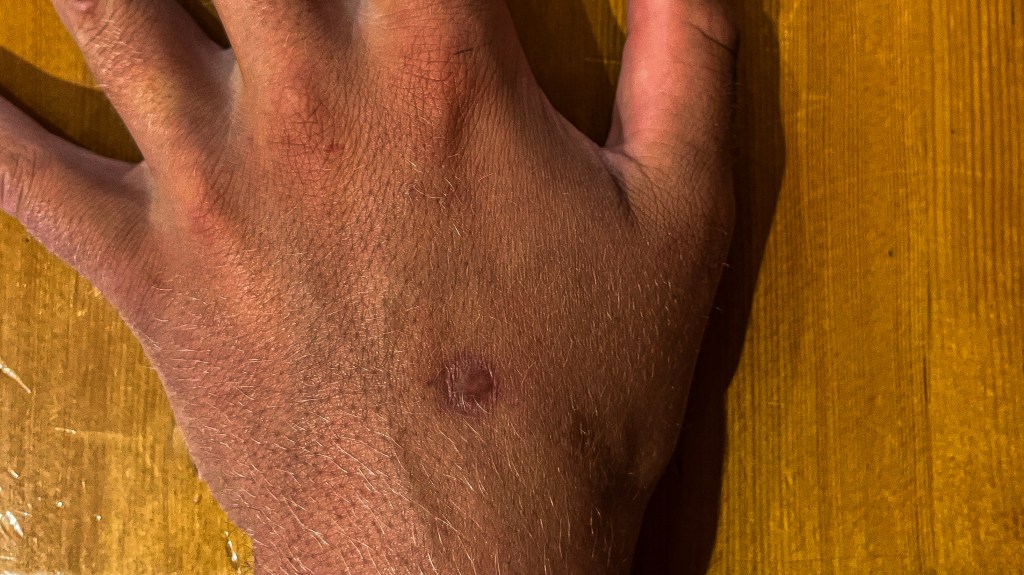
    For a long moment, we sat in silence. Rain drummed against the window, the heater rattled, the room carried the smell of damp jackets and red wine. I stared at my hands — the same hands that gripped a steering wheel for miles and miles, had been beaten in the sun, had a scar forming from the cigarette burn — and they felt new. A kind of alive I hadn’t felt in a long time.

    Brooklyn smiled faintly, watching me settle.

    “Whatever that was,” she said, “you just touched something real.”

    And I believed her.

    Because whatever had woken inside me — it wasn’t just energy.

    It was a remembrance.

    Like a part of me I’d forgotten was finally clawing its way back to life.

    XX.  The Alaskan Summer

    May 2025

    By the time the first cruise ships docked in Ketchikan, everything was ready.

    Was I nervous? Absolutely. I was about to lead strangers from all over the world on a hike through the Alaskan rainforest, talk about trees and totems, and pretend like I’d done it all before.
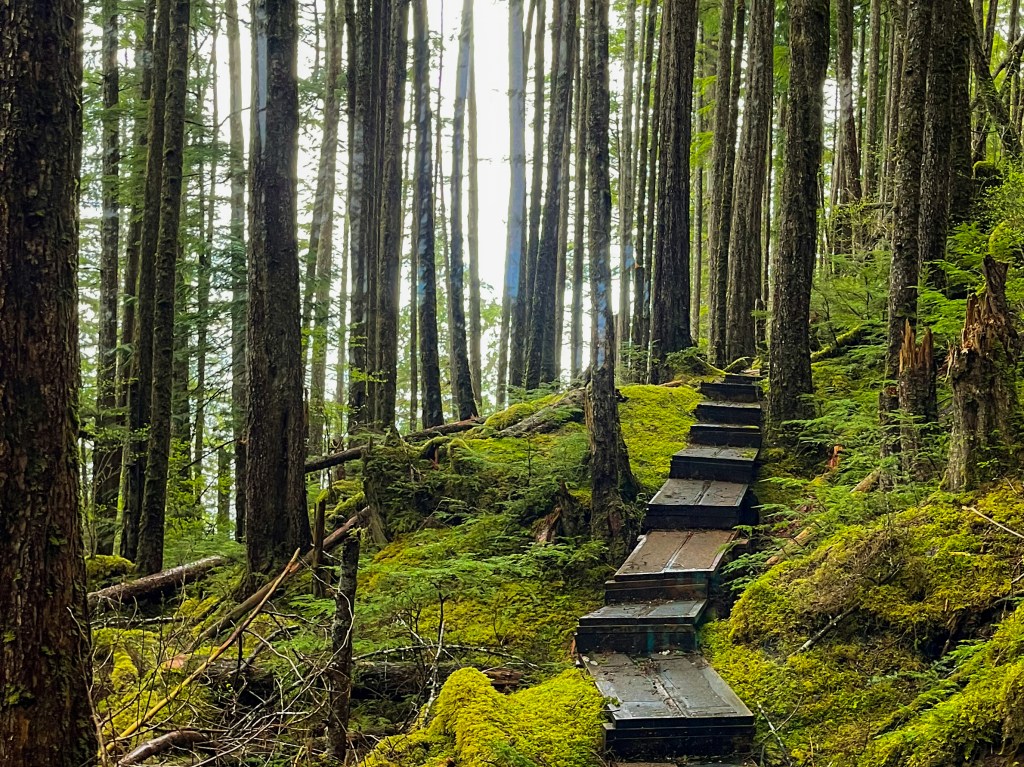
    The Betton Island trail

    But when that first boatload of guests stepped onto the beach of Betton Island, something shifted. Confidence surged through me — this was what I was meant to do. Months later, I can barely remember the details of that first tour — just that I stuttered, forgot a few facts, and probably left out half of what I was supposed to say. But I do remember the smiles, the solid handshakes, and a few crisp twenty-dollar bills tucked into my palm.

    As they climbed back onto the banana boat and waved from the water, I felt the tension drain from me.

    The season had just begun, but I already knew — it was going to be a good one.

    Before I knew it, I’d been in Alaska nearly a month, and my roommates started trickling in.

    First was Keaton, a kind soul from Idaho with serious talent on the guitar — the kind of player who makes it look effortless. His voice carried that raspy, outlaw grit that belongs around a campfire with a half-empty whiskey bottle and stars overhead.

    Next came Westin, calm and respectful, the kind of guy who listens more than he speaks. He’d spent two years serving a mission for the Church of Latter-Day Saints in Japan, and you could tell — everything about him had this grounded patience.

    And then there was CJ.

    Oh, CJ.

    CJ is hard to put into words. I’d never met anyone so charming and offensive at the same time. He spoke in what he called “Cjanese” — a language entirely his own — spinning slang and half-jokes so fast you couldn’t tell where the bit ended and the truth began. His introduction to the rest of the crew was… polarizing, to say the least.

    The guys? We were all pretty much down with him right away. He had that reckless humor and laid-back cool that made for good conversation and better beer talk.

    The girls? Every single one of them immediately agreed:

    “Yeah, this guy’s an asshole.”

    By the time I had roommates and I was polishing my tour speech, I was settled in. But something was nagging at me. Ketchikan — and the Alaskan experience — was not the fix-all I thought it would be.

    With Brooklyn, after work, we’d stay up late drinking wine and smoking cigarettes on the porch. Then when CJ arrived, I’d never deny a beer when it was offered. The only reason I wasn’t smoking weed was the threat of Coast Guard drug tests. I kept telling myself, I’m just settling in, this is natural. Once I get into a routine, I’ll sober up. I’ll find the clarity I’ve been looking for.

    But I wouldn’t admit that wasn’t true. Hell, all the traveling through the West hadn’t gotten the monkey off my back. And slowly, the realization I’d known all along began to sink in — you can’t run from yourself.

    I was still plagued by cravings. Nothing in particular, just the need for something to take the edge off — a buzz, a burn, the curl of smoke in my lungs. I felt broken.

    The work helped, though. The tours were demanding — a performance, really — and to get the tips, I had to be sharp. Living with Keaton and Westin, both devout followers of Christ, meant I was in a clean, calm environment. They never drank, never smoked, and their quiet faith filled our apartment with this strange peace. I found myself drinking less, sleeping more, waking up clearer. But the pull never fully left.

    That’s when CJ and I had a simple conversation that changed everything.

    I’d taken a liking to the guy — well, not at first. My first impression was what a douchebag. But after a few days, I learned his bit, his humor, his strange poetry. He had this way of saying things that made you both laugh and think. Plus, on the first day we met, he wore a shirt from one of my favorite coffee shops back home. I took it as a sign — the universe subtly letting me know I was where I was meant to be, with who I was meant to be with.

    A few weeks later, we were sitting on our balcony, looking out over the Narrows on one of those rare bluebird Ketchikan days.

    CJ leaned back in his chair, squinting at the light on the water. “Hell of an office,” he said, grinning.

    “No kidding,” I laughed, though my chest felt heavy. The night before had been rough. I’d blacked out at a team cookout, woke up with no memory of how I got home and a hole the size of my fist in our bathroom door. Laughing, my coworkers filled me in, stories I didn’t want to hear. I was ashamed. Alaska was supposed to be where I figured it all out, and here I was, same as before.

    I stared out across the water and finally said it. “Man, almost a year ago, I left a toxic lifestyle in Southern California. I told myself I’d change, get healthy, find clarity, be someone I could actually respect. And then last night… I blacked out again. Crashed out. I’m stuck in the same rhythm.”

    CJ didn’t say anything at first. He just nodded slowly, eyes on the horizon. “Yeah, I know what you mean, man. It’s not an easy road. I’ve seen that cycle in people — hell, I’ve lived it. I used to work in bars, remember? People get caught in these grooves. Feels like you’re moving forward but really you’re just going in circles.”

    I looked over. “So how’d you get out?”

    He smirked, took a long breath, and said, “Well, what I live by — what I always keep in mind — is simple: we’re all just on a floating rock, man.”

    I laughed. “That’s your grand philosophy?”

    He grinned. “Damn right it is. People take life too seriously. They think everyone’s watching, judging. But truth is — nobody gives a fuck. You got plastered last night? So what. The sun still rose today, and it’ll rise again tomorrow. You’re not the first, and you sure as hell won’t be the last. The world keeps spinning.”

    He leaned forward, elbows on his knees, eyes narrowed like he was searching the water for something deeper. “If you want to change, that’s on you. Nobody’s gonna do it for you, and nobody should care whether you do or don’t. It’s your life, man. Your responsibility. The minute you stop thinking it’s anyone else’s problem, that’s when it starts to click.”

    I nodded, silent.

    He sipped from his mug of tea — it was always tea with CJ — and said, almost to himself, “When I get the urge to drink or smoke, but something in me says maybe not tonight, I just remember — it’s a hankering. That’s all it is. It’ll pass if you let it.”

    “It’s just a hankering,” I said quietly, testing the words.

    He grinned. “Damn right. You don’t have to fight it. Just watch it drift by. Same way you’d watch a wave roll in, break, and get sucked back out.”

    We sat there for a while, the Narrows glittering gold, the cries of gulls faintly from the docks. I thought about all the running I’d done — all the miles, all the cities, all the people I’d met — and how none of it ever quieted the noise in my head.

    “Thanks, man,” I said finally. “Food for thought.”

    He nodded, eyes still on the horizon. “Anytime. Now quit thinkin’ so damn much and enjoy the view. We’re in Alaska, after all.”

    As the weeks would blur into months, I slipped into a rhythm — familiar, steady — but with more mindfulness. Cj’s words still echoed in my head: If you’re gonna change, it’s your choice alone. A truth I had known all along, but needed Cj to make me face.

    By mid June, I was halfway through the season. Alaska had become routine. Then I got sick. A pounding headache, muscle fatigue so deep I could hardly lift my arms, no appetite. Days in bed, living off water and ibuprofen. When the fever broke, the body healed, but the mind didn’t. I stayed under the covers, watching sunlight crawl across the ceiling, paralyzed by anxiety. My heart raced over nothing: money, the future, the vague sense I was drifting too far from everyone I loved.

    It was the first real breakdown I’d had since running from Santa Barbara. And I couldn’t make sense of it. I had everything I thought I needed: a job I cared about, good people around me, a roof over my head. Yet I felt hollow. Lonely, even when surrounded by laughter. I missed California — the golden afternoons, the crash of the Pacific, the warmth of the sun on my skin, the simple joy of highway drives with the windows down. But I knew if I went back, I’d just start the cycle again. I’d be restless within weeks. There was nothing for me back there except the comfort I was supposed to outgrow. In hindsight I can see it was a textbook case of burnout. 

    At work, I stumbled through tours I could once recite in my sleep. My timing was off, my facts tangled. At home, I slept through my days off, skipping out on hikes, bonfires, and anything that required energy. Alaska was supposed to sober me up — to be the fix — but the stillness had just made the noise in my head louder.

    Then one morning, instead of rotting in bed again, I opened my Ipad. I started to write. A year of stories had been bottled up — stories from the road, heartbreaks, deserts, climbs, chance encounters. I poured them out before work, after work, late into the night. I wrote until my fingers cramped. On my days off, I’d sit in a coffee shop by the docks, typing as rain streaked down the windows, watching the people come and go.

    Somewhere in those words, I began to find my way back. Writing became a rope I could climb out of the pit with. Through revisiting the past, I remembered how far I’d come — the freedom, the movement, reigniting faith that somehow things have always worked out, will always work out. I built a small website, The Dirtbag Database, and started posting my stories there, one by one. People read them. People wrote back. For the first time in a long time, I felt connected — to others, to purpose, to myself.

    And slowly, I remembered: I’d never needed to have it all figured out before. So why start now?

    With the first stories posted and more scheduled to go live, I began to feel like myself again for the first time in a long while. I approached life with a new vigor — a new idea: live a life worth words.

    So that’s what I chose to do. And I’m glad I figured it out when I did, because by then it was nearly the end of July, and I was really starting to see what the Alaskan summer was all about.

    Though rare, those off-days felt sacred. When schedules aligned or everyone miraculously got off early, the whole town seemed to breathe easier. Ketchikan turned lively the moment the sun broke through —craft fairs popping up along the docks, live music drifting out of bars and open windows. Other times we’d shoulder our packs and hike to a summit on the edge of town, spending the night in one of the Forest Service cabins if the next morning’s shift started late enough. We’d sit around a crackling fire, sparks swirling into the cool air, talking softly under stars that didn’t fully appear until after ten. In the height of summer the sun took its time giving way to night, and those hours—caught between day and dark — felt like a reward for surviving the grind.
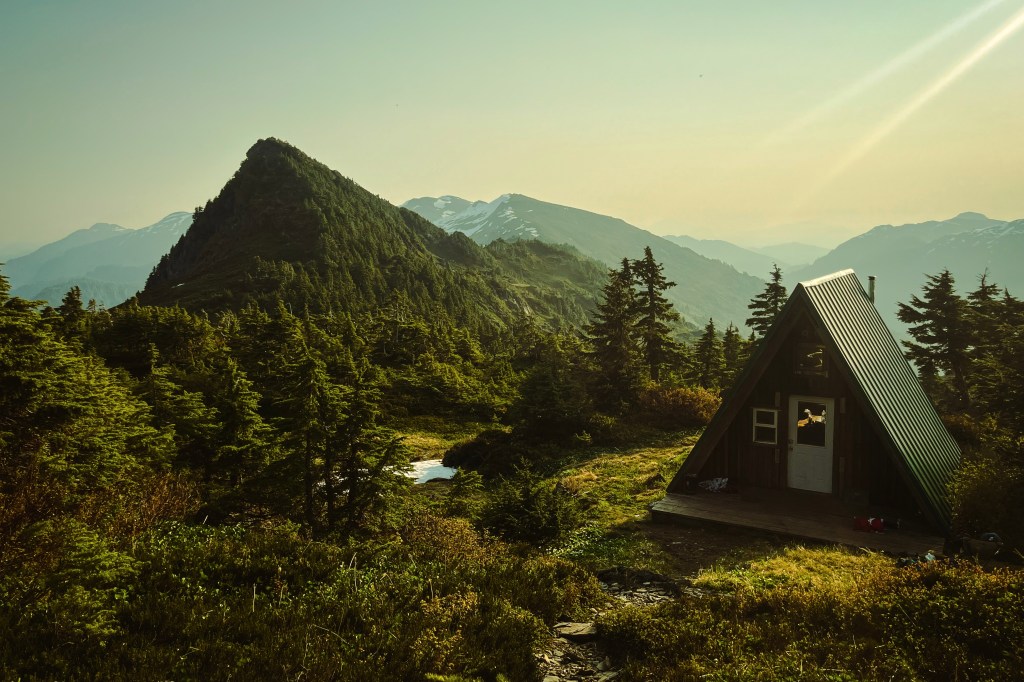
    The Deer Mtn. Classic

    Sunny days made the work easier and everyone happier. Everyone began to look a little more alive. 

    If guiding tours hadn’t already felt like work, now it really didn’t at all. Between groups, we’d strip down and lay on the hot black stones of the beach. After tours, we’d stop the boat on the ride back to the marina to jump from the top of sheer rocks into the deep blue of the Alaskan Pacific.

    It was in those days of sun and ease that I began to form a connection with someone unlike anyone I’d met before — Captain Mitch.

    He was my father’s age and had lived many lives — a neuroscientist, pastor, and captain all wrapped into one. But despite our gap in age, education, and faith, we found a kind of kinship. Mitch had a grizzled look about him — laugh lines, sun-worn skin, and a gruff humor that always cut through the silence.

    Together we made a great team. From the marina, we’d take guests to the island. On days I wasn’t giving tours, I worked as his deckhand — cracking jokes with passengers, pointing out whale spouts, and making sure no one stood up while we were underway.

    And Mitch? He drove the Banana Boat — a 400-horsepower, bright yellow, twin-motor fast rescue boat — like he’d stolen it. The more nervous the guests looked, the harder he pushed the throttle. He’d bring the engines up to nearly 5,000 RPM and head straight for the rocky edges of the islands, turning at the last second. The passengers would whoop and holler, sprayed with sheets of saltwater that crashed over the sides of the boat.

    We’d comb the jagged shorelines looking for wildlife — seals, eagles, deer — making sure everyone aboard had a good time, or at least a memorable one.
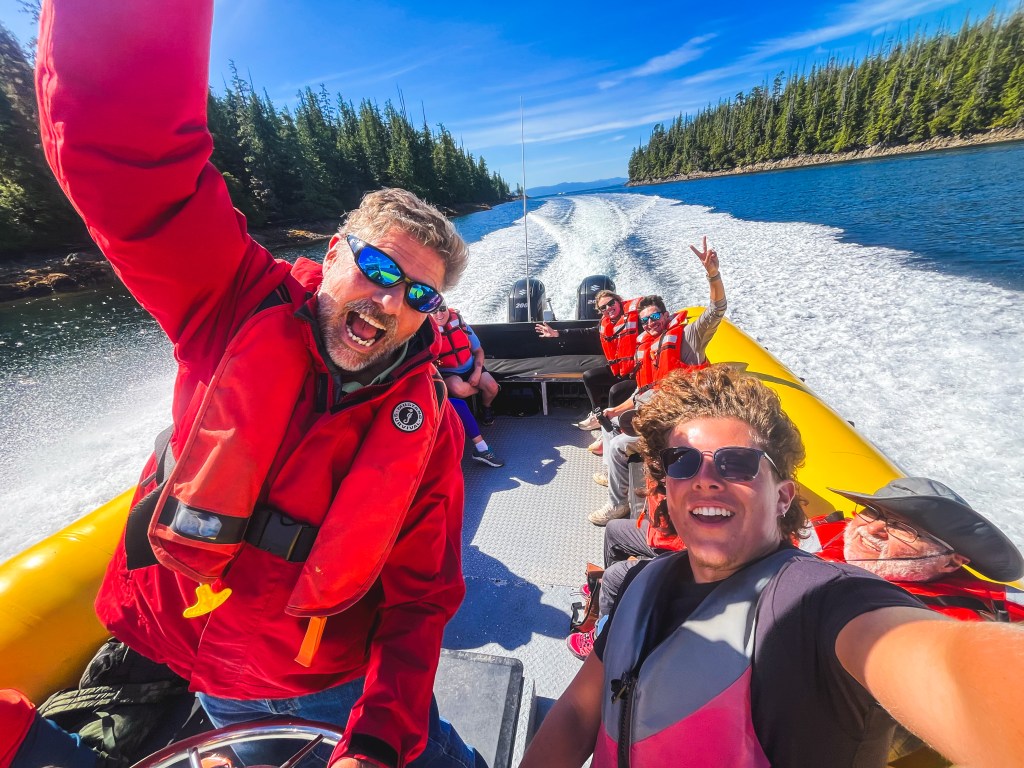
    Some days the rain came down hard. I’d stand there with a squeegee, clearing the windshield while Mitch still drove like nothing had changed. The rain soaked through my jacket and hair, pelting my face with stinging drops. I’d work tirelessly, back and forth across the glass, but often the rain fell faster than I could clear it. Those days were always fun — the kind of wild that reminded you where you were: Southeast Alaska.

    But the best part was always the hour and a half Mitch and I had to ourselves between dropping-off and picking-up the tour groups. Especially on sunny days.

    We’d drift far out into the rolling blue of the Behm Canal. Mitch would pass me an apple or a plum, and I’d take off my shirt, lay on the big yellow inflatable tube that lined the boat, and let the sun soak in. The water rocked us gently. Sometimes I’d fall asleep; other times we’d just talk — about everything and nothing at all.

    One day, a particularly hot and clear afternoon in late July, we sat a mile from shore — the only boat in sight. I told Mitch about something strange that had happened recently.

    “You know, Mitch,” I began, “the other day something peculiar happened at the grocery store. I walked in and almost instantly met eyes with a woman — a young pretty woman, but not necessarily in a romantic way, just someone I admired. I smiled. She smiled back. No words. I went about my shopping, grabbed a tea, sat down to use the Wi-Fi and write.”

    Mitch nodded, curious where it was going.

    “About forty minutes later,” I continued, “the same woman came back. She walked straight over to my table, I pulled out my headphones as she took a seat across from me, and almost frantically said, ‘Hey, I know this is random, but I drove to the edge of town and had to turn around. My God told me to give this to you.’ Then she pressed $150 into my hand and said, ‘I hope you can get whatever you need. God bless you.’ And then she was gone.”

    I paused. Mitch’s face wrinkled in thought.

    “I didn’t need the money,” I said, “so I tucked it into the back of a book for a rainy day. I couldn’t have refused it — she’d driven all the way back just to find me. How she knew I was still there, I have no idea. What do you think, Mitch?”

    He smiled, earnest and calm, and looked me in the eye.

    “God is reaching out to you, Matt,” he said. “There’s no other way to put it.”

    His words hung in the air for a while, carried off by the breeze that rippled across the water. I didn’t say anything right away — just watched the light scatter off the waves, a thousand tiny mirrors reflecting the sky. It was quiet out there, no boats, no engines, just the soft hum of the sea against the hull.

    I wasn’t sure what I believed, or what “God reaching out” was supposed to look like. But something about the moment — the timing, the strange certainty in that woman’s eyes, Mitch’s steady voice beside me — it all felt like more than coincidence. Maybe it wasn’t about religion. Maybe it was just the universe, or fate, or whatever name you want to give to the feeling that you’re exactly where you’re meant to be.

    Mitch leaned back in his seat and smiled that weathered smile of his. “You’ll come to find, life is serendipitous,” he said. “It’s not about finding the answers. It’s about paying attention to the doors that open.”

    I nodded, letting the words sink in. The water rocked the boat gently. For the first time in a long time, I felt still. Not restless, not reaching — just still.

    Maybe that’s what faith really is. Not knowing, but listening.

    In the middle of August, CJ quit — no warning, and only with one of those short goodbyes that let me know I hadn’t seen the last of him. Our manager had laid into him for driving the box truck a little too fast, and that was it. He’d had enough. One afternoon he came home, dropped his gear by the door, and said he’d be flying out in a few days.

    It wasn’t just him. Burnout was spreading like wildfire through the crew. People snapped over small things, silly feuds broke out, and slowly the lack of management became more and more apparent. The energy that had once carried us through long rainy days was gone, replaced by quiet grumbling and tired eyes.

    I tried to keep my head down, determined to grind through the season, to not let the negativity drag me under. But I caught myself thinking about home too often — the warmth of California sun, long stretches of highway, the smell of a real authentic taqueria. I didn’t want to be someone counting down the days, not while living out what was supposed to be my dream. Still, the light at the end of the tunnel was all I could see.

    I needed something to shift — a break, or maybe just a change of scene.

    Aug 27th, 2025 

    That’s when the call came.

    I was just about to leave the marina for the island when my Tulip’s name flashed on my phone.

    “Hey Matt, kayak guides are needed up in Juneau,” she said. “Would you want to go for the month of September?”

    I didn’t even hesitate.

    “Hell yeah, I’d love to,” I said — maybe a little too quickly.

    “Great,” she replied. “I’ll send your plane tickets tomorrow afternoon.” Then the line went dead.

    I stood there for a moment, phone still in my hand, staring out at the water. I hadn’t seen it coming, but I couldn’t stop smiling. A twist in the story, right when I needed one.

    September was just days away.

  • After time on the road with Funk and Thorn, life slipped back into a slower rhythm. The next few weeks became a reset, a chance to recharge and ground before taking off again. Days filled with old friends, the kind of familiar faces that remind you who you are beneath all the dust and miles.

    We planned an adventure of our own — me and the crew I’d run with the longest. Fin, who I hadn’t seen since that September night in Washington. The twins, Graham and Ro, carrying their own balance of fire and calm. And the man we call  B-dog — a legend in his own right.

    For a stretch of time, it felt good to be rooted, back among the people who’d known me before the road, before heartbreak, before all the wandering, and now after it all too. We were together again, and adventure was inevitable. Each of us brought something vital to the mix, the way ingredients do in a recipe you don’t dare mess with.

    Fin has an adventurous, unbreakable spirit — the kind you can’t teach. He summited Mount Whitney at fourteen and never slowed down after that. Gym shorts, mismatched sneakers, never a second thought — he is the father of the group, the one who pulled us all together. He’d known the twins long before I drifted into their orbit in high school, and they welcomed me like I’d always belonged.

    The twins — Ro and Graham — a perfect balance. Ro is a tank, pure energy, always fired up and ready to send it. Graham, quieter in his movements, has a logical streak, a way of checking the group’s pulse, making sure the fun didn’t get lost. His easy sparkle can turn around the darkest mood.

    And then there is B-dog. Unlike anyone else. A math whiz who lives and breathes numbers, and somehow makes it cool. We got close in that last year of high school, wandering into secret places, getting lost in hikes and even more in conversations that left you questioning your own existence. He knew the twins from playing tennis, and when he slid into the group, it was seamless — like he’d always been meant to be there.

    Together, we are inseparable. Every day with them turns into an adventure, stitched into memory with laughter, sweat, and the kind of bond you only get once in a lifetime. Back in high school, every free weekend was spent pushing the limits of our small town, seeing how far we could get before Sunday night dragged us back. By then, we’d combed over every trail, every swimming hole, every corner of our woods — or so we thought. Back home again, something fresh was needed — something we hadn’t touched before.

    ——————————————

    March 23rd, 2025

    The five of us sat around a fire pit, sipping whiskey and picking at a charcuterie board, the way we always did before a trip. Fire pit nights were our ritual — the spark that lit whatever adventure came next.

    “But where should we go? We’ve seen everything around here,” Graham said, after we caught up on the miles in between.

    A few half-hearted ideas floated into the circle, old haunts we’d worn thin, places that no longer stirred the blood. The crew grumbled, restless, unsatisfied. An idea sat heavy on my chest, one I wasn’t sure I was ready to share. Still, these were my brothers. With them, any place could be gold. Maybe they deserved to see this one, a hidden spot shown to me months before. It felt like a last-chance moment, a rare chance to show them something real before life pulled us in different directions again.

    A long pull from the glass, a throat cleared.

    “I’ve got an idea,” the words caught. “But it’s… kind of a secret.”

    Their heads snapped toward me.

    “Well, you can’t just leave us on a cliffhanger like that,” Ro pushed.

    “There’s this place,” the words came slow, “a spot a girl showed me a while back. A little paradise, tucked away in the hills.”

    “How far?” B-dog asked, already leaning in.

    “Not far at all.”

    “And it’s somewhere we’ve never been?” Fin scoffed. “Yeah, right.”

    “You’ll see tomorrow,” hiding a grin. “I’ll plug in the directions, and you boys can follow me out.”

    They pressed for details, but some things had to stay unspoken until the moment was right. Eventually the talk turned, plans set. We’d roll out in the morning, packs loaded, fired up to steal away for a few days.

    Walking home through the quiet neighborhood, doubt crept in. Was it too soon to go back there? To stir up ghosts? That spot wasn’t just paradise — it was heavy with memory, tied to someone who still drifted through my mind when nights grew quiet. Maybe it wasn’t the right time. But with these guys — my crew — it felt right. Memories didn’t have to taint each other. They could stack, layer on layer, the old preserved and the new alive in its own way. Tomorrow, they’d see it.

    March 24th, 2025

    Early the next morning, just as boots were laced, a car horn blared outside. The boys were already riled up, engines humming. Stepping into crisp spring light, the charge of the day settled in. The sky was cloudless, the air electric. Adventure was waiting.

    We cruised down to the gas station, filling tanks. Directions plugged in, a hat tipped, a grin shared.

    “Let’s get after it.”

    First stop? Walmart. Another ritual. We grabbed food, missing supplies, and of course, the mandatory impulse buy — this time a cheap little fishing pole and a box of lures, agreed upon unanimously like it was law.

    Back on the road, we headed north until the same exit I’d taken months earlier appeared. Ranch land unfurled around us, but it already felt different. Where January hills had been painted with thin strokes of green beneath dry oat grass, now they rolled in full color — lush, alive, speckled with wildflowers in bursts of yellow, white, and purple. The air itself felt different. Warmer. Brighter. The sun seemed to hit harder, like it wanted us to know this was a new season.

    The road twisted into the hills, the same road she had once shown me, only now I wasn’t alone with her — I was leading my best friends into the secret. Their cars jostling through pot holes behind me. 

    I couldn’t help but remember the first time. Dani in the passenger seat, her laugh carried out the window, the golden light on her hair. Every bend of the road still held her ghost. But now those memories overlapped with something new — Directly behind me, The twin’s suv rumbling in tow, bass music pumping faintly from the car, in the rearview I could see Graham and Ro, faces smiling, cracking jokes.  

    The air felt charged, like I was bridging two timelines: the sacredness of when Dani had first unveiled this hidden place, and the wild joy of bringing my brothers there now. Tires hummed as we wound deeper into the hills, and for the moment, it was like I was watching the past and present fold into one another.

    The mountains rose ahead, and with them came the turnoff. My stomach dropped.

    A gate blocked the road, a sun-faded sign reading: Road Closed. Creeks Dani and I had crossed months before were now swollen and raging with spring runoff. Pulled over, ran a hand through my hair, checked my phone — one bar. Deep in now, half the day already burned.

    I coaxed Google Maps into giving a detour loading… loading… loading… — ten more miles, on roads unknown. Out here, that could mean anything, but we all had ground clearance and enough spirit to push on. I walked back to the cars behind me.

    “Little detour. Should be all good.”

    The road turned to dirt, winding between abandoned buildings and old oaks, climbing higher. Hillsides grew steeper, corners sharper, drops falling away into dark gullies. Knuckles tightened on the wheel, but we made it through. At last, an intersection appeared — the old road I remembered. A breath let out I hadn’t realized I was holding.

    Back on pavement, the last mile rolled us into a wide gravel lot. When we killed the engines, the silence roared. I looked around at my crew climbing out of their cars, stretching, laughing, completely unaware of how heavy this place felt to me. I melted into the drivers seat, stared through the sunroof. A deep breath then I stepped out. The place looked almost the same as the first time, but under a new spell: sunlight draped in softer hues, birdsong threading through the oaks, the stream beside camp swollen with fresh water. A few cars scattered through the campground, but it still felt ours.

    “Not a bad place to call home for the next few days,” Graham said, grinning ear to ear.

    Camp went up fast — something we must’ve done a hundred times together. Tents, awnings, stove, cooler. Everything slid into place like muscle memory. Back in high school it had been blue tarps and jet-boils; now it felt like living in style. By thirty, I mused, we’d all be rolling up in RVs.

    We were stocked with food, gear, and time. Three nights, three days, far from service and deep in something spectacular. Those days blurred, as they always do when you’re exactly where you’re meant to be.

    The first afternoon I led them to the pool where Dani and I had sat months before. Only now, spring rains had swollen it wide and a warm breeze rustled the oaks overhead. The water shimmered a shade of blue too perfect to ignore. We stripped down and dove in — splashing, floating, sinking into the rhythm of a place where time doesn’t exist.

    Later, after our ritualistic camp-special dinner — pesto, Spam, gnocchi, and a little dirt for seasoning — B-dog and Ro crashed early. The rest of us couldn’t resist climbing the shoulder above camp. In the dark we scrambled up rock slabs until we reached the top, the Milky Way spilling across the sky like a river of silver. Silence wrapped around us.

    Graham eventually broke it:

    “Man, I needed this. Didn’t realize how fast life moves at school… it’s been a long time since I’ve felt this still.”

    Fin nodded. “Yeah, times like this remind me how important it is to take a load off now and then.”

    I hadn’t been in school for nearly a year, and though most of that time was spent outdoors, I’d been running from place to place. This felt different. Slower. Calmer.

    “I think I’m experiencing the same thing,” I said. “Feels so good, so easy — to be in a place like this with you guys, the people who know me best.”

    We stayed on those rocks until the stars seemed to burn hotter, brighter with every passing minute. Eventually, we wandered back down and collapsed into our tents.

    March 25th, 2025

    The morning came early with the sun bleeding through the mesh. I climbed out into the cool air, started the coffee, and sat at the picnic table listening to the slow rhythm of camp waking up — snoring, shifting, zippers unzipping. No rush. No plans.

    By nine, everyone was moving. B-dog rolled sausages on the stove, Graham scrambled eggs, I set out muffins that vanished in minutes. Once we’d eaten, I stood.

    “Grab swim trunks and a towel. We’re going up the stream.”

    I remembered the narrow trail Dani had shown me. Fifteen minutes later we were standing high above a shaded ravine, looking down at blue-green pools gleaming through breaks in the canopy. The trail wound down tight switchbacks carved into chaparral, delivering us into dappled light.

    It was pristine. Big flat rocks for sunbathing and diving. Pools glowing aquamarine, clear enough to see every pebble. I sprawled on a warm rock with a pineapple in hand, happy as a clam.

    For hours we lounged, smoked, swam and casted lures with the dinky fishing rod, watching the day change color by color. First that thin, silver morning light. Then the hard white burn of midday, where the sun beat down warming our skin, and the rocks too. And finally, the slow descent — shadows stretching long, the world turning gold. We spent nearly the whole day by the water, leaping from rocks, chasing newts through the shallows. Pure fun that needed nothing but a good spot and great friends.

    That night we circled the fire. Sparks floated up like fireflies while our voices carried — stories, jokes, half-baked philosophies. The flames and the laughter warmed us. When the stars finally burned brighter than the embers, we drifted into our tents, wrapped in that buzz you only get after a day perfectly spent.

    March 26th, 2025

    Morning came slow. None of us eager to move, we lingered at camp until heat pressed down and drove us back to the swimming hole. Hours blurred again — floating, smoking, laughing — until restlessness finally got us. Behind camp loomed an 8,000-foot peak, I’d heard a rumor that from the top you could see past the Coastal Range all the way to the ocean. We decided to find out.

    By three o’clock, packs were slung and boots laced. The trailhead was only a short walk down the road, the path winding through meadows littered with wildflowers and stone caves carved into cartoon shapes by wind and time. These guys are my favorite people to hike with — we always fall into an easy rhythm, pace set by nonsense hypotheticals and steady laughter.

    The trail meandered deeper into the hills, thinning to a faint track choked with tangled brush. I kept thinking: when do we actually start climbing? Canyon walls rose tight around us, sun slipping behind the ridgeline. In the cool shadow we crossed a gully where a stream gurgled down, and I ducked my head under, letting the cold mountain water rinse sweat from my skin. Across the gully the trail reared up. Here we go.

    Conversation died out, replaced by heavy breath and grit as we switchbacked skyward. We broke into sunlight, the off-camber slope blazing in the heat. Sweat rolled down my face, darkening the dirt trail with drops. Still, everyone stuck close. We were in it together, bound by the same struggle.

    At a rocky perch, we stopped to breathe and take it in — the campground a speck in the shadowed valley far below, the rocks we’d climbed that first night, the spine of the Coastal Range stretching west, and far beyond it, shimmering like heat waves off pavement: the ocean. We stopped to take it in. Catching our breath.

    I glanced once more at the horizon. Only gonna get better. Then pushed on.

    The sun sagged low, shadows bleeding long. Near the summit we sat in the dirt at a rocky outcropping, the valley sunk in shadow, mountains draped in gold. Silence settled. We didn’t need to speak — the mountain-high had us buzzing.

    Fin rummaged in his pack and with a smirk pulled out a single cigarette. My mouth watered. I hadn’t touched tobacco since Death Valley. Smoke curled upward, catching the golden light like strands of silk. He passed it on. Old western music drifted from a tinny speaker, my hat tipped low over my eyes. Everything felt cinematic — like we were in some forgotten reel of film.

    When the smoke reached me, I drew deep. The taste hit sharp and acrid, the buzz rushing from my skull to my fingertips. I exhaled slow, watching the haze catch fire in the sun’s last light. Breathless silence all around us. The mountain still. The moment perfect.

    To the fading tune of Marty Robbins

    The outlaw that never was rode… 

    I pressed the glowing end into the back of my left hand. Skin hissed. Pain bloomed. A brand. A reminder burned into me: this time, these friends, this mountain. Tomorrow we’d scatter again, each to our own corners of the map. But I’d carry this mark with me, proof that our trails once crossed, perfectly.

    Later, back at camp, the fire had burned down to embers. One by one the boys slipped off to their tents until I was the last one out, still rooted to the stump by the ring of fading coals. The stars hung sharp above me, the stream bubbling in the distance, and my hand still ached dully from the burn. I should have been wrecked from the hike, from the hours under the sun, but sleep wouldn’t come. Something in me resisted leaving that night behind.

    I thought of the miles I’d come since walking away from everything I knew. The strangers who had turned into friends. I thought of seeing these streams, mountains, and trees for the first time with Dani, and of seeing them again now with my crew.

    Same place, different eyes. I thought of what was to come, where the road may lead as if I had the faintest idea. Only after I had worn my thoughts thin and the cold bit through my jacket I retreated to my tent.

    She was there, lying in the tall grass beside me. The whole field glowed with a sandstone-golden light, as if the sun had paused mid-set and stretched the moment just for us. I could feel the warmth on my face, the soft brush of her hair across my cheek as she leaned close. My chest tightened. When her lightning-strike eyes met mine, I was paralyzed—

    —and then I woke. A jolt, breathless. Staring through the mesh of the tent into a night that was black and soundless but for the stream whispering past camp. My heart kicked against my ribs. Reality landed sharp and heavy. Dragging my palm across my face, I groaned into the dark,

    “fuck.”

    Then rolled over and buried my head in the pillow, trying, uselessly to shake her image from my mind.

    March 27th, 2025

    The next morning, after camp-stove breakfast tacos, I hugged each of the boys goodbye and watched their taillights disappear around the bend. Alone again, I wandered down to the stream — the same stream Dani and I had walked beside months before. The water carried past, tumbling over stones. I sat on the bank, my head still reeling from the dream, and pulled out my phone. Opened the voice memo app. Took a deep breath. Hit record.

    “Hey Dani, I hope this finds you well,” I started, my voice catching, but I pushed through. “I’ve spent the past few days hiding away at the paradise you showed me months ago. Now the grasses are long and green. The sapphire pools are full of newts. The meadows are littered with wildflowers…”

    Only she’ll ever know all of what I said sitting there.

    I stopped the recording feeling empty, before I could overthink it, slipped the phone back into my pocket, and sat there for a long time listening to the stream — her stream — until I knew I had to get up or I would never leave.

    Driving out, I tried to savor every curve in the road, holding it in like a last drag. I smiled to myself. That retreat had given me exactly what I needed. But the clock was ticking again, and I was already hurtling toward my next adventure.

    —————————————————

    REI runs, gear lists checked and rechecked, downsizing ruthlessly. This time there’d be no truck. Everything I owned for the next six months had to fit in a single pack.

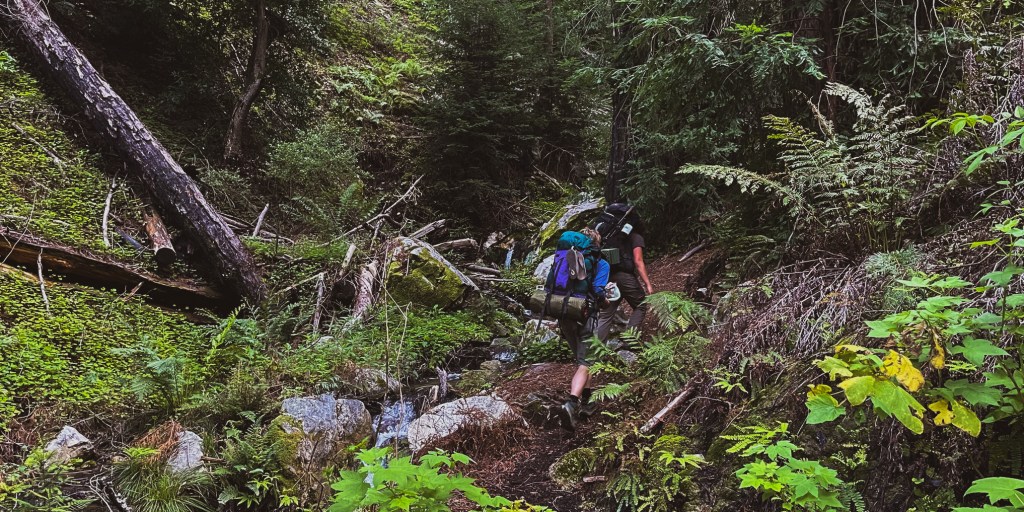
    Days before leaving, I took one last trip into Big Sur with Frizzy — my brother in all but blood. For three days we hiked deep beneath redwoods, talking about everything — travel, heartbreaks, wild nights in Santa Barbara, quiet ones in Missoula, all the tangled threads of our shared history. We didn’t know where we’d cross paths again, but it’d be somewhere alive. It always was.

    Frizzy and I, Pfeiffer Big Sur SP

    When the trip blinked by and we stood in the fading light, ready to part ways, I shook his hand, held it firm.

    “I’m gonna miss you, brother. I love you.”

    He smiled back. “Godspeed, man. I’ll see you down the trail. Love you too.”

    Watching his taillights vanish, I knew it’d be a while before we meet again. But I also knew — we will.

    ———————————————-

    April 10th, 2025

    There was one more thing I had to do. I gave Funk a call as I pulled up outside her house. The same Funk who I had the pleasure of getting to know only weeks before on our spontaneous adventure to Pinnacles. Who already felt like an old friend despite the short stretch of time shared between us. I leaned against my truck, as she came down the steps of her porch in the dusty rose haze of the sunset.

    I took the glass coke bottle I had stuffed with a rolled piece of paper and a small bouquet of wildflowers. And pressed it into her hands. On the paper were the directions — a key to the hidden paradise tucked away in the hills.  A place I’d made a promise to myself to keep close, secret, sacred.

    I told her, “Here is a quest for you, directions to a very special place, it’s not just a spot on the map. This is a token of my trust.”

    She looked down at the bottle, then back up at me, her eyes soft, shining against the setting sun. I could tell she understood what I meant — A gift I would never give lightly.

    We hugged hard before parting ways, and I drove off knowing I wouldn’t see her for a long time. But I felt something solid settle between us that day. As if by handing her a key to paradise, I’d marked our bond. A promise that even scattered across the map, we’d hold each other close to our hearts.

    April 12th, 2025
    The cabin lights dimmed. Engines screamed. I felt the plane lift, heavy wheels leaving earth, and just like that — I was gone again. Into the unknown.

    When we reached altitude, I pressed my forehead against the window. Below me, through breaks in the clouds, the Big Sur coastline slid by — those same ridges and trails I’d been running just days before, now reduced to memory. The sky burned molten orange as the sun fell, then swallowed itself in darkness. Outside the tiny oval window, the world was nothing but blackness, broken only by the occasional scatter of lights, little constellations of human life, flickering in the void.  

    I spent the night in an airport, a liminal world of fluorescent light and restless bodies. Shops pushed trinkets, travelers pushed past each other, everyone rushing toward somewhere. I just sat and watched, still as stone, while chaos circled me. It felt like molting skin — like I was leaving behind a shell of the person I’d been, stepping toward something unformed.

  • XVI. The Coast’s Call

    March 14th, 2025 

    The sun had just crested the Black Mountains. Standing 191 feet below sea level in the gravel lot beside the truck, a smile came easy. Two months in Death Valley felt like a blur, a cloud of cigarette smoke and sin, but they had been necessary. A stepping stone to a beginning. With a little clarity clawed from the chaos, leaving wasn’t too hard. The coast was calling.

    My dreams had been filled with the winding curves of Highway 1, sandy beaches of Santa Barbara, waves lapping the shore. I set my Coffee in the cup holder, slammed the driver’s door, the engine rumbled awake like an old friend. One chapter closed, another cracked wide open. Pointed the truck west, the straight, lonesome, desert highway lay ahead, pressed the pedal down, gone. In the mirror, the ranch shrank like a strange dream. A laugh broke free. La vida loca, baby.

    Hours later, cresting the final ridge, there she was — the Pacific, endless and sparkling like shards of glass in the sunlight. Below, tucked between mountain and sea: Santa Barbara. The place that always finds a way to pull me back.

    The best part wasn’t just returning to a town loaded with rich memories, but knowing more would be made — this time with a steadier rhythm, keeping clear of old trouble. And knowing, in the time I had been gone, Frizzy had returned. The legend. I gave him a call.

    He answered on the first ring with his signature greeting:

    “Ohhh heyyy there partnerrrr.”

    I laughed. “What do you say we grab a burrito?”

    Frizzy had known I’d return, just never told him when. “Hell yea! Come by my new place!”

    “Already on the way.”

    He was out the door by the time I pulled up. Frizzy ran to the driver’s door and gave me a hard hug, slapped each other’s back, and laughed like no time had passed.

    “Long time no see, brother.”

    “Oh, you can say that again,” he grinned. “Now let’s get these burritos. We’ve got a lot to catch up on.”

    Stuffed with carne asada, rice, and guac, we stretched out on the beach, sun in our faces. 

    “One of the last things you told me in Missoula was that you had to get back to California. Once you said that, Frizz, I knew you would.”

    His nose was sunburnt, hair a mess, grin wide. “I loved Missoula. But this —” he gestured at the horizon, “out here where the mountains kiss the sea… this is where I belong.”

    And he was right. It showed in his face, rang in his voice. Santa Barbara was the dream he’d been chasing since growing up on the East Coast, hearing of California for the first time. Now he was living it — burritos, waves, sunshine, a touch of chaos. Just his style.

    After the sun slipped beneath the horizon, I said my goodbye to Frizzy and drove across town. Time to see Mayo and Kenneth — two friends who knew a version of me that felt more like an out of trend phase now. My first return to Santa Barbara after hitting the road had spun out messy and fast, but this time was different. Now I carried a steadiness, a clarity, that let me walk back into town without being swallowed by its old distractions.

    On Kenneth’s back patio, we settled into conversation. Since my last visit in December, I’d wandered Death Valley and lived the outlaw rhythm of that desert — stories I spilled, as the stars above came out to shine. Kenneth told me what life had been like in Santa Barbara since we’d last met. Kenneth has always been one of those rock-solid guys, the kind you want next to you when the ground gives way. Nearly a year before, we’d staggered down the icy slopes of Mount Whitney together, half frozen and halfway to death. He’d seen me through the highs of Santa Barbara’s wild days, and the crash that followed.

    Mid-conversation, the patio door slid open. Mayo burst out, as subtle as ever, shattering the quiet of the evening.

    “Yo,” he grinned. “Wanna hike to the hot springs with me and a few friends?”

    Nearly nine p.m. on a day that had started at sunrise in Death Valley. Still, something inside said go. This was Santa Barbara. Of course I was going to the damn hot springs.

    “I’ll grab a towel and a couple of lavender smokes.” Lavender and blue lotus rolls had replaced the tobacco cigarettes that became too much of a habit in Death Valley.

    By ten, we were on the trail. It wound back into the Santa Ynez mountains behind Montecito, the smell of sulfur and sage thick in the canyon. Moonlight shimmered across the top pool — the source — seven pools with walls of stone and mud, water whispering down in between.

    Clothes slipped off, bodies sank into heat. Muscles eased. A nearly full moon lit the canyon in mystic glow. Eyes closed, soaking it in.

    A while later, the heat of the top pool sent me down to a lower pool looking for cooler water, I found one — already occupied. By a girl with blonde hair wild and messy, and an open, curious face.

    “Mind if I join?”

    “Not at all.” She said cooly 

    I slid into the water across from her, offered her a lavender smoke, and we lit up as steam swirled around us. Her name was Funk. We talked about everything, Santa Barbara, travel, strange questions about life and meaning. She had that rare spark: playful but grounded, childlike curiosity with old-soul depth. I couldn’t place it then, but something about her pulled me in like gravity, something about her. 

    That night, I got her number.

    She took mine down too, on a flip-phone. In this day and age? I thought, How cool.

    I didn’t know when I’d see her again, but had a feeling this wouldn’t be our last adventure.

    March 15th, 2025 — Isla Vista, CA

    The following night, Mayo was playing a show in the legendary Isla Vista. 

    First I called up Frizzy 

    “Hey there partner, Mayo is playing a show tonight, what do ya say we boogie on down?” 

    “Ohh you know it partner, send me the address I’ll see ya there.” I could hear the excitement rising in Frizzy’s voice, It would be a good night.

    Mayo has this way of laying down a beat that makes your body move without realizing it. There we were Frizzy and I, drenched in sweat from getting down to heavy tunes, when I bumped into a friend I hadn’t seen in far too long.

    “Hey Matt! No way, I haven’t seen you in forever.”

    I turned, blinking through the dim lights. “Thorn! Oh my gosh, it’s been a minute.”

    She grinned with that same adventurous spark I remembered. “I’m headed up to Pinnacles on my way home on Thursday. Wanna caravan?”

    Spontaneous trip to Pinnacles with Thorn? Not even a question. “Hell yeah. Gas in the tank, money in the bank, let’s do it.”

    Thorn is unlike anyone I’ve ever met. Her curiosity perfectly preserved. She carries this wild energy, this hunger to wring everything she can from life. On hikes or random adventures, she’ll stop suddenly and point out striations in a rock, an edible berry clinging to its stem, or a tiny mushroom tucked in the roots of a tree — things I would’ve walked right past. Her sharp eye for the overlooked slows me down, grounds me. Around Thorn, it feels not just acceptable but necessary to stop and smell the flowers.

    “Cool. I’ll text you tomorrow.” She melted back into the crowd, and I went right back to dancing.

    Later, I found Frizzy.

    “Hey man, what are you doing Thursday?”

    He laughed, dragging a hand down his face. “Ah, don’t remind me. Got a couple midterms in the morning.”

    Unfortunate. I thought, still, Santa Barbara was full of familiar faces — if Frizz couldn’t roll, I’d find someone else to ride shotgun.

    Jumping and spinning in the grassy backyard of the apartment  where the show was. That’s when I saw her, Funk. From the night before. But under the backyard string lights, I got a better look. Wild spiky hair, wide jeans, and a funky vest, the kind of outfit that lets everyone know she’s the main character. I danced my way over.

    “Hey, Funk!”

    “Yo, what up, Matt?”

    With a grin, I said, “I got a shotgun seat headed up to Pinnacles with your name on it.”

    She thought for a moment, clearly intrigued. “When are we going? I’ve got work on Saturday.”

    “Early morning Thursday. I’ll get you back to SB by Friday night.”

    “Hell yea, let’s do it.” She said, and we got back to dancing.

    I wasn’t sure what had prompted me to do something so spontaneous, maybe it was her wild hair, maybe the thrill of meeting someone so exceptionally unique. Either way, I trusted my gut. If it feels right, how could it be wrong?

    XVII. Natural Mystic

    March 20th, 2025

    That Thursday, my alarm went off at four a.m. by five, I had coffee in my system, a good hot shower, and was ready to pick up Funk. She’d sent me her address, so I drove across town from where I was staying with my buddies and found her waiting out front with a bit of camping gear, a pack, and an excited smile. She climbed in, and I texted Thorn: Yo, Funk and I are headed north, we’ll meet you in SLO.

    Long car rides with strangers are always exciting, especially once you’re rolling and realize you’ve got plenty to talk about, not to mention you’re headed to some of your favorite places in the world. In the first light of morning, we crested Cachuma Pass, then had a hundred miles of rolling ranchland ahead.

    I glanced over at her, the road stretching ahead.

    “So, Funk — what’s your story?”

    She grinned. “That’s a loaded question.”

    I laughed. “Well, I didn’t invite you along for small talk.”

    That seemed to unlock something. She leaned back in her seat, eyes on the passing hills.

    “I grew up in New York City. Life there was good — my parents, my friends, the exciting life of the city. But the real gift was travel. As a kid, I went everywhere. Family in one place, friends in another. Thanks to that I got to see a lot of the world from a young age…”

    The way she spoke wasn’t bragging. It was softer, almost reverent, like each trip had left a mark on her. She’d seen more of the world before eighteen than most people see in a lifetime.

    As she talked, I began to understand what pulled me toward her. A mutual interest, hunger to see the world, and Funk carried it differently than most. For her, it wasn’t about stamps in a passport — it was about connection. She spoke with an old-soul depth, but her curiosity was still fresh, alive, untouched. It made sense now, how she could come off as both seasoned and brand new simultaneously.

    She never mentioned why she chose California, and I didn’t press. We had miles ahead of us. I figured the story would surface when it needed to.

    After the sun came up we reached SLO where my parents and Marley met us with open arms. I introduced them to Funk, and made us a quick breakfast while we waited for Thorn to arrive. When she did, I took Marley with us, telling my parents I’d drop her off at school. The four of us went to my favorite, sleepy hole-in-the-wall coffee shop tucked away on a side street, with funky art on the walls and a koi pond in the back. We sipped lattes and talked. After my adventure with Marley months earlier, we’d grown closer, and I felt proud introducing her to Funk and Thorn — two women who lit me up with their energy, who never apologized for being entirely themselves. They were wild in their own ways, unafraid to live loud and true. I hoped some of that might rub off on her — that she might draw courage from their example, let go of the weight of other people’s opinions, and learn to blaze her own trail.

    After I dropped Marley off, Funk settled into the passenger seat, Thorn close behind in her car. Somewhere along the winding two-lane that hugged the coast before turning inland, conversation with Funk drifted deeper. 

    Funk leaned back in the passenger seat, watching the ocean pass in the side mirror.

    “Growing up in New York,” she said. “Thought I had it figured out. Then I met this girl, an ex for now, but she had this way of… waking me up. She rekindled a sense of adventure in me.” 

    I glanced over at her, the wind tangling her hair, the hills racing past.

    “So when it ended… you left?”

    “Not because it ended, or the heartbreak it left behind” she said with a faint smile. “Because that sense of adventure, It shoved me out the door. Made me hungry again. For the world, for life.” 

    “Hence, I’m way out on the West Coast” 

    I nodded, feeling the truth of it in my chest.

    “I think I know what you mean,” I said, glancing over. “I’ve been heartbroken before, it reminded me who I was, it got me off my ass and on the road. The end of a chapter can be the beginning you need.” 

    She smiled at the windshield. “Guess we’re both proof of that.”

    In that stretch of road, we found a quiet kinship, the kind you can only find when someone cracks themselves open a little. 

    The road turned inland, careening through vineyards and ranchland, climbing over a low mountain range before dropping into the Salinas Valley. It was a beautiful day, a warm breeze pouring through the sunroof as we tore up Highway 101, listening to the Grateful Dead. Funk flipped through a novel by some wanderlust romantic; the breeze fluttered the pages. Thorn cruised behind us, occasionally sticking her arm out to ride the wind.

    We were free, me unanchored from a timeclock, the girls untethered from school for spring break. The highway hummed beneath us until a sign appeared:

    Pinnacles National Park – Next Exit

    I flicked on my turn signal, peeling off the highway into The little old town of Soledad By the time we hit the farm roads outside Soledad, the mountains were shouldering higher, green and gold under the midday sun. Pinnacles rose in the distance, jagged teeth against a bright sky. Funk put down her book, soaking in the new scenery. It had been years since I’d driven this road, and it felt nostalgic to see an old place through new eyes, in the same truck.

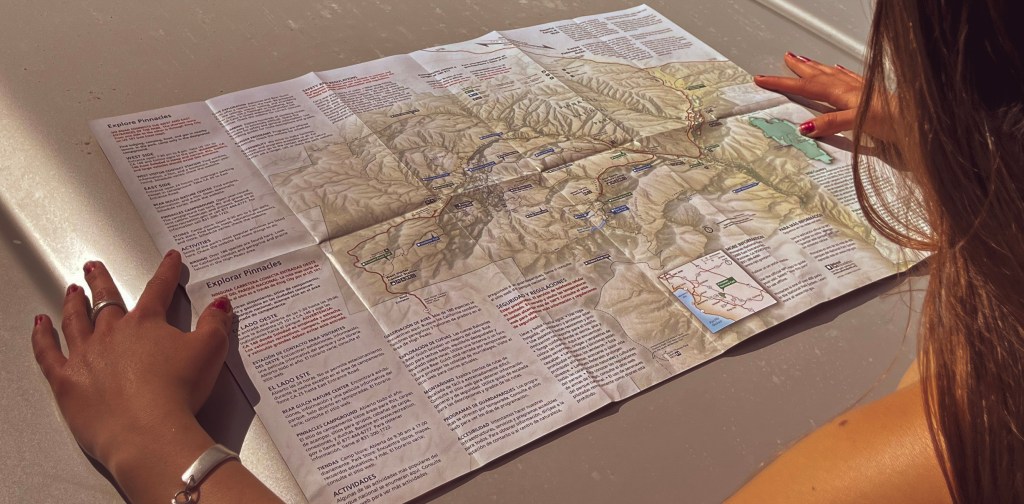
    Twenty-something miles later, we reached the East Entrance. The ranger at the gate handed us a pamphlet, we rolled past the gift shop and across a little stream into the shade of the campground. I rolled into the dusty site we had reserved and Thorn pulled up beside us. We climbed out, hugged, and grinned, we’d made it.

    With hours of daylight left, we set up camp. Funk stretched out in the tent with a book and a lavender cigar I’d rolled, Thorn napped in the sun, and I sat on a beat-up picnic bench, sticky eating a mango, listening to the stream trickle by.

    What a life.

    Hours later I woke up on the same picnic table, content, listening to the girls’ voices carry through the golden air. The sun had dipped lower, stretching shadows, and  softening the edges of the mountains around.

    “Hey Matt, let’s get out for a hike!” Thorn called.

    “Sounds good to me!”

    I brushed the dust from my bare feet with a sock, slid my boots on, grabbed my pack, and hopped into the backseat of Thorn’s car. “Let’s hit it!”

    A few miles later we pulled into the Bear Gulch trailhead, where chaparral gave way to riparian pockets, and boulders the size of houses stood stacked like something from a dream. We spilled out of the car, buzzing with the kind of energy only adventure sparks.

    The trail pulled us upward. Shade cooled the path, birds called from hidden perches, and every turn revealed new rock formations to scramble over. Then came the talus caves, monument-sized boulders carpeted in moss, collapsed into strange passageways, beams of light cutting through cracks high above. A stream trickled unseen beneath our boots, the sound of water mixing with our laughter. We followed narrow, winding steps of stairs up through the dark caves, occasionally a bat would flit past a ray of light coming from above, we could catch the silhouette. In parts where the cave had no light leaking through we’d sit, daring the complete darkness, giggling, whooping, and hollering as our voices bounced back at us from the walls.

    Bear Gulch Trail

    Climbing into the light again felt like surfacing from another world. Sun blinded us as we stepped out onto narrow stone stairs beside a small waterfall, the sound echoing against the boulders on either side. At the top lay the Bear Gulch Reservoir, a glassy pond tucked into its rock basin, glowing gold in the late afternoon light.

    We threw our packs down and collapsed near the water’s edge. Bullfrogs croaked, a small snake glided across the surface, Vultures, silhouetted in the golden light soared above, in that moment it felt like we were the only people on earth, laughing, passing around dried fruit, skipping stones. Bliss was simple and it was right there, unadorned.

    Spontaneous trips always end up perfect. When there’s no plan, everything falls into place. And the kind of people who say yes to a wild adventure, who don’t hesitate at the thought of dirtbagging it, waiting for tomorrow to bathe in a river, and chasing sunsets, those are my people.

    Bear Gulch Reservoir

    As the sun slipped away, the stars spilled out overhead. Time slowed to a crawl. Moments suspended, untouchable.

    The hike back was darker, spookier than before, the caves swallowing us whole, our headlamps casting weak cones of light. We laughed in the shadows anyway, enthralled by the unique trail. By the time we stumbled back to the car, the night had grown quiet. It felt like we had been gone for days, we hugged beneath the stars, after our hike I felt so much closer to Thorn and Funk, simple fun can do that. 

    Funk and I stayed up late, talking about this and that, throwing random sticks on to the weak fire, we built from what we could find, it didn’t matter to us, we were in a national park under diamond embezzled skies, deep in conversation. Thorn had passed out quickly once we got back to the campsite.

    Funk had jokes, stories, sharp observations, reflections from the day that cracked us up and sparked deep conversation. Around the fire that night it all flowed easy, laughter, sparks lifting into the dark, the kind of fun that brings you to the present, makes you forget everything but here and now. 

    When the measly fire finally gave out, just a bed of embers glowing low, Funk and I climbed into the cab of my truck. Rolled a joint. Spark, flash. Inhale. Exhale. Reclining back in the seats, we let ourselves sink deeper and deeper into the high, the smoke rising in lazy spirals, caught in the green glow of the dash lights.

    I handed Funk the aux cord. She plugged it into her beat-up flip phone and queued the first track: Lebanese Blonde by Thievery Corporation. The bassline slid in smooth, heavy, hypnotic, spilling from the speakers like velvet. I leaned back behind my shades, shot her a sly grin. She smiled back, a reverent silence blanketed us, it felt disrespectful to speak over such a hot track. 

    The music spoke for us, lifting us from where we sat, carrying us to the stars that burned through the sunroof, higher, somewhere untethered. In that cab we traveled dimensions without moving an inch, completely immersed in the sound.  Each beat carried us further from the world, deeper into some shared rhythm we didn’t have to explain. 

    The next track crept in — Natural Mystic —and it was like the truck filled with something more than smoke. The air thickened, charged, as if the song itself had weight. Tendrils curled and twisted, forming shapes that shimmered and dissolved. Funk and I swayed, eyes half-closed, our movements syncing with the slow heartbeat of the bass.

    The voice of Bob Marley didn’t sound like it came from the speakers anymore — it poured straight through the air, through the smoke, through us. Every note felt alive, seeping into my skin, tugging me somewhere beyond the truck, beyond the night, into a space where time bent and blurred. The campground outside dissolved; only the mystic remained, creeping steady and unseen, whispering that we were part of something ancient, vast, and breathing.

    For the moment, it felt like we weren’t just hearing a song — we were inside it, drifting through its current, carried by an invisible tide.

    Funk played track after track, weird, funky, foreign grooves I’d never heard before, and together we just floated, two shadows in a haze of smoke.

    When the last song faded, we both knew it was the last. Neither of us reached for another. We just looked at each other, grins mirrored in the dim green glow, and in that wordless moment I knew, I’d found a friend. A shotgun rider for the long haul.

    We crawled from the cab in a thick cloud of smoke, I climbed to my tent and passed out content from a day well lived, still wearing my jeans

    March 21st, 2025

    The next morning we woke with the sun, shaking off sleep and lounging around at camp making breakfast tacos. After our meal we tore down the camp with fresh energy. I pointed the truck west. “I’ve got a spot in mind.”

    Miles of farmland fell away until we wound down into a canyon, across a narrow green bridge high above a river cutting through through the canyon in shimmering blues and greens. Then all the way down to the waters edge. We sprawled on the gravel beach in swimwear, snacking, sunning, diving into the cold water. The quiet canyon cradled us in leisure.

    After hours by the river I stood, brushing sand from my legs. “We’ve got more to see.”

    Back on the road, we cut west into Carmel Valley. Old oak tunnels, cracked pavement, potholes, the kind of backroad that hums with character. Windows down, music up, Funk stuck her arms through the sunroof, hair whipping. I dangled my hand out the window, letting the wind dance between my fingers.

    By the time we reached the little town in the valley, we were ready to keep snacking. Elderberry tonic waters, dried mango, chips and guac outside a sleepy market. The sun warmed our shoulders as we lounged in plastic chairs.

    “What’s the plan?” I asked.

    “Down for anything,” Thorn shrugged. Funk nodded.

    “Big Sur?”

    Both smiled. Funk’s eyes lit up.

    The coast didn’t disappoint. It never does. South from Carmel, Highway 1 hugs the cliffs, meadows green from spring rains tumbling to the sea. Funk was glued to the window.

    “It feels surreal,” she said softly. “To be in a place I’ve only ever read about. I get it now…”

    ”get what?” I asked.

    “How this place inspired so many authors.” She said, still staring at the passing scenery.

    We stopped at a pullout near Bixby Bridge, the ocean crashing below, wind whipping the grass around us. Postcard-perfect. Funk smiled, wide, genuine, unguarded. We jumped around and let the wind make our hair dance, as we posed for photos like a couple of tourists. 

    Big Sur, north of Bixby Bridge

    Further south we ducked beneath the redwoods into Pfeiffer State Park, somewhere along the way we had lost sight of Thorn, but soon she pulled up. We wandered out redwoods towering, a cold river tumbling over big smooth stones. We lounged by the water, passed a joint, chatting, while the hours slid past like the current. I thought of my younger self biking into this very campground years ago, chasing freedom with friends. Full circle now, here I was older with new friends Funk and Thorn still chasing freedom.

    Eventually dusk came. We hugged Thorn goodbye, grateful for her electric spark, her willingness to pull us into adventure. Her taillights disappeared around the bend, and just like that it was down to two.

    “I’ve got one more place to show you,” I told Funk.

    Nepenthe. Perched high above the Pacific, the restaurant’s deck suspended between mountains and sea. We sat at the bar, 

    “Two Shirley temples please” Funk said, smoothly sliding her card across the counter.

    We carried them out to the balcony, and watched the sun bleed gold over the horizon. It was the perfect ending, two days lived to the fullest, and a friendship set in stone.

    Nepenthe

    The ride home was quiet. Funk fell asleep before we even left Carmel, curled against the door, her head resting on the seatbelt. I kept the music low and let the quiet become its own rhythm. Highway therapy.

    I reflected on the hours we had spent jam packed, with a perfect balance of travelling miles, energetic engaging conversation, moments when no conversation was needed, and moments spent in pure leisure. I wouldn’t have wanted it any other way, and it was only because the three of us had been at the same show, and all had enough of a touch of spontaneity rising up in us. When there’s no plan, everything runs exactly as it should.

    By the time I pulled onto her street in Santa Barbara it was nearly midnight. I carried her bag and gear from the trunk, shook her gently awake. Sleepy smile, soft words:

    “Thanks for taking me along for the ride.”

    “Thanks for the time,” I said. “I’m so glad we met.”

    She stepped out, gave me a hug, promised our paths would cross again. Then she climbed her porch steps, turned once to look back, and disappeared inside.

    I slid behind the wheel and kept driving, north now, exhaustion heavy but spirit light. Two days. Two friends. A wild adventure. A reminder of why I chase the road.

    And I slept that night more than satisfied, anchored not in a place, but in the connection built along the way.

  • XIV. The Garden of Eden

    We lay beneath an ancient oak, its branches sprawling like the rafters of a cathedral above us. Out here, the world had gone still, no hum of cars, no signal to reach us, just her and me tangled in the tall grass. The meadow breathed slow, gold from the fading sun and flecked with the tender green of new growth after the rain. Across the rolling hills, oaks stood like old sentinels, their shadows stretching long. Somewhere beyond the mountains to the west, the sun slipped toward the Pacific, and the sky shifted, gold to fire to a wild, impossible pink. It felt as if the whole earth had tilted just to let us watch. Her hair brushed my cheek, and her finger traced slow, looping patterns along my arm, some beautiful cursive; each line pulled me deeper into the stillness, and I thought, If time stopped here, I’d never ask it to move again. But of course, it never would.

    December 29th, 2024

    Ranchlands flew past the windows of the truck, Marley’s hair whipped in the wind.

    Ding. We were back in cell range

    I flashed a glance at the cup holder where my phone sat, The screen was lit. What I saw, made my stomach flutter

    Dani: Hey, coming back to California in a couple days, are you in town? 

    I looked over “Hey Mar, could you unlock my phone and respond to that message” 

    “sure thing, what should I send? “

    ”Just text: I sure am” 

    “Ok, done” 

    January 3rd, 2025 

    Days later, I stood in my front yard on a moonless night, waiting. The street sign flashed, reflecting the glint of headlights far down the road. An engine’s hum grew louder, and then, Dani’s car, the same one I’d followed down from the stormy North Rim months ago.

    I walked closer as she pulled up. She jumped out, slammed the door, and even in the streetlight, her eyes gleamed, like a crack of lightning commencing a storm. I opened my mouth, but no words came. Instead, I opened my arms. She stepped into them without hesitation, met my lips, with a kiss passionate like a strike of heat, sharp, intoxicating.. When she pulled away, I couldn’t wipe the smile from my face.

    We climbed into my truck without a plan.

    “Pick a direction,” I said.

    “North,” she grinned.

    We rolled out onto the empty freeway, catching each other up on months apart, highs, lows, and the strange in-betweens. Somewhere past midnight, winding down narrow backroads through oak-dotted backcountry, I glanced over.

    “Hope you’re ready for an adventure.”

    She shot me a look, cool, certain. “You know I am.”

    A gravel turnoff brought us to an old high-school haunt, an abandoned mine in the sticks. Headlamps clicked on, boots crunched gravel, and the night swallowed us whole. The chasm yawned open before us, a dark void into the earth. My light couldn’t even touch the bottom. We picked our way along the rim until an old bent ladder led into the dark.

    “I’ll go first,” I called, descending into the smell of rust and rock. She followed. The tunnels twisted, some low enough to make us crouch, the air stale and thick. A wrong turn here, a dead end there, then, past a pile of rubble and down a set of rusted cart rails, we found a narrow air shaft. We climbed through, emerging back into the night like swimmers breaking the surface. I breathed deep, clearing the old mine from my lungs. Dani came out behind me, grinning. I liked that, her readiness to take risks, to wander into the unknown for the hell of it, for the sake of the story, for the sake of adventure. 

    January 4th, 2025

    The next morning, sunlight spilled through the windows over black coffee and avocado toast. Dani leaned over the table, eyes bright.

    “I’ve got something to show you,” she said. “Haven’t been there in a long, long time.”

    “Around here? You’re gonna show me something in the town I grew up in? Not likely.”

    “You’ll see.” Her smile was one that said she knew something I didn’t.

    We left the GPS untouched, Dani gave turn-by-turns as the freeway carried us north. She pointed out places from her California childhood, schools, roadside diners, dirt roads, and her voice softened with each memory. Something in the way she spoke told me the place we were headed wasn’t just pretty; it was sacred.

    We took an off-ramp to nowhere, straight road, golden ranchland, scattered oaks, mountains rising ahead like they guarded something. The asphalt tunneled under twisted branches, over narrow bridges, across creeks that reflected the light of the sun.

    Finally, a gravel lot. I stepped out, took it in.

    To the west, mountains loomed. To one side, massive rock slabs rose into the sky. To the other, a meadow scattered with wind-carved caves in shapes strange, like out of a cartoon. Above us, a canopy of oak and black walnut filtered the light into something holy. A stream wandered through, glinting between the trees.

    “Consider me impressed,” I said.

    Dani smiled. “Wait until you see the rest.”

    We followed the stream, and with each step I felt like I was seeing more of Dani, glimpses of who she was, where she’d come from. Something had shifted between us, and slowly, like the water meandering through stones beside us, I began to unearth the secrets hidden behind her gaze. The stream carried us to a swimming hole, deep, blue, and glass-clear, where a small waterfall spilled into the pool. We sat at the edge while she told me about coming here as a kid with her mom: scrambling over these rocks, chasing newts through shallow pools, cooling off in the streams on hot summer days. Her words painted the place with more than beauty, they wove it together with her laughter, her childhood, and memories cherished.

    I realized then this wasn’t just a hidden paradise. This was her paradise. Her Garden of Eden. Untouched by time the way it held memories like pressed flowers.

    “Thank you,” I said quietly. “For bringing me here.”

    She looked at me like she was measuring my sincerity, then nodded. “I’m glad I could show you” 

    Honored. I took a moment to look around, and then to Dani, how she seemed to be of the water, the trees, and the breeze herself. With the memories she told stories of, and the moment I shared with her beside that stream, I understood, in that moment, the place became sacred to me too.    

    All day, we wandered the hills, followed the creeks, and climbed the rocks, searching for newts, breathing in the serenity of a place that felt hidden from everything. That day, I saw her in a new light. I couldn’t name it, but I was falling further into the storm her eyes held. I knew the lightning behind her gaze had struck me.

    When the sun began to sink behind the mountains, we knew we should leave before the remote valley fell into shadow. Before climbing into the driver’s seat, I took one last look at a place so pristine, so sacred, and somehow hidden beneath my nose my whole life. I’m glad it had taken so long, I’m glad my first memories there were with Dani. 

    The sun and the adventure had left us tired in the best way, content, the kind of tired you earn. We didn’t speak much as we left the valley; there was no need. The golden light caught in the mirror, casting Dani in a glow. I reached over and took her hand as the road unwound the same way it had brought us in hours earlier. The colors outside deepened, melting from blue to gold. Out the passenger window, a meadow spread wide, cast in the golden light, dotted with oak trees, unbroken by fences, houses, or people. It was perfect. I wasn’t ready to leave.

    Impulsively, I pulled over. Dani, catching the hint, jumped out with me. I took her hand and we ran, far from the road and deep into the meadow, the tall oat grass brushing our legs until we collapsed, breathless, laughing into the open field. She rested her head on my chest, and I wrapped her in my arms.

    We lay beneath an ancient oak, its branches sprawling above like the rafters in a cathedral. Out here, the world had gone still, no hum of cars, no signal to reach us, just her and I tangled in the tall grass. The meadow breathed slow, gold from the fading sun and flecked with the tender green of new growth after the rain. Across the rolling hills, oaks stood like old sentinels, their shadows stretching long. Somewhere beyond the mountains to the west, the sun slipped toward the Pacific, and the sky shifted, gold to fire to a wild, impossible pink. It felt as if the whole earth had tilted just to let us watch. Her hair brushed my cheek, and her finger traced slow, looping patterns along my arm, some beautiful cursive; each line pulled me deeper into the stillness, and I thought, if time stopped here, I’d never ask it to move again. But of course, it never would.

    January 5th, 2025

    Early the next morning, we woke up eager to see what the day held. My truck rumbled to life, It was my turn to choose the adventure. 

    Only one place came to mind.

    Without a word, I turned north on the PCH. We raced up the road in dawn’s light, passing through sleepy seaside towns until the houses thinned and the highway cut through ranchlands then gave way to ragged cliffs. The air was sharp with salt, the horizon endless.

    Of course, we went to Big Sur.

    First stop, Limekiln State Park. Dani had been long ago; for me, it was all new. Early in the morning, we had the place to ourselves. From the stony beach, we slipped into the redwood forest, where the loam was soft underfoot and small waterfalls threaded through the roots of giants. The air was cool, still, holding a kind of hush that made each step feel like walking through a church.

    The trail led us to a clearing where three long-abandoned lime kilns stood, monolithic, rust-cloaked, moss seeping down their sides. Nature was taking it all back: ferns sprouting from cracks in the stone, vines climbing what industry had left behind. It was haunting and beautiful, a quiet reminder that everything is temporary.

    We wandered for hours, chasing the sound of falling water, ducking beneath the old growth’s shadow. Eventually, we emerged back onto the beach, blinking in the sun. We sat on the rocky shore and wrote for a while, the pages of our notebooks fluttering in the wind coming off the ocean, before piling back into the truck and heading farther up the coast. 

    Where a road-closed sign crossed the highway due to a landslide, I pulled into a gravel pullout on the cliff’s edge, popped the tent, and we lay inside, sun streaming through the mesh walls, warming us in a soft, slow way. Below, the Pacific spread out in deep blues and flashes of aquamarine, waves curling and breaking far below. There was nowhere else I wanted to be. Time passed like water through open fingers as we talked about everything and nothing. An old cypress, twisted and salt-worn from decades of storms, leaned out over the cliff. Barefoot, we climbed it, lounging in the crook of its branches, the breeze in our hair, the sea air crisp and clean. There was purity to it — simple fun. The best kind.

    When the sun began its descent, we headed south, stopping at places that called our names. We wandered hidden redwood groves, balanced across fallen trunks that bridged silver streams, scrambled up moss-covered boulders, and listened to the songs of brooks in the dappled shade. Big Sur has always felt like that to me, untouched by time, another world entirely.

    I didn’t think about how the next day would change everything, breaking the spell. Maybe some part of me felt it anyway, buried beneath the ease of her laughter and the soft cadence of her voice, like a storm building above a lonesome desert. Still, I stayed in the present, reckless in my devotion to it, letting the moments root themselves: the trees, the ocean, the quiet we didn’t have to fill. I knew it was dangerous, letting myself slip into something so uncertain. But love is never just the sunny days, it’s the downpour, the lightning strikes, and the scars that stay.

    The sun dropped lower, we drove from the hills of Big Sur. I remembered a break in the fence on the ocean side and found it again. Just like the day before, I took her hand and we ran from the road, across the meadows, down to the edge of the earth. The oat grass swayed in the wind, the ocean thundered below, and the sky was ablaze, gold deepening into pink. The scenery wrapped around us, holding the moment still. I breathed it in, alive, elevated, bliss, one last golden memory before it all shifted.

    That night, by the side of the road, she looked at me one last time and slipped me a smile.

    “Thanks for the adventure,” she said softly.

    “Anytime,” I told her, and I meant it.

    Then she was gone, once again taillights swallowed by the dark. The night air was cooler now, edged with something I couldn’t name, but would soon understand. It all felt impossibly brief, like waking from a dream where you try, uselessly, to fall back asleep, only to find the dream has already slipped away.
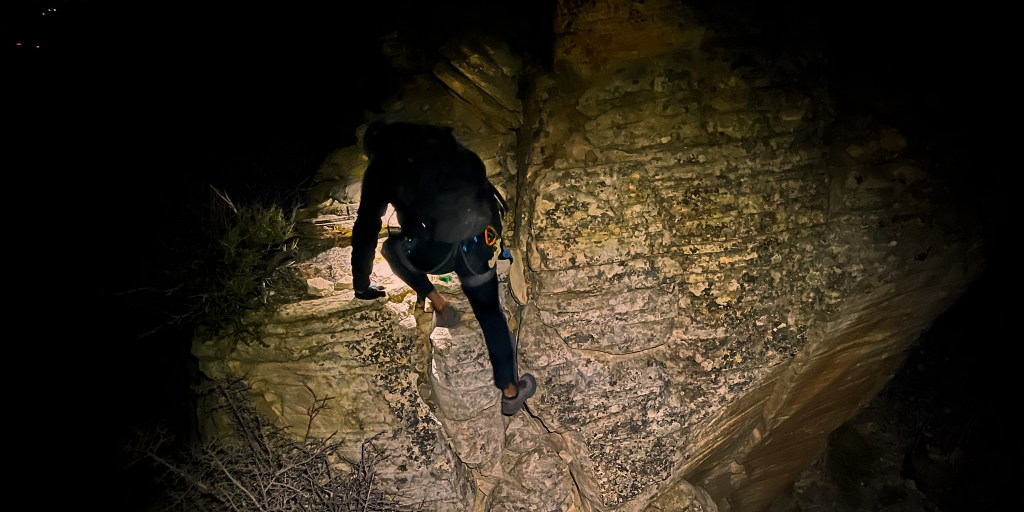
    XV. The Valley of Death 

    January 6th, 2025

    It was time to get out, far out. Packing my truck kept my mind busy, kept me from replaying those days with Dani, and the thoughts of seeing her again. With the trunk loaded, the cab humming, I hugged my parents and Marley, said my farewells, and climbed into the driver’s seat, my throne. One twist of the key, one shift into drive, and I was headed east. The desert was calling, and I knew better than to deny it.

    I blazed down back roads through the in-between places, the desolate pockets that exist between everything else. I let my mind unwind. Let the guilt of slipping back into Santa Barbara’s old rhythms fade. Let the heaviness of being home slough off. But I couldn’t shake the image of Dani’s taillights disappearing into the night. Maybe I didn’t want to. Maybe I wasn’t ready. Either way, I was hurtling toward something I couldn’t yet name.

    The land rolled past in cinematic scraps, abandoned trailers collapsing into graffiti-stained skeletons, rusted barbed wire fences clinging to fenceposts older than memory, ranchland where the water had long since dried up. The road burned through the California valley, orchards stretched for miles. Once the sun set the land had melted into desolate rocky desert, in the distance, a borax plant burned fluorescent in the dark, roof panels missing, siding flapping in the wind. It ran day and night, eating itself alive.

    I drove until my mind emptied, until I’d left behind a weight I hadn’t known I was carrying. When exhaustion finally caught me, I stopped at Ballarat, a ghost town I remembered from years ago, weathered wooden buildings slouching into the sand, a graveyard marked with desert stones and a fence stitched from barbed wire and sticks. I didn’t mind sleeping among ghosts, and they didn’t seem to mind me. But that night, the wind howled like a hungry thing, clawing at my tent, testing for a way inside.

    January 7th, 2025 — Death Valley NP 

    At first light I stumbled from the tent, groggy and cold, and only then saw the Panamint Range snow capped and towering in the east, hidden from me in last night’s darkness. Admiring the mountains, I sat in the dirt and made a cup of coffee before pulling back onto the road, climbing toward the pass that would bring me into Death Valley.

    In Panamint Springs, I ducked into a weatherworn diner. The windows were fogged and corroded, muting the view of the barren desert outside. I ordered black coffee and biscuits with gravy, holding onto the last familiar comforts before being flung into whatever came next. I finished my plate quick, hadn’t realized how hungry I’d grown, leaving so many miles behind. 

    “You need anything, honey?” the waitress asked, leaning in with a pot of steaming black coffee.

    “Top me off,” I said.

    “Oh, sure thing,” she replied, pouring the black silk into my mug.

    I needed more than coffee, but for now it would have to do.

    Walking out to my truck the wind whipped, bitter, cold, and harsh, my stomach churned, one mountain pass lay between myself and the infamous Death Valley. 

    When I turned the key to leave, it stuck, just for a moment. A jiggle freed it. Odd, but I didn’t dwell on it. The road ahead was long.

    From there, it was a straight climb to Towne Pass, nearly 5,000 feet, jagged peaks crowded on either side before the land opened into a view of Death Valley, shrouded in dust storms. The valley floor was hidden, swallowed in thick, brown, rolling clouds.

    I descended, the road arrow-straight, the air growing hotter and heavier. Dust scoured the windshield. Through the vents, I could smell the earth itself. At a small settlement I stopped for gas, I didn’t know how long it’d be before I’d have another chance to fill up, standing at pump while the wind lashed my face with sand, stinging like glass splinters. Less than two days before I’d been in paradise; now I was stepping into something hellish. The calm, then the storm.

    When I turned the key again, it caught once more. Another jiggle, another reprieve.

    The dust finally thinned, but still I was dropping lower. Miles ago I’d left the pass; now I was heading for 191 feet below sea level.

    My new home, the ranch, appeared like a mirage, gravel streets, sagging mobile homes, a handful of weatherbeaten apartments with tired AC units hanging from the walls. Old-timers and rookies sat smoking at sun-bleached picnic tables under the wind-warped salt cedars, watching me pull in.

    I cut the engine. I felt it then, the key caught, wouldn’t turn at all. This time, no amount of jiggling worked. My stomach sank.

    The desert had me now, and I wouldn’t be leaving on four wheels anytime soon.

    I had come to work in the heart of Death Valley, the beautiful and strange Oasis at Death Valley.

    I checked in, filled out the usual stack of paperwork, and was left to it. My room was in an apartment — nicer than the one in Zion — just one roommate this time, and it wasn’t the size of a storage closet. A single window looked out toward the Panamint Range. I didn’t know it yet, but that window would become my favorite part of the room — mornings when the peaks blushed with the first pink light, evenings when the sky burned gold and the mountains faded into shadow.

    After unloading the truck, which now sat parked for an indefinite stretch right outside the apartment, I took a walk to see what — or who — I might find. Death Valley had been a last-minute decision, a why-not choice when the map in my head was still blank. Around the ranch, the crowd was mixed: older folks with cigarette-rough voices and faces cut deep from years beneath the desert sun, and younger ones chasing something they couldn’t name.

    Then I met Old Man Ben. He passed me a cigarette with a nod, his eyes tired but kind, his weathered face a map of every road he’d walked. Sitting there with him, I learned his rhythm — content in the desert, happy with life, sipping Bud Light from the can, a speaker spilling old rock ‘n’ roll into the dry air. He told me stories: about summer days when the heat climbed over 130 degrees, about almost hitting a bighorn sheep on a lonesome desert highway at two in the morning, about the people who had drifted in and out of this place. I could tell he’d seen a lot from that picnic table, just watching as the world’s hurried ones passed him by.

    When we finished our smokes, I shook his hand and wandered toward the fence at the edge of the neighborhood — a sun-beaten chain link, warped by time. I slipped through a jagged hole and stepped into another world. The desert stretched out before me, endless, vast, strangely inviting. The sun was setting, flooding the west with molten orange and red. And in that moment, Death Valley didn’t feel like a bad idea at all.

    It felt like a secret.

    A home for runaways, black sheep, and the kind of misfits who never quite make it back.

    —————————————-

    I settled in fast. Within days, I’d found a small circle of friends that fit together in the way only desert rats can manage, a mismatched but perfect puzzle. There was a woman old enough to be my mom, yet we had chosen to live the same type of life, so our conversations seemed to land somewhere in the overlap between our ages. Then there was a guy my age from the East Coast, a westbound drifter with a silver tongue. He could charm a newcomer into a game of poker or talk them into buying a pack of cigarettes from him at a price just under the general store’s outrageous rates, a salesman in the purest form. And of course, there were the transients, the ones who arrived without warning and left just as suddenly, drawn now and then to the picnic bench for a smoke or a story.

    My job was at the bottom rung, housekeeping, but the setting made up for it. The hotel was a strange desert gem, built in the 1920s and its age showed in a charming way. There were tunnels and tucked-away rooms, sprawling gardens and palm-shaded ponds, grassy lawns that seemed impossible in this climate, and a deep blue pool where the water caught the sun just right. Inside, Wild West paintings hung on adobe walls, rugs from far-off markets softened the tile, and rustic chandeliers swayed gently in the air-conditioning. The lobby smelled faintly of leather and desert air, with a library corner where sunlight fell through tall windows, framing the oasis and, beyond it, the flats of the valley backed by the towering Panamint Range.

    The Oasis at Death Valley

    Housekeeping was fast-paced, beds made with military precision, towels folded into exacting shapes, every surface wiped down until not a single speck of dust dared remain. For such a high-end place, perfection wasn’t optional, it was the standard. The work kept my body moving and my mind focused, the hours slipping by in the rhythm of hustle.

    Off the clock, the days belonged to the sun. Death Valley in winter was a smart move, seventies by day, sometimes creeping into the eighties, with air so dry it felt like it could preserve you. We’d sit outside for hours, conversations spilling out without end, laughter echoing in the still desert air. No one ever seemed to need much sleep. We worked hard, but made sure every moment we weren’t on the clock was wrung dry.

    After a few weeks of being stranded in the valley, I was ready to get my truck running again, to go see the valley and to make a trip to town. 

    That’s when I met Rob.

    He was the kind of older man you could read like a road map — skin tanned and creased, arms inked with tattoos fading from years in the desert, gold teeth flashing when he laughed. There was a rough charm about him, the kind that comes from living fast and paying for it later. He could roll a cigarette in the time it took most people to find their lighter, and he always seemed to have one hanging from his lip, the ember glowing against the afternoon sun.

    When I told him I’d finally ordered the parts to fix my truck, he didn’t hesitate. He slipped a key from his pocket, grinned, and let himself into the hotel’s maintenance warehouse like it was his own garage. Moments later he was back, arms loaded with tools I didn’t even know I’d need. Out in the dirt lot, he stood with me every step of the way as I drilled out the old ignition, sliding the new one in like we were swapping organs. He traced the wires for me, explaining which ones talked to the security system and how to fool it into thinking my new key was the one it had always known.

    Rob was the perfect kind of desert mechanic — the kind you find exactly once, if you’re lucky. Out here, there wasn’t a single proper auto shop for miles, but I had something better: a man who could coax a half-dead engine back to life with a screwdriver, a cigarette, and a curse. By the end, my truck was humming, and Rob just smiled like it had never been in doubt.

    Life in the Valley had its own charm — a dust-coated, sun-baked Wild West. The place felt like it was run by a loose band of outlaws. Law enforcement was scarce, but we had our own code: treat people the way you want to be treated, and if you didn’t, well… you’d get served.

    Some nights I’d aim the truck toward nowhere, windows down, the warm desert air rushing in like a tide. The road ran straight as a rifle shot, blacktop stretching into the dark. My headlights carved out a narrow world — two pale beams cutting across the emptiness — while the rest of the valley lay silent and unseen.

    The stars out here didn’t just hang in the sky; they poured over it, spilling from horizon to horizon in a silver river. Out under all that space, it felt like the earth itself had loosened its grip. I could press the pedal down, feel the hum of the engine in my bones, and for a moment, that blurred like the yellow lines on the tarmac, I’d feel like a ghost slipping through the night. 

    The phone sat dark in the cup holder beside me. I didn’t touch it. Didn’t need to. The road was long, and I knew the kind of quiet that followed me out there wasn’t just in the desert air, it was the kind that settles in your chest and stays.

    I was running, love casts a long shadow, even at night. Dani’s line had gone quiet. Cut cold. No texts. No calls. Just a sudden absence where a connection used to be. It wasn’t just silence, it was a door slammed on something I wasn’t ready to let go of. Out here in the dark, it followed me, riding shotgun.

    I was living hard and fast — the only way to survive out in Death Valley. Long shifts, smoke swirling in the stale air, falling into the valley’s relentless rhythm. Still, I had to keep reminding myself: this was just a stopping point, a place to clear my head, save some cash, and get ready for whatever came next.

    One morning, something clicked. My next job was lined up, the savings stacked enough to bridge the gap. It was time. I packed my truck, tipped my hat to Rob, Old Man Ben, and the ragtag crew I’d come to know. 

    Before heading back west, I drove out to Badwater Basin, that endless white salt flat where the world feels both vast and strangely intimate. I laid back on the cracked earth, the rough ground pressing into my back, and stared up at the sky, the Milky Way spilling wide above me, stars so bright they looked like a painting. The silence was thick, the kind that fills every space inside you. Out here, under that infinite sky, all the noise and chaos of the valley faded away, leaving just me and the desert’s quiet heartbeat.

    That night, lying there in the stillness, I felt the weight of everything I’d lived through since arriving, settle into my bones. Lessons from the valley, the friends, the freedom  and the bittersweet ache of leaving it all behind. It was a moment as sharp and clear as the cold desert air, the last taste of a place that had both held me and set me loose. Tomorrow I’d drive away, but for now, I was exactly where I needed to be.

  • XII. Ghosts of the Past

    December 13th, 2024 — Southern California

    The next morning, I woke well-rested. The desert nightmare was behind me now, buried under sand and starlight. I turned west onto the highway and drove toward the coast, up and over one last jagged range. Then, for the first time in six months, laid eyes on the Pacific, shimmering and endless, swallowing the horizon in a silver blaze.

    I dropped down out of the hills into San Diego, then merged onto the northbound 405. The air thickened with ocean salt and exhaust, the silhouettes of palm trees swayed in the freeway wind, and that feeling rose inside me. I was back in California.

    It wasn’t just the landscape, the gold-tinged surf towns, the sunburnt cars and weathered neon. It was something quieter. A pull. A pulse in my chest. Getting close to home.

    Six months on the road had been a dream, a whirlwind of peaks, desert skies, and strangers-turned-friends. It taught more than any classroom or job ever could. But the miles piled up, and the thrill of the unknown slowly blurred into a quiet kind of fatigue. I was ready for a pause. To reset. To be with family, see old friends, and gather myself for whatever came next.

    Before leaving Zion, I’d arranged a transfer to Death Valley, a place I’d never been. I was set to start there on January 7th. The first adventure of the year — or so I thought.

    By the time I reached Los Angeles, the sun was beginning to set. The city’s smog lit up like fire, casting a copper glow through the skyscrapers. I pulled off the freeway into a crumbling neighborhood — graffiti-tagged storefronts, shattered glass at the curbs, car horns shouting from every direction. I weaved through it all, past tire shops and taco stands, until the road began to climb.

    Up in the hills, the world changed. Palms gave way to pines, and mansions peeked out from behind gated driveways. I parked on a quiet side street and jogged the last stretch to the top of the hill.

    There it was — Griffith Observatory. I’d seen it in movies, on postcards, on bucket lists. Now I stood beneath its massive domes, watching the sun sink behind the Santa Monica Mountains. I climbed the steps to the rooftop and leaned against a wall that thousands had before me, watching as the city below flickered alive with headlights. A rare stillness settled over me. After the chaos of last night, after the long hours behind the wheel, this was a breath I didn’t know I’d been holding.

    The Griffith Observatory

    Still didn’t know where I’d sleep that night. But for now, that didn’t matter. I had made it back.

    An idea struck: Malibu. I could camp in the hills, the same ones I once wandered with Sofia on that sun-drunk day that now felt like another life. I typed in the directions, road closed. Fires had shut down parts of PCH.

    I sighed. Maybe it was for the best. Some places are too fragile to revisit. Some memories are meant to stay untouched, preserved like fossils in stone.

    In the fading light I walked back to my truck, headed north and drove. That night, I drove and drove, like I was caught in a trance. The hum of the tires, the rhythm of the road, it all blurred into something dreamlike. Then, a sign flashed by in my periphery:

    Santa Barbara – Next 12 Exits.

    My stomach flipped.

    The same town I once ran from. A place thick with memories, both golden and heavy. I questioned whether I was ready to face it again — but of course I was. I’d earned this return.

    I pulled off near downtown and parked. Sat there for a moment, breathing it all in. I had changed, deeply. But this place still had its ghosts. I could feel them clinging to the corners of my mind. Old habits, old expectations, still alive in the cracks of these streets. A version of me had been left here, and he hadn’t moved an inch. Still pacing inside the walls of memory, locked in time.

    I started the truck again and wound my way up into the Santa Ynez Mountains. Higher and higher, until the lights of the city sparkled below like a distant galaxy. I popped up the tent, climbed inside, and laid back to watch the oil rigs blink on the horizon. Tomorrow was sure to be interesting.

    December 14th, 2024 — Santa Barbara, CA

    I woke late. The sleep had been deep, the kind that cleans you out. Two things needed to be checked off the list that morning.

    First stop was the ocean.

    I parked, pulled on swim trunks, and ran toward the waves like a kid on the first day of summer. The water was cold, electric. Dove under and let it rinse me clean. Salt hit my lips. The sky stretched wide above, blue melting into the mountains behind the town. The whole thing felt surreal. Floating there, I remembered what it felt like to belong nowhere and everywhere at once.

    When done, I hit the next craving.

    A burrito.

    I drove to my favorite taqueria, the one that never changed. Ordered carnitas, rice, beans, guac, folded into that perfect golden tortilla, and cracked open a glass bottle of Coca-Cola. Sat outside with the sun on my back and let the flavors hit like a time machine. Hadn’t realized how much I missed this.

    I was ready.

    Ready to see the people I left behind.

    Kenneth had sent his new address a few months back. I hadn’t told anyone I was coming — figured I’d just show up, classic move.

    The place was a modest bungalow tucked away on the east end of town. I slipped around back and found a few lawn chairs in the sun. Still full from the burrito, peeled off my shirt, stretched out, and fell asleep to the warm hum of the neighborhood.

    Woke with a jolt, shadows long now across the yard. Kenneth stood smiling on the patio.

    “Hey you there!” he called.

    I jumped up and walked over. “Howdy, brother.” Pulled him into a firm hug.

    “It’s been a while,” he said, that same grin as always.

    “Sure has.”

    Flashed back to our time on Mount Whitney, the mountain that chewed us up and spat us out. We’d both caught the climbing bug, and I was glad to have him by my side.

    Then, just like old times, Mayo burst out of the house like a shot of espresso.

    “Matt!”

    He wrapped me in a bear hug that lifted my feet off the ground.

    “Yo, it’s so good to see you,” I laughed.

    These were the kind of friends you could walk through hell with and come out the other side laughing.

    As the sun sank low and golden, we stayed out back swapping stories, six months of life condensed into a few hours. The roads we’d taken, the people we’d loved, the ones we’d lost. The lessons that burned deep.

    Then Mayo turned to me, a grin stretching across his face. “There’s a party at Kara’s tonight. You coming?”

    I hesitated for half a second.

    A party in Santa Barbara? With this crew?

    Of course I was coming.

    We piled into Mayo’s truck and rolled across town, windows down, music up, cases of beer wedged between our knees. I let the wind whip through my hair and thought, just like old times — but it wasn’t nostalgia.

    It felt more like a bullet already fired. A course already set. I was slipping into the same old mess, and there was no stopping it now.

    The party was already in full swing. Familiar faces greeted me like no time had passed, people I’d ghosted six months earlier. But there was no bitterness. They welcomed me back with open arms.

    I told stories from the road — campfires, summits, strange encounters — and they listened, nodding, laughing, passing the bottle. I drank. Smoked. Laughed, too. But somewhere beneath it all, I was spinning.

    A slow unraveling.

    Looked around at the crowd, faces I’d known too well. The same floors, the same sounds. It was as if the six months on the road had been nothing but a fever dream. A mirage. Some story I made up to convince myself I was healing. Growing. Becoming someone new.

    But none of that mattered now.

    Because here I was, wasted in Santa Barbara. Again. With the same people. In the same place. And it made me sick. I ran to the backyard and threw up my guts, hoping it would sober me up, hoping it would fix the mess in my mind. It didn’t.

    December 15th, 2024 — Santa Barbara, CA

    Crashed on the couch, and when I woke, the taste of regret was thick in my mouth. Hated the skin I was in. What was it all for? I asked the ceiling. Why leave, just to crawl back into the same hollow rhythm the moment I could?

    The self-loathing was sharp. Real. Head heavy. Heart, heavier.

    I knew I couldn’t stay long after that.

    The town pressed in on me like a shrinking room. And the ghosts I thought I’d buried… they came right back, without asking. I could feel them in the cracks of every sidewalk. But there was one more thing left to do.

    And after last night, I wasn’t sure I could.

    I needed to see Sofia.

    Word moves fast in Santa Barbara. By 11 a.m., my phone lit up.

    Sofia: Heyy, heard you’re back in town.

    Stared at the screen. My stomach flipped.

    Had to know. Had I really moved on?

    Me: Yea. Wanna go for a drive?

    She answered fast.

    Sofia: You bet. Send me your location, I’ll be there in 20 or less.

    Dropped the pin and stepped outside, heart thudding. What felt like a minute later, I heard it: tires chirping, bass rattling, engine revving. Here we go.

    She screeched to a halt in front of me, the same gleam in her eye.

    “Get in, loser,” she laughed, throwing her jacket from the passenger seat to the back.

    I jogged around, strapped in, flashed a grin. “Hit it.”

    She didn’t need to be told twice.

    The engine roared, and we launched up into the hills.

    We climbed her favorite, Gibraltar Road, twisting along cliffs with no guardrails, switchbacks sharp enough to make your gut drop. She didn’t like to talk when she drove. She liked the feel of the machine, the music turned up loud, the silence between gears.

    I rolled down the window, leaned out, let the wind slap me awake.

    At the top of the mountain, she pulled off at a rusted old water tower, sun-bleached and covered in graffiti. We climbed to the top, sat side by side, looking out at Santa Barbara spread below, the Pacific beyond it, gleaming and endless.

    We talked.

    Told her about the road, the Cascades, Zion, the strangers, the quiet moments I’d held close. She told me how she’d fallen in love with the man she left me for. They were still together.

    Looked at her, those amber eyes. No one else’s had ever come close to that color. Warm. Dangerous. The kind of eyes that pull you into her fire and make you thank them for the burn.

    And still, something had shifted.

    The chemistry was there, still burning on low, but the spell had broken. She’d grown. So had I. Could see now why I had fallen so hard. And could see right through it, too.

    I looked at her and offered a handshake.

    “I’d be lying if I said I didn’t miss you. Let’s be friends.”

    She smiled. A real, genuine smile.

    “Deal.”

    We climbed down. Drove back into town. Grabbed a bite, joked about old times. She dropped me off on the side of the street.

    I nodded. “Till next time.”

    She nodded back, revved the engine, and disappeared around the corner.

    I climbed into my truck, looked out at the city I once called home, and just like I had months before —

    I ran from Santa Barbara.

    Later that day, parked the truck in the same spot I always had, right in front of my childhood home. Stepped out and shut the door, the silence afterward ringing louder than any road noise. Stepped inside and was met with hugs from my parents, their faces soft with surprise and relief. My little sister, Marley, had grown sharper in the time I’d been gone, eyes wiser, smile the same.

    Dropped my pack in the old room and collapsed onto the bed. The miles I’d carried caught up all at once, and for the first time in what felt like years, I slept — deep, heavy, undisturbed — for nearly fourteen hours. I was home, at last.

    —————————————

    In the weeks that followed, I sank into the slow rhythm of a place that once felt like everything. Cleaned out the truck, sorted gear, walked the old streets, visited favorite beaches and coffee shops. Met up with friends I hadn’t seen in ages and retraced old footsteps through town — familiar storefronts, potholed backroads, the same smells in the air. Everything looked the same, but something in me had shifted.

    Started hearing ghosts, not the haunting kind, but echoes of who I used to be. Their voices were tucked in old corners, caught in conversations with people who hadn’t changed. People who still saw me as the person I was before the heartbreak, before the road, before the clarity. It wasn’t their fault, but it cut deep. Couldn’t explain what had changed. Could only feel it. And it made me restless. Made me ache to be gone again.

    Christmas came and went like a blur. I knew I had to do something to shake the weight I felt at home, to breathe again. So I hatched a plan — not just for myself, but for Marley too. If I could show her the place that had kept me sane, maybe I could remind myself of who I was becoming.

    XIII. Sea to Sky 

    December 27th, 2024 — Big Sur

    In the soft gray light of the morning on December 27th, we loaded her bag into the truck and hit the road. I didn’t tell her where we were going, only that it was an adventure. We drove north, the highway unraveling before us as the sky caught fire with sunrise. To our left, the Pacific shimmered. To our right, the land rose steep and wild.

    Big Sur.

    My sanctuary. The place where the mountains crash into the sea, and time folds in on itself.

    Our first stop was Salmon Creek Falls, swollen and roaring from recent rains. I watched Marley peer over the edge and smiled, thinking of sunburnt days beneath that waterfall with a girl I once loved. Even further back, I saw the ghosts of my youth, me and my friends, biking down the coast with nothing but patched-up panniers on old bikes with steel frames, my first tastes of freedom.

    We continued north along Highway 1. I’d driven countless roads by now, but none compared to this one. The cliffs here don’t just drop, they dive into the ocean, reckless and alive. The road clings to them, winding and narrow, with waves exploding below and wild towering mountains stretching endlessly to the east.

    By afternoon, we pulled into Kirk Creek Campground, a grassy perch above the water dotted with wind-worn shrubs. Cone Peak stood tall behind us, silent and commanding, the highest coastal mountain in the lower 48, and our mission for tomorrow.

    Kirk Creek Campground

    I pointed to it and said, “Today we rest. Tomorrow, we climb that.”

    Marley nodded, her eyes wide with a quiet thrill. “Okay. Sounds good to me.”

    That evening, we lingered by the picnic table. Journaling while she doodled, clouds drifting overhead like smoke. I built up a fire and told my sister the story of the cheif, It had been too long since I’d felt this kind of stillness, this kind of presence. When the last log burned to embers, I looked across the fire at her.

    “Long day tomorrow,” I said. “Let’s get some sleep.”

    Later, in the tent, we lay side by side listening to the waves crash against the cliffs far below. No cell signal. No pressure. No one expecting anything of me. Just the night, the sea, and my sister. Out here, I could finally breathe. Out here, I could just be. 

    December 28th, 2024 — Big Sur 

    Beep. Beep. Beep.

    4:30 a.m.

    The world was still black outside the tent. I unzipped my sleeping bag, climbed into the cold, and shook Marley gently. She groaned, then blinked at me with wide, eager eyes, half asleep, fully game.

    I lit the camp stove, the hiss of gas breaking the silence, and boiled water for instant coffee. I handed her a cinnamon roll I’d picked up the day before. Our breakfast was quick, quiet. The air was damp and smelled faintly of salt and earth.

    Within minutes, we were in the truck, driving toward the trailhead.

    The route to Cone Peak’s summit is not for the faint of heart. The “Sea to Sky” trail, a name that’s as much warning as description, climbs over 5,000 vertical feet in less than five miles. An unofficial path, barely marked, starting from a gravel pullout just off Highway 1.

    Cone Peak (Right)

    We parked in the dark and began searching for the rumored trail. First, a bushwhack, oat grass snagging at our pants, branches tugging at our packs, until, just when I started to wonder if it even existed, we found it. The narrow track dropped into the shadowy embrace of Limekiln State Park’s redwood forest.

    We crossed a creek, the water icy around our boots, then climbed out of the gulley to face our first challenge, Stone Ridge. It rose before us like a wall, a grassy slope pitched so steep it seemed to fold into the sky. Oat grass swayed in the first winds of morning, whispering in the crisp light.

    “Poles out,” I said. We extended our trekking poles, planted them deep, and began the grind, one deliberate step after another. My calves burned. Sweat stung my eyes. When I looked back, the tops of the redwoods were bathed in a faint orange glow. Behind them, the horizon was waking.

    Marley was breathing hard, her face set with quiet determination.

    “Good job, sis,” I called down to her. “We’ll be on the ridge soon.”

    Whether or not that was true, I wasn’t sure. But I knew we couldn’t stop.

    When we finally crested the ridge, the morning had fully bloomed. We sank into the long grass, chests heaving, and stared out at a view that could stop time, the Pacific stretched endlessly west, and along the coast, mountains spilled down toward it like the fingers of some great sleeping god.

    I turned to her. “You know, Marley, mountain climbing isn’t about how fast you can hike. It’s about how still you can make your mind. And once you decide to climb… once you commit… there’s no turning back.”

    She nodded. Not the quick nod of politeness, but the slow kind, an acknowledgment. She didn’t just hear it. She felt it.

    From there, we climbed higher still, across meadows of wind-swept tall golden grass, through patches of dense, tangled brush, up rocky outcrops warm with the sun’s first touch. Hours passed. The ocean fell farther away, the sky drew closer.

    At last, we reached the base of the final approach, a narrow saddle between Stone Ridge and the summit. Ahead was a short but sharp scramble over jagged, knife-edge rock. To either side, a drop that would turn a slip into a long, irreversible fall.

    “I’ll go first,” I told her. “Hand me your poles when you’re ready.”

    The rock was rough and solid beneath my hands. I climbed to the first shelf and reached down for her poles. Marley followed, moving with a confidence I hadn’t expected but should have known was there all along.

    One more section, simple moves, but serious exposure. I held my breath as she crossed. She made it look easy.

    From there, the trail widened. We joined the official Cone Peak Trail for the final quarter mile, a gentle wrap around the mountain’s shoulder. The hard parts of the day began to dissolve into that strange, electric calm that only comes at the end of a climb.

    And then we were there.

    The summit of Cone Peak, tallest coastal mountain in the lower 48. The Pacific was a silver-blue sheet below us. The Santa Lucia Range rolled away in every direction. Marley stood beside me, her hair whipping in the wind, her eyes bright with that mountain climbing high.

    We didn’t say much. We didn’t need to.

    We had climbed from the sea to the sky.

    Somewhere in that climb I had found myself again.

    I glanced over at Marley. It seemed she’d found something up here too, whatever it was, I was glad she had. We hadn’t always gotten along growing up, but it was on us now to change that. She was just starting her journey through high school, and if I could do anything as her big brother, it was to keep reminding her there’s a big, beautiful world waiting beyond the edge of familiar, from the tops of mountains to the pages of the tattered journal I left in her hands.

    By the time we reached the summit of Cone Peak, my watch read 13:00. The long climb was behind us, and the long trek down lay ahead. For hours, we moved through golden meadows of oat grass, the stalks brushing our knees, the Pacific shimmering below us like a silver mirage.

    We were still high on the ridge when the sun began to sink, staining the horizon in molten orange. 

    By the time we dropped back into the forest, we were retracing the same shadowed trails we’d stepped onto thirteen hours earlier. Headlamps clicked on. Our chatter thinned to silence, the kind earned after a shared triumph. My legs throbbed with each step, my shirt was heavy with sweat, In the cone of light cast from her head lamp, I could see Marley’s face content, steady, and pushing on without complaint.

    One tough critter, I thought. She’s going to leave one hell of a story behind.

    By the time we reached the trailhead, the night was deep and still, the kind where the stars look close enough to touch. We dropped our packs, leaned against the truck, and let the silence settle. The mountain loomed behind us, its dark outline sharp against the sky, and I thought about how far we’d come, not just today, but from where we’d started.

    Marley leaned next me, kicking her boots against the gravel, hair tangled, cheeks flushed from the cold. She caught my eye and gave a small grin, one of those wordless exchanges that says more than talking ever could.

    I didn’t tell her, but I hoped she’d remember this day, the ache in her legs, the steepness of the climb, the way the ocean shimmered like quicksilver, the meadows lit in gold, the way the summit opened the whole world beneath our feet. All of it.

    We climbed in, headlights cutting through the dark, the road winding us away from the mountain. Out the rearview, I caught one last glimpse of its shadowed peak, standing quiet and sure, like it was keeping a secret we’d both just been let in on.

    Back at the campground, we collapsed into the tent, bodies heavy and minds still buzzing with the mountain’s quiet.

    December 29th, 2024 — Big Sur

    By morning, a light drizzle tapped on the nylon. We’d done what we came to do, and that was enough. We packed quick, loading our damp gear into the truck, and rolled onto Highway 1, southbound toward home. The itch had been scratched, the claustrophobic being inside let loose for a few days.

    The rain thinned to mist, then broke entirely, and we rolled the windows down. Salt air rushed in. Music up. The ocean kept flashing in and out of view as we wound down from Big Sur’s dark shoulders into the golden sweep of ranchland that lined the coast.

    DING.

    Signal again.

    My phone lit up in the cup holder. I glanced down. A flutter in my stomach.

    A message from Dani.

    Dani: Hey, coming back to California in a couple days, are you in town? 

  • X. The West Temple

    The weeks in Zion had passed in a blur. Fun, sure, but slipping into the same old mess: cigarettes, bottles, and late-night dice games. The novelty was fading, and a familiar emptiness started to creep in. I needed something raw. Something real. Something to push me to the edge.

    That’s when Max showed up.

    He was a coworker I’d grown to admire. The kind of guy who didn’t talk big but lived big, strong, gritty, and generous with his passion: mountaineering. He walked up to my table in the cafeteria with his usual easy smile, plopped down beside me, and after a few forkfuls of food said, “I’m climbing the West Temple on Tuesday. Wanna come?”

    I looked over, half expecting him to be joking. But by now, I knew better. Max didn’t joke about things like this. My stomach turned at the thought, Dangerous, intense, but deep down, it felt like a calling. A door swinging open when I needed it most.

    “I’ll check my schedule,” I said. “If I’m off, I’m in.”

    Pulled it up on my phone. Tuesday was blank.

    Grinned. “What time?”

    “5:30 a.m.,” he said, finishing the last of his meal. He stood, grabbed his tray, and over his shoulder called, “I’ll text you the details. It’s sure to be a good one.”

    The West Temple is Zion’s peak of peaks, 7,810 feet tall, a raw sandstone monolith like a holy temple into the sky. The tallest formation in the park. A mountain carved from ancient wind and time, shaped like a tiered cake with sheer faces dropping thousands of feet to the canyon below. The only way to the summit is a narrow ridgeline, just a few feet wide in some spots. One wrong step, and it’s a long fall to nowhere.

    The West Temple at sunset (far right)

    The climb would be brutal, steep, exposed, and far beyond anything I’d done before. But some voice, gut, heart, or something older, said I couldn’t ignore it. The opportunity had come. I had to go.

    November 19th, 2024 — Zion National Park

    Days later, I pulled into the gravel lot on the western edge of the park, just outside Springdale. The green glow of the dashboard clock lit the cab: 05:28. No one else had arrived yet.

    Stepped out into the cold November air. In the distance, the silhouette of the West Temple loomed a mile off as the crow flies, yet it looked impossibly close, impossibly vast. A sleeping giant waiting to be stirred.

    Then came the sound of an engine. Headlights of an old Subaru rolled into the lot, gravel crunching under the tires. The door opened, and out stepped Eric, a climber from the nearby town of La Verkin. He looked like he’d been forged in the desert itself, weathered, solid, experienced. The kind of man who didn’t just climb mountains, but belonged to them.

    Then Max got out. That same glimmer in his eye. Like a kid about to pull off something wild. He was ready for the hell-and-back adventure that lay ahead.

    Standing there with the two of them, men who might as well have been carved from the red rock themselves, I felt a quiet kind of honor. Like an apprentice stepping into a rite of passage. If nothing else, I knew one thing: I had to keep up.

    We threw on our packs and started the trek, first moving through brush and winding trails that skirted patches of mesquite. The calm before the storm, just one foot in front of the other, settling into the rhythm of the unknown. An adventure begun, with no idea when we’d be back at the parking lot.

    Just as the sun peeked over the canyon walls, we reached the first face, and I got my first taste of the red rock we’d be climbing all day. A simple move, but with enough exposure to send adrenaline rushing through my veins.

    Climbing that first shelf put the mission into perspective. We stood high above the desert floor, the landscape falling away beneath us. I looked up, the mountain still loomed, closer now, but still vast.

    Eric pointed to a break in the rock high above. “That notch right there,” he said, “is where we need to be. It’s the only way to gain the ridge, and that ridge is our route to the summit.”

    The notch

    The notch was a narrow split in the sandstone ridge, the key to unlocking the upper world. From where we stood to the base of the notch was a long steep trudge through loose sandstone rubble; those were the last easy steps of the day.

    We reached the base just before 11:30. I let out a dry chuckle, nearly six hours of hiking behind us, and only just arriving at the point where the real climbing began.

    We moved slowly into the notch, one careful step at a time. At this depth in the route, there was no room for error. I picked my line through the sandstone, weaving between boulders piled between the towering rock walls. The shade felt like mercy. Even in November, the canyon sun burns hot.

    At the top, we paused for a breather and got our first glimpse of the backside. The drop was just as sheer as the front, but instead of looking down at Springdale, we stared into a vast, maze-like sprawl of redrock canyons stretching endlessly into the wild.

    Eric turned to me.

    “Matt, leave your trekking poles. From here on out, they’ll just get in your way.”

    The poles had helped on the gravelly chutes, but what came next would require my hands too. Leaned them against a rock, unsure how long before I’d see them again.

    From there, we climbed up onto the main ridge, a narrow stretch of sandstone backlit by the sun. We’d gained the ridge. Stood for a moment in reverent silence. The drop-offs on either side were dizzying, but the climb still ahead was even more staggering.

    Max looked back.

    “We’re committed. No turning back now,” he said, grimacing. “Today we summit this mountain… or we die trying.”

    Those words hit hard. Not just about mountaineering, they were a lesson. A mantra. When you lock onto a goal, you don’t flinch. Tunnel vision. Total commitment.

    We picked our way along the ridgeline, slow and deliberate. Always at least three points of contact. And we did our best to not look down. Fully present. Every move, every step, every breath intentional. When the margin for error is that thin, your full concentration is the only thing keeping you alive.

    Eventually we reached a drop in the ridge, about twelve feet, right next to an ancient pine twisted like driftwood. The wind had shaped it over decades, maybe centuries, and still it clung to life, rooted stubbornly in the rock.

    A faded handline was tied to a rock nearby, sun-bleached and worn. Eric gave it a few solid tugs.

    “Seems good enough. I’ll go first.”

    With both hands gripping the rope, he lowered himself carefully down the face, picking his line like a man who’d done this a hundred times. At the bottom, he called, “Down.”

    My turn. I grabbed the rope and began following his steps. About halfway down, a piece of sandstone supporting my left foot crumbled, the foothold snapped clean off. Heard it break, bounce once, then vanish into the void below.

    Crack. Tlack. Gone.

    I held tight to the rope but lost footing, swinging hard into a jagged branch jutting from the old pine. It tore deep into my thigh. I grunted, pain and surprise flashing through me.

    Adrenaline dulled the shock, but it was bad. Swung back into the sandstone, scraping my knuckles bloody, and searched for new footholds. Slowly, worked down to the saddle.

    At the bottom, Eric looked me over.

    “That looked nasty. You alright?”

    “Yeah,” I said, breathing hard. “I’m good.”

    My leg throbbed, but better not to check. Either way, there was no turning back now.

    Max met us in the saddle, and we pushed on. Still a lot of ground to gain before reaching the base of the peak, a towering formation shaped like a wedding cake. The ridgeline narrowed with every step, progress slowing to a crawl. In sections, the ridge was less than five feet across, a fall on either side certain death.

    The sun beat down, sweat dripped from my forehead, but a familiar peace settled in. That meditative focus that comes when walking a razor’s edge between life and death. Sharpened awareness. Quiet clarity.

    As the sun began its slow descent behind the canyons, we reached another rope. This one climbed vertically through a narrow chimney, anchored to a tree far above. Eric went first, fluid, confident, like he belonged on the wall. At the top, he called out that he was off rope.

    My turn. Took a breath, studied the line. The rope felt worn, creaked against the trunk. Hands were tired, but adrenaline kept me moving. Climbed carefully, testing each step. Made it. Relieved, but not done. A short scramble followed, over steep, exposed rock. By now, climbing was instinct.

    Then it appeared: the final face.

    A 5.8 crux, the technical crux of the entire day, leading to the second of three summit levels. Bolts hammered in by climbers before us jutted from the red sandstone, weathered but solid.

    Eric led again, roping in and moving with grace. Wedged his feet into a crack, clipped the rope as he climbed, carving a route for us. I watched closely, memorizing each move.

    When it was my turn, strapped tight the Velcro on my climbing shoes, clipped the rope into my harness, and began. Palms gripped the warm sandstone, grit digging into skin, grounding. Picked the way up, careful and precise.

    Halfway, hit a reachy move, stomach dropping. Took a breath, extended a leg toward the next foothold while gripping the rock tight. Foot found purchase. Pressed into it and kept climbing. Eric shouted encouragement from above, Max from below. Their voices kept me moving.

    The crux of the West Temple

    At the top, I unclipped and exhaled, relief, pride, presence. Just one final half-mile traverse remained to reach the summit.

    That last stretch was a trial in a different way. Legs ached. Hours of climbing clung to every muscle. The sun was low now, casting everything in gold. Picked through brush, skirted patches of snow, and faced one last climb: a landslide of sandstone rubble lit like a stairway to the heavens.

    Step after step, until finally, stood on top.

    The summit didn’t feel real. Around me, a 360-degree panorama of desert and canyon stretched endlessly, every fold of red rock bathed in golden light. The air was thin and cold, but not a single breeze stirred. Stillness made the place feel untouched, suspended in time.

    An ancient energy lingered there, silent and watchful. Something sacred had taken root at the peak and remained, unspoiled, because so few ever reach it. Remoteness had protected it. Difficulty of the climb had kept it pure. It was as if the mountain had chosen solitude, and in doing so, had held on to something eternal.

    Sat. Breathed. Took it in.

    The summit of the West Temple

    The descent would be long, and dark, but in that moment, I didn’t care. I was full. Alive.

    Thoughts wandered to Mount Whitney — how close I’d come to the summit, only to turn around. That heartbreak. That unfinished business.

    But here I was now, at the top of the West Temple. On a peak so tall, so dangerous, and so beautiful, saying to myself:

    Hell yes. I just did that.

    It was more than a climb. It was growth. Redemption.

    Accomplished, Max, Eric, and I took one last look from the peak, then began the long descent.

    We reached the top of the 5.8 crux just as the sun dipped below the horizon. Light was fading fast. Wrapped the rope around the trunk of a sturdy bush, and one by one, rappelled down. I’d only rappelled a handful of times, all since arriving in Zion. Hands clenched the rope as it slid through the device, lowering me slowly, deliberately. When my feet touched solid ground again, unhooked and looked up, waiting for Max to follow.

    That was the first rappel of many. We’d climbed so many steep faces that day, faces too sheer to downclimb. Picked our way back along the ridge, stopping every ten minutes to set up another rappel, each one bringing us closer to the desert floor.

    Still high on the ridge when the last light drained from the sky. Stopped to put on my headlamp and glanced upward. The Milky Way burned above, purple, brilliant, alive. I wanted to sit there and stargaze all night. But we had hours to go. Clicked on the headlamp, casting a narrow cone of light on the red rock, and continued downward.

    1 of many rappels

    Over an hour later, we reached the notch. The moon had risen high, casting an eerie glow across the sandstone walls. Found my hiking poles where I’d left them seven hours earlier. Descended into the steep, gravelly fingers of the mountain, the same ones we’d climbed that morning.

    By now I was in a trance. Eyes locked on the trail beneath my feet. No point checking how far we’d come or how far we still had to go. We moved slowly, sometimes losing the path in the rubble and backtracking through the dark. Every downward step slammed into my knees. Leaned hard on the poles. They were the only reason balance held as altitude dropped inch by inch.

    Finally, the last mile.

    Delirium had set in. Nothing hurt anymore, and I was somehow wide awake. We moved like ghosts, and then, suddenly, the cars.

    Midnight.

    Eighteen hours after starting, we were back.

    Leaning the poles against the car, I shook the hands of the men who had led me up the most challenging climb of my life. Tossed the pack and poles into the passenger seat, slid behind the wheel, turned the key. The engine rumbled to life. Slowly, I drove through the silence of the night, back toward the lodge.

    The West Temple still loomed in the moonlight behind, but now it looked different. Not like something I had conquered, more like an old friend.

    At the bunkhouse, nodded to coworkers on the porch, stumbled inside, and collapsed into bed. The pillow hit, and I was gone.

    Waking the next morning, I felt alive. Clear. Like I had found something lost, and brought it back from the summit.

    The few weeks that remained of my stay in Zion passed fast.

    I worked hard, saved what I could. After climbing the West Temple, I felt like I’d done what I came to do. I was satisfied. Ready to get back on the road.

    On my final night, my truck was packed and humming. I walked to the mess hall one last time, piled a big hearty meal on my plate, tipped my hat to the few close friends I’d made, and climbed into the driver’s seat. The road home was calling; I answered without hesitation.

    Driving into the desert my mind wandered, I reflected on the wisdom shared with me in Zion, the wild nights deep in the canyon, and her, Dani. 

    The sight of her tail lights still etched in my mind. Nothing I could cling to, but the thought of her lingered, like an echo off canyon walls. 

    I wondered where she was, what she was chasing now. 

    I didn’t know when or where, but something told me I hadn’t seen the last of her. 

    XI. If You Climb Into the Saddle…

    December 12th, 2024 — Southeast CA

    The day I crossed the border from Arizona into California marked six months since leaving home.

    Not desperate to return, but eager. Ready to see friends again, to sit by the sea, to look at a familiar place with new eyes.

    But first, I had to make it. From the dry, cracked desert of southeastern California all the way back up the coast. That day I drove for hours from the pine-draped town of Flagstaff. The sun had long since dropped. Eyelids hung heavy. I needed a place to camp.

    Just outside the tiny town of Jacumba Hot Springs, I turned off the highway onto a winding dirt road. It twisted into the desert, the night was dark, black as coal. I searched for a wide enough shoulder to pull off, but the sand was soft. The truck shifted beneath me. Uneasy, found a spot to turn around. But the ground wasn’t solid. Mid-turn, the front wheels dipped, then the rear, sinking deep into soft desert sand.

    I tried creeping forward, gentle on the gas, but the tires just spun. The engine whined. The hole dug deeper.

    Jumped out, cursed under my breath, surveyed the damage. Sure enough, both rear tires were buried nearly a foot deep.

    Back in the cab, I tried rolling backwards. No dice. Just more revving, more sand flying. Exhausted, this was not the situation to deal with, not here, not now, not so close to home.

    Grabbed the shovel from the truck bed and started to dig. Cleared the sand, tried again, nothing. The tires just spun and undid the work. Now the left wheel sat nearly two feet deep. I could see over the roof of the truck.

    Kept digging.

    Kenneth’s words flashed through my mind a line he’d scrawled in my journal long ago: If you climb in the saddle, be ready for the ride.

    Chuckled. This was part of the ride.

    So I kept digging.

    Tried again. Deeper.

    By now, it was hopeless. The desert was dead quiet except for the hum of cicadas. Hadn’t seen anyone since a border patrol truck when I passed through the town, hours ago.  From where I stood, lights twinkled across the border in Mexico.

    Sleep wouldn’t come until I got the truck out.

    Walked back toward cell service and called a tow truck. Gave a brief rundown of the situation. They said about 45 minutes. I waited.

    Nearly an hour later, headlights bounced down the highway. Ran out and waved them down.

    The driver was an older man, arms inked in tattoos. A real desert veteran. He looked at the truck, then at me with a raised brow and a smirk.

    “Pretty damn stuck there, sonny.”

    “Yep,” I laughed. “Ain’t the first time, either.”

    He kicked the sand. “I’ll have to be careful bringing my rig down here, don’t want us both getting stuck. Then we’ll have a real problem.”

    He eased the tow-truck down the sandy road slowly, careful not to sink. Stopped just short of the worst of it, then hauled out two thick steel cables from the winch.

    “Get in the cab and turn it on,” he barked. “When I tell you, crank the wheel and be easy on the gas. Don’t dig it deeper.”

    Nodded, climbed in, rolled down the window.

    “Throw it in reverse,” he yelled over the hum of the winch. “Wheel all the way left!”

    Did as he said. The winch groaned and tightened. The truck shuddered as the undercarriage dragged across the sand, grinding. Slowly, the back end lifted, tires inching up, until the whole truck lurched free, scraping through a desert shrub on the way out.

    “Now straighten the wheels and throw it in neutral!”

    Obeyed.

    He pulled me slowly back up the road I’d driven down nearly four hours before.

    When the tires hit pavement, I stepped out, stared at the truck. Not in a hole. Not stuck. Just dusty.

    Exhaled hard.

    Shook the man’s hand. “Appreciate it,” I said.

    He nodded.

    Googled the nearest truck stop, and that night, I slept like a baby.

    I was going to make it home, no matter what the desert threw at me.

  • VII. The Road To Zion 

    September 26th, 2024 – Missoula, MT

    I left Missoula mid-morning, Autumn waving from her porch, wrapped in the golden glow of late September. Caught one last glimpse of her through the rearview mirror, her hair loose, a hopeful smile etched on her face, the old sun-faded porch beneath her bare feet. Wanted to freeze the moment. To stay. But the road was calling, and I wasn’t the kind of man who could stay still for long, not yet.

    Southbound, the miles began to blur. Passed through Bozeman where I spent the night, restless in the college dormitory of an old friend, replaying everything I was already beginning to miss, her laugh, the smell of pancakes in the morning, the way her arms felt like home.

    September 27th, 2024 – Yellowstone National Park

    The next day, I rose with the sun and entered Yellowstone through the north. Herds of bison grazed along the roadside, waterfalls crashed into ancient canyons, steam hissed from the ground like some sacred breath of the Earth. It was beautiful, undeniably, but even surrounded by that grandeur, a quiet ache lingered. Moving forward, but my heart was trailing somewhere behind.

    By dusk, I reached the Tetons, where jagged peaks tore through the horizon like a cathedral to the sky. Parked facing the range, cooked dinner from the campground, and watched the sun melt behind the mountains. That night, the stars burned bright, bright in a way I could never forget.

    September 28th, 2024 – On the Road

    Grand Teton, WY

    The following morning, I headed south toward Jackson Hole, the road winding like a ribbon through golden acres of ranchland. Debated my route cut east to Colorado or keep heading south into Utah. Followed a hunch, an impulse. Utah was pulling at me, and I’ve learned not to question those pulls.

    Hours later, I crested the Wasatch Range and descended into Salt Lake City. Nearing the downtown park, the sound of drums and laughter drew my attention. Pulled over. A patchwork band of hippies, musicians, and strangers danced barefoot in the grass. Smoke hung low in the autumn air, and the rhythm of a fifteen-piece jam band shook the trees.

    “Why not?” I whispered, stepping into the mix.

    Salt Lake City, UT

    I danced. I laughed. Passed a joint with a stranger who called himself Coyote. Time stopped for a little while.

    That night I didn’t know where to sleep, so I drove west until the lights disappeared. Found a quiet stretch of beach along the Great Salt Lake, parked by the water, and fell asleep to the sound of silence. 

    September 29th, 2024 – The Great Salt Lake

    When I woke, the lake was a mirror. Still. Infinite. It felt holy. Later that morning, I drove to the Bonneville Salt Flats. Cranked the stereo and rolled out across the endless white. Crystals crunched beneath my tires. Floored it, wind tearing through the open window, the bandana around my neck flapping wildly. Hanging out the side, I screamed into the nothing. Weightless, infinite, freedom in its truest form.

    Bonneville Salt Flats, UT

    After that flight, I looped back to Salt Lake and then made the long, dusty drive south to Moab. Took a narrow canyon road deep into red rock country, past petroglyphs and crumbling ruins, signs of those who’d walked here long before me. That night I built a fire alone in the canyon. Flames danced off the ancient walls, and I let myself feel the solitude. Not the kind that aches, but the kind that lets you know you’re alive.

    October 1st, 2024 – October 7th, 2024 – On The Road

    From there I drifted east to Aspen, Colorado, wandering the quiet serenity of the John Denver Memorial Garden. Peaceful. Reflective. I understood, finally, the songs he wrote. I was living them now.

    I crossed the Continental Divide at dawn, thin mountain air filling my lungs as I paused at the pass. Watched the shadows of the Rockies stretch to the west and knew I was getting closer to something, though I still didn’t know what.

    On the descent, I stopped in a small mining town named Argonaut. A woman in the coffee shop told me how water had flooded the mines years ago, ending an era. I sipped a latte, dipped in the cold river, and watched the wind rattle old windowpanes. That night, I slept beneath the stars, the ghosts of miners in the hills above.

    Golden came next. Stayed with a friend from high school attending college in the small Rocky Mountain town, and wandered the vibrant streets while he was in class. 

    Then south to Pikes Peak, where I pushed my truck to 14,000 feet. The Rockies stretched endlessly, a living map of everything I had left behind, and everything still to come.

    In Pagosa Springs, I soaked in hot pools by the river. The October sun warmed my skin, steam curling into the blue sky. A man with a man bun passed a joint my way. We talked for hours, about nothing and everything, coffee, music, fear, freedom. It felt like dirtbag church.

    The next morning, I drove into New Mexico. The land was dry, empty, strange. Passed abandoned outposts, crossed winding dirt roads, and eventually found myself in Monument Valley. That night, I shared my fire with a stray dog and watched the red towers rise around us like stone gods. Smoked an herbal cigarette from the reservation and stared up at the blanket of diamonds. Felt something shift. A page turning. A new chapter beginning.

    Monument Valley, AZ

    October 8th, 2024 – Zion National Park

    The next morning, I hit the road one final time. The drive into Zion was magic. Sunlight spilled between sandstone giants, and the long tunnel carved into the mountain opened into a view that took my breath away. Zion Canyon. It was more than beautiful, it felt destined.
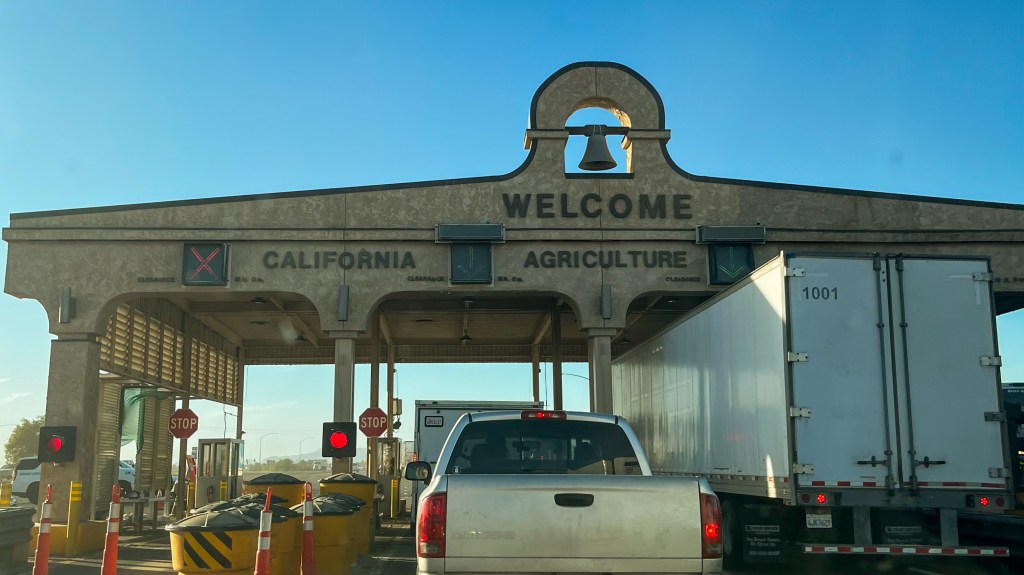
    At the base, I punched in the gate code from my employment email. The private road snaked toward the lodge, closed to all but workers and tour buses. The Virgin River shimmered beside me, Angel’s Landing towering in the distance like a monument to the divine.

    I parked. I stepped out. I smiled.

    I had made it.

    My road to Zion was complete.

    VIII. Where the Misfits Fit

    October 8th, 2024 – Zion National Park

    I checked into Zion and filled out the usual paperwork. They handed me a room key, gave a few directions, and left me to it. I unpacked the trunk of my truck and tried to settle into my new quarters, a cramped, stale room in the old bunkhouse. The air inside was thick with the scent of dust and mold. My mattress sagged in the middle like it had hosted decades of worn-out wanderers before me.

    I wandered down the hallway into the common room. A few cracked leather couches sat slumped against the walls, cushions tired and lopsided like they’d given up trying to hold form. Beyond that was the patio, two weathered wooden benches surrounded by a mess of cigarette butts scattered like breadcrumbs from someone else’s long night.

    No one was around. It was the middle of the day, so I figured most folks were on shift. I made my way toward the main lodge, where the mess hall sat, and where I’d be working for the next few months.

    As I stepped outside, the canyon swallowed me whole. Towering walls of Navajo sandstone stretched thousands of feet into the sky, layers stacked like stories of ancient time, each one glowing warm under the sun. I let out a small chuckle. I’d lived in some pretty wild places before, but between two monoliths of fire-red rock in a national park? This was something else entirely.

    The lodge itself showed its age in all the best ways; classic, weather-worn architecture, solid wood beams, and a front lawn so green it felt surreal against the desert hues. Families sprawled out on picnic blankets while deer grazed lazily among them, undisturbed and perfectly at peace.

    I sat down on a bench at the edge of the grass and let my eyes drift up the canyon walls. From the cottonwoods lining the Virgin River to the towering peaks that kissed the clouds, it was hard to believe this would be home. I could see Angels Landing rising in the distance like a giant’s spine, and I knew The Narrows lay just beyond that, waiting.

    The lawn at Zion’s Lodge

    I was eager to see what life in the canyon might bring, but my mind was still anchored to sleepy Missoula mornings with Autumn, her smile, her touch, the serenity she carried. I could picture it so easily: moving there, enrolling at the college, building a simple, steady life with her. But I knew I had to let that vision go, at least for now. I pulled out my phone and called her. She answered on the first ring.

    “Hey,” I began, my voice already heavier than I’d planned. “I miss you terribly… but I need to put some distance between us. If I keep selling myself on the idea that I’ll see you again, making promises I’m not sure I can keep, things will turn sour.”

    On the other end, I heard her breathing, shaky and uneven, each exhale cutting into me.

    “I’m so sorry,” I said. “I hope you can understand.”

    A pause, then her soft reply: “I do… I’ll miss you, that’s all.”

    “I’ll miss you too,” I promised. I thought of all the peace she brought me, how I’d never met anyone quite like her, but the right words refused to come.

    “Take care of yourself, Autumn. I love you,” I finally said.

    More shaky breaths, then her voice, choked but certain, “I will. And you better do the same, Matt. I love you too.”

    The line went quiet. I let out a long breath I didn’t realize I’d been holding, the weight of the call settling over me like the canyon walls themselves.

    I sat there until the sun dipped below the cliffs and the canyon filled with shadow. It was early still, but the falling light made it feel like night. I walked over to the cafeteria, which smelled exactly how you’d expect a desert park mess hall to smell, not good, not bad, just… institutional.

    Inside, a handful of coworkers were gathered around long tables, eating and chatting. I grabbed a plate of gumbo and rice, tonight’s special, and took a seat near the edge. I hadn’t realized how hungry I was until I started eating. I cleaned my plate and went back for seconds, grateful for something warm.

    After dinner, I stepped back outside. The lawn was dark now, a soft desert breeze threading through the cottonwoods. Sitting beneath one of them was a young woman I’d seen earlier in the mess hall. I walked over and introduced myself.

    She told me a bit about herself; where she was from, how she ended up in Zion. She said the job had its ups and downs but that the people made it worth it. “If you want to meet everyone,” she told me, “you’ll find them hanging out on the porch outside the dorm.”

    I thanked her, told her I’d see her around, and started back the way I came. Something about the moment struck me, the stillness of the canyon, the hush of new beginnings. Zion felt like a turning point, a place I was meant to be.

    Approaching the dorms, I heard laughter and caught a cloud of smoke drifting in the porch light, that warm amber hue that made every face look like a ghost from some half-remembered dream. I climbed the steps and felt their eyes on me. Not hostile. Not exactly curious either. Just that indifferent, seasoned look, the kind of gaze you get after you’ve watched a hundred new arrivals come and go. The kind of gaze that’s been the new kid, too.

    At the top, I tipped my hat.

    “Hey, new guy,” someone called. “Pull up a chair.”

    Leaning up against the railing, I found a stack of beat-up camp chairs, sun-faded, stained with coffee and God knows what else. I dragged one over and joined the circle.

    Introductions went around like a bottle. I caught half the names, the rest would come with time. And they would come. This wasn’t a crowd you brushed past. This was my new family.

    They were all some version of me, burned out, blown in, or just plain curious. Nobody ends up working for minimum wage in the desert unless they’re running from something, or trying to find something worth staying for. We were housekeepers, servers, line cooks, front desk attendants. Holding degrees never used or dreams we hadn’t fully let go of. Some of us had left relationships. Others left cities. Some just caught a westbound wind and didn’t ask questions.

    Someone passed me a cigarette. Then offered me a pull from a bottle of brown liquor.

    “Where you from?” a voice asked from the shadows.

    “And what brought you to Zion?”

    The first question was easy. The second made me pause.

    What had brought me here?

    I flicked the lighter, took a drag, and let the silence stretch for just a second longer than polite.

    “Needed a change,” I said. “The road just kind of led here.”

    The guy nodded, his hoodie casting a shadow over his eyes. “That’s the only kind of answer that makes sense around here.”

    As I listened to the conversation late past midnight, I noticed eyes, everyone’s told a story. Everyone’s eyes held a different map.

    Some were weathered, like old trail signs on backcountry roads, pointing to lives lived hard and fast. You could see miles behind them: the heartbreaks, the addiction, the nights they almost didn’t make it home. Others had the dull weight of fatigue, not from one long night, but from years of compromise. The eyes of people who had tried to fit into a world that didn’t quite have a place for them, tired of the city, tired of the grind, tired of love that turned to dust.

    And then there were the bright ones. Eyes still wide with wonder. New to the park. New to this life. They scanned the faces around the circle like they were looking for proof that magic still existed, or at least that this wasn’t all just another dead end. You could see the light catching in them, reflecting the canyon walls even in the dark, like they were still falling in love with everything, the desert air, the feeling of being untethered, the kind of freedom that doesn’t show up on a map. The eyes of dreamers, black cats, and runaways.

    As I listened, I learned more about what life in the park would be like, and it sure wasn’t glamorous. The pay sucked, the work was dirty, the showers barely ran hot, but I knew there was something sacred in it. Something raw and untamed. We were misfits, sure, but the canyon didn’t care. It held all of us the same, the broken, the lost, the idealistic, the reckless, and in doing so, it gave us room to breathe again.

    IX. Paths Crossed 

    Even as life in Zion settled in, a part of me still felt tethered to Missoula. In quiet moments, thoughts of Autumn came, her smile, her touch, the serenity she carried. But something unshakable whispered: Not yet. Not here.

    There’s a legend deep in Zion’s red rock canyon, of an angel standing at the edge of the cliffs, welcoming weary travelers with grace.

    Nearly two weeks in the canyon, learning how life moved between towering walls. By day, working the café’s greasy grill, wiping down sticky counters, keeping the stream of tourists fed. By night, gathering with the misfits, servers, dishwashers, vagabonds, seekers, on the porch beneath stars, sharing cheap liquor and stories from the road. Zion had a way of drawing us all in: those on the run, those chasing something, those who had no clue which they were.

    I was ready for an adventure, I remembered, a quiet digital connection lingering on the edges of my life. Her name was Dani. We’d followed each other online for a while, trading glances through screens. Wanted to meet her for some time. Knew she lived in Northern Arizona, figured now was as good a time as ever. I finally sent a message: Wanna go on an adventure? Told her I’d been living in Zion for a little while and would be here for the foreseeable future. She replied later that day, Let’s meet in the middle. Horseshoe Bend. Friday. 8am. Be there or be square. I Liked that, no questions, no second-guessing.

    ——————————————————————————————————————————

    October 18th, 2024 – Page, AZ

    Before sunrise, hit the road, winding out of Zion’s red cathedral and racing south toward the Arizona desert. As the sun cracked open the sky, light spilled over empty roads and vast desolate plains. To some, a wasteland. To me, freedom. Buzzing,  not with nerves, but the electric hum when fate shifts in your chest.

    I pulled into the lot at Horseshoe Bend and walked to the overlook. The Colorado River carved a perfect U through the earth, the canyon glowing a sandstone hue of gold beneath the October sky. Stood there in my dad’s old Carhartt, breath clouding in the crisp air, when footsteps sounded behind.

    Horseshoe Bend, AZ

    I turned. Reddish-blonde hair slipped out from beneath a hoodie. Then her eyes, gray-blue and stormy, flickering like lightning across a desert plain. I smiled. “Hey Dani. Good to finally meet you.”

    She grinned back, cool and easy. “Likewise.”

    Leaning on the rail overlooking the river, the kind of view that makes anything feel sacred, talking like we’d known each other for years. She carried a calm confidence, someone who didn’t need to prove anything, just show up and be. After that brief chat, she said, “Come on. I’ve got something to show you.”

    Followed her north to the edge of Page, Arizona. She pulled into an empty lot behind an old general store, gave me that look, trust me, and sprinted up a sandy trail. I Slammed my truck door and ran after her, laughing.

    At the top of the hill, she turned. “Check it out.”

    Before us sat a massive sandstone formation, an open cave shaped like an amphitheater, carved by time and wind. We ran down to it, sand kicked up behind our steps, we sat beneath the arch. The space felt divine. The way our voices echoed, the way light hit her hair, it was like sitting in a cathedral carved by nature itself.

    Page, AZ

    We talked deeper now. I asked about her roots, where she grew up. That’s when she hit me with it: “I thought you knew… I’m from where you are. Back in California.”

    She named my hometown. Knew my friends. Knew the very hills I ran through as a kid. Somehow we hadn’t met until now, we laughed at the impossibility of it, the smallness of the world. But part of me didn’t feel surprised.

    Looking at her beneath that red rock arch, something clicked into place. I remembered the tarot reading in Missoula, rain pattering at the café windows, cards splayed on purple velvet. The reader warned: You’ll have to choose. A path that feels safe… or the one that feels like destiny.

    Was this her? Sitting right in front of me. With eyes like desert lightning and a voice that echoed against sandstone. Didn’t know what this was yet. But it felt more than coincidence, and it sure didn’t feel like a choice.

    Running back down to the cars, she hopped into the passenger seat of my truck. I Looked over and said,

    “Pick a direction.”

    She pointed east with a sly smile.

    “Roger that,” I grinned, cranking the wheel and pulling onto the next open road.

    We drove deeper into rural Arizona,  just desert, tumbleweeds, and sky. Endless sky.

    The kind of place where time evaporates.

    Wandered down long-forgotten ranch roads, explored broken bones of old gas stations long abandoned, rusted relics from another era. Conversation flowed effortlessly. Dani was fascinating. The more she shared, the more I sensed there was buried deeper still. Her big eyes held secrets, not the kind she’d give away easily, not the kind I could ignore. Didn’t want easy answers. I wanted to earn the story behind her gaze.

    As the sun dipped to the horizon, we found ourselves west of Page, chasing fading light toward the North Rim of the Grand Canyon. Storm clouds rolled in, low and brooding, and the first raindrops began to fall. Not sure how late we’d be out, decided to grab her car and caravan the rest of the way. I led, with her headlights glowing steady behind, cutting through the desert gloom. The vermilion cliffs rose to our right, a brooding red beneath the darkening sky.

    Then, we began to climb.

    The road wound into higher elevation. Watched the outside temperature drop on the dash, 46… 45… 44. Rain turned to sleet, then thick flakes of snow. Patches gathered at the road’s edge, then began to cover the pavement. Flicked wipers to high, squinting through the blur. Trees rose like ghosts from the roadside, and soon, nothing was visible behind but white haze and her twin beams.

    I pulled over.

    A moment later, she was at the door, hopping back into the passenger seat. We both knew my tires had better tread.

    Kept climbing, deeper into snowy silence. Spotted a forest road and turned, tires skidding as I gunned the gas to keep from sliding into the trees. She laughed, a wild, fearless laugh, and gave a look that made me forget the danger altogether. A short way down the road, it appeared like a dream: an old fire watchtower rising eighty feet into the sky.

    Threw on layers in the cab, then bolted through the snow to the base of the tower. The steps were slick, rails biting at our fingers, but climbed fast, adrenaline warming us. At the top, we stood inside a swirling vortex of snow, the wind circling like a spell cast by the mountain itself.

    North Rim, AZ

    I turned to her, and time cracked open.

    She looked like something out of legend. Skin glowing against the stormlight, hair that soft sandstone hue, eyes,  those impossible, storm-colored eyes, stopped me cold.

    Everything paused.

    The snow. The wind. My breath.

    All that was felt was the space between us, electric.

    Then, she leaned in and kissed me.

    The kind of kiss that sears itself into memory. Can still feel it. Still taste the cold on her lips and the warmth beneath it. When she pulled away, there were no words. None needed.

    Finally, I broke the silence with a breathless chuckle,

    “It’s getting cold as fuck up here.”

    She laughed. “Wanna go warm up in the car?”

    “Already headed down,” I said, turning for the stairs.

    Night fell fast. Any last trace of daylight lost behind the clouds. Drove back to her car. She jumped out and walked to my window, cheeks flushed red from cold, wearing a soft smile.

    “Thanks for the adventure,” she said, then leaned in and kissed me again longer, slower.

    “Glad we finally met,” I said.

    “I’ll follow you down,” I said, voice lower. “Make sure we both get out safe.”

    For the next hour, she led us back through the desert, her taillights through the windshield like a tether to the present. Could still feel her lips, still hear the snow spinning around the tower, couldn’t stop seeing her eyes. Overwhelmed, haunted in the best way.

    Eventually, we reached the split, her road headed south, mine north.

    Flicked high beams twice.

    And watched her taillights fade slowly from the mirror, swallowed by the night.

    Didn’t know when I’d see her again.

    But already felt like I was racing time.

  • IV. The Chief 

    Fin and I settled into a rhythm as summer unfolded in the Cascades. The work was simple but steady, rotating through positions on the alpine coaster: checking wristbands, walking guests through the controls, watching the track from the summit. Pride came in sending folks flying down that hill with a grin.

    It was the first real taste of seasonal freedom, good pay, good coworkers, and best of all, every off day began with new mountains and trails unknown.

    Compared to Santa Barbara, life in the Cascades moved at a different pace. Slower. Quieter. More intentional. Late-night parties were traded for sunrise hikes, solo wanders to icy alpine lakes, afternoons spent hammocking beneath giant trees. The noise faded, replaced by listening again, to the wind, the water, my gut.

    Leavenworth, WA

    The summer passed like that, quick but full. By the time it came to a close, the itch was back. The call of the road. A new chapter tugging at the hem of my shirt.

    ———————————————

    August 31, 2024 – Leavenworth, WA

    Three nights before departure, Fin and I drove up to a mountain peak that overlooked the edge of town. The plan was simple: catch the view, take a moment, one last memory before it all changed again.

    The road started as pavement, then turned to dirt. We climbed slowly, headlights bouncing through tight brush and shadows.

    After what felt like twenty minutes, I glanced over.

    “Are we still on the right road?”

    Fin pulled up the gps, the glow lighting his face. “Yeah,” he said, tapping the screen. “Only five miles.”

    “Feels like we’ve gone that far already,” I muttered, dropping the parking brake so we could crawl forward again.

    The higher we got, the worse the road became, potholes, deep ruts, brush clawing at the sides of the truck like fingers in the dark. Rocks clanged against the undercarriage. Clunk. Scrape. Rattle. My hands tightened on the wheel, breathing steady, inching forward.

    We rounded a bend into a clearing just as the last light drained from the sky. I hesitated, maybe stop here? Watch the horizon fade?
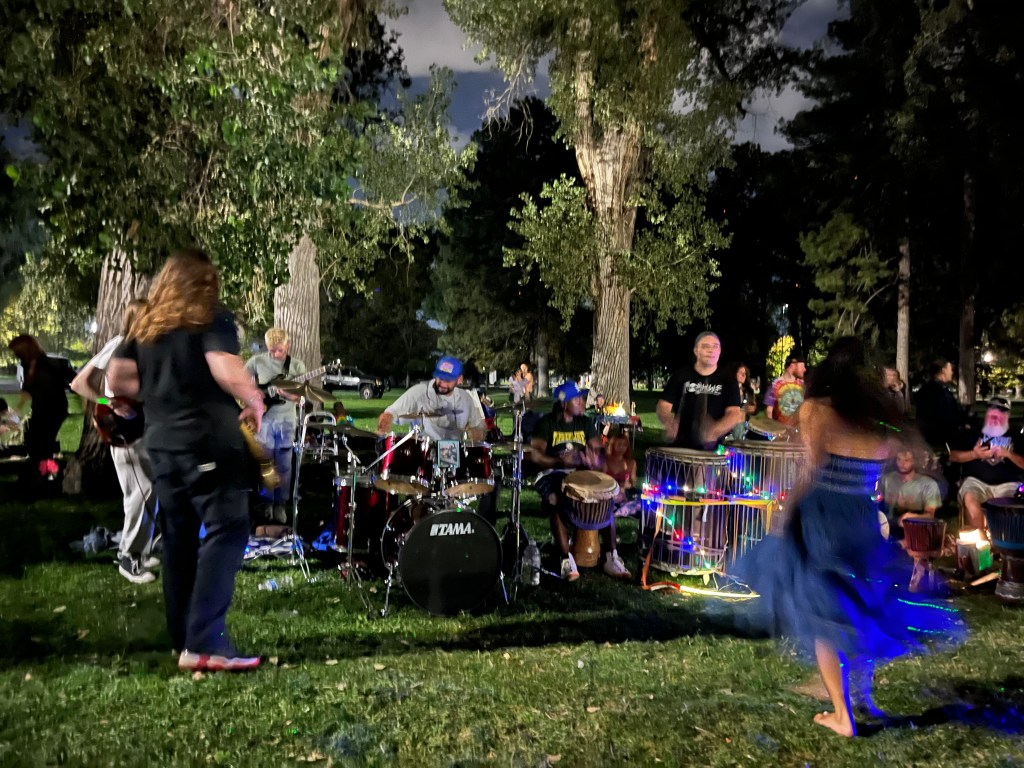
    But something inside said keep going. No reason why, just the certainty of it.
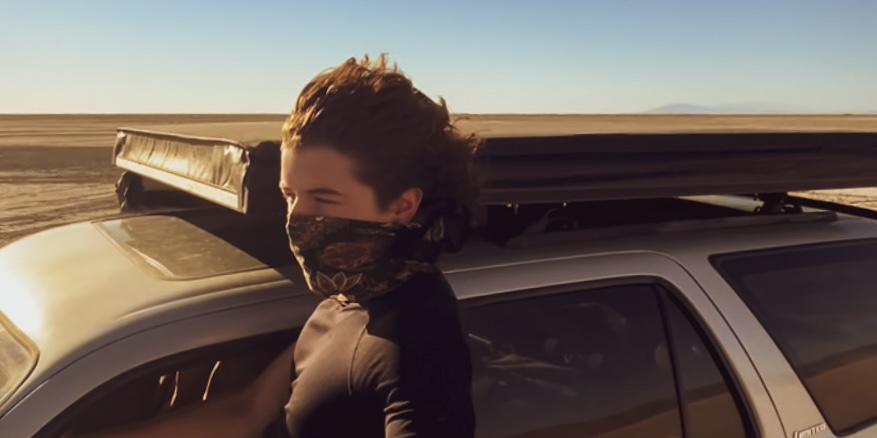
    Another stretch of climbing, more ruts, more grinding rock, and then the truck lurched up and over a final crest.

    We’d made it.

    Moonlight lit a small clearing at the summit. I stopped the truck at the edge, and cut the engine. Dust hung in the air like smoke. Stepping out onto dry ground brought a long stretch and a laugh.

    “That was a mission,” I said.

    Fin came around the truck. “Yeah, hey, check this out.”

    He pointed to a fire ring built from heavy rocks. Embers still glowed faint orange inside it.

    Just then, bam. A pair of headlights burst from the tree line. High beams. Blinding.

    We froze.

    The lights clicked off. Silence.

    Then, slam. A car door. Footsteps. A silhouette approached, backlit by moonlight.

    A man, tall and weathered, long hair swaying with each step. His voice came deep, sharp, but calm, like a river running cold.

    “Evening, gentlemen,” he said.

    “I’m Chief Red Hawk of the Cherokee Nation.”

    “I’ve walked this earth laying down the law for the native peoples of this land.”

    We stood still.

    “What are your names?”

    I swallowed. “Matt” 

    “Fin,” my friend added.

    The Chief nodded, eyes gleaming in the dark. Then he gestured to the fire ring. “These glowing embers are from a sage ceremony I performed tonight. The smoke dispels negative energy. It forms a bridge to the world of our ancestors.”

    Beneath a blanket of stars, we listened as he spoke about how this quiet beauty was the only place he felt at home. Out here, he could carry out his purpose: to protect native people and native land.

    Then his gaze fixed on me. “So what brings you to me tonight?”

    I took a deep breath. The truth. Three days from now, I’d leave town, leave behind everyone and everything known. The destination unclear, the reason undeniable. Scared, yes, but something bigger was pulling me forward.

    “It feels like destiny,” I said. “Like I don’t really have a choice.”

    He nodded quietly.

    “Do you have any advice?”

    A long look. Then: “When you feel alone, build a fire. Don’t burn a forest down. Just find a good spot, gather kindling, medium sticks, and logs. Build it right. Then stay with it. Burn every last piece of wood.”

    The words landed deep, not just heard, but felt.

    He reached into his coat, pulling out a bundle of sage. With a match, he lit it and let it smolder. “Hold your arms out,” he said.

    Standing there, arms wide, he circled slowly, tracing the outline of my body in smoke. Wisps curled into the night.

    When he finished, he hugged me firmly. “Good luck,” he said.

    A handshake, a thank-you, and we were back in the truck.

    We drove down slow, tires crunching over rock and dirt. Silence held until Fin finally said, “You know, I had a feeling we had to make it to the top.”

    “Yeah,” I nodded. “Felt it too.”

    The moment stayed. Still does. Something about the Chief felt like fate, his advice I didn’t just remember, but carried.

    Three nights later, the sun had just dipped below the mountains. The truck was packed, tank full. A long hug for Fin.

    “Till next time.”

    “Take care of yourself, brother.”

    Engine on. Marlboro Reds opened, a tradition for new chapters. One cigarette turned over and tucked back in the pack, my lucky cigarette. Another lit. A long drag.

    I took out my journal, the one given to me on my last night in Santa Barbara, pages scattered with quotes from friends. Somehow, they always found me when needed most. Flipping to a blank page, ready to mark the end of one chapter and the first pen strokes of the next, staring back at me, a stanza in Kenneth’s cursive:

    Do not go gentle into that good night,

    Old age should burn and rave at close of day;

    Rage, rage against the dying of the light. —Thomas

    I chuckled, noted the date, closed the journal, shifted into drive, and rolled east into the dark, toward whatever came next.

    V. “DRAW THREE” 

    September 3rd, 2024 – Missoula, MT

    Missoula came into view on a hot afternoon, smoke drifting in the air and a thunderstorm brewing on the horizon. Thick clouds loomed over the valley, sunlight filtering through in a burning haze.

    Missoula, MT

    A narrow street in the old railroad district led to the address Frizzy had sent. Across the way stood an old wooden house with flaking white paint and an elm tree hanging low.

    Before there was a chance to knock, the front door flew open slam! and out burst Frizzy, arms wide and wild-eyed as ever.

    “Oh hey there, partner!” he shouted, pulling me into a bear hug.

    “It’s been too long,” I said, clapping his back.

    “We’ve got a lot to catch up on,” he grinned. “And I’m sure you’re beat from those miles. Come on in.”

    The last time we’d seen each other was back in Santa Barbara, when the days were drenched in sun and the nights in tequila and noise. Back then, he had no plans to leave. But after a heartbreak of his own, he too was set in motion, he’d traded the beach for the mountains, forestry courses, clean air, and a slower pace.

    There was a steadiness to him now. Still wild, sure, but grounded. It gave me hope.

    “You know,” I told him as we stepped off the concrete porch, “back in Santa Barbara we met as boys, but here in Montana… we meet again as men.”

    Frizzy laughed. “I’d have to agree, partner.”

    We walked toward downtown. He had a class to catch, so the rest of the evening was spent wandering the streets alone while dusk settled over town. The sky was a painted mess of gold and deep pink, storm clouds rolling over the mountains like smoke signals from another world. Rain came soft, then heavy, but warm. Shirt soaked, I strolled the quiet sidewalks laughing to myself, dancing through the empty streets like a fool with no place to be.

    Up ahead, golden light spilled from a window, reflecting in puddles. Inside, a café glowed like a lantern, refuge from the downpour. At a small table draped in purple velvet, an older woman shuffled a worn deck of tarot cards. Her eyes were kind and knowing.

    “Mind if I join you?” I asked.

    “Not at all,” she said, offering a handshake.

    The cards whispered together as she shuffled, laying them out in a fan.

    “Draw three,” she said.

    Seven of Wands. Eight of Cups. VI — The Lovers.

    She tapped the first. “Choosing your truth, listening only to yourself when it’s time to decide.”

    The second: “Reward, abundance, but only if you have the courage to leave behind what no longer serves you.”

    The last she hesitated for a moment. “The Lovers. Love will find you soon, sudden and certain. You’ll see a future with this person, clear and bright. But just when you’ve settled into that vision, another will appear, someone who feels fated. Then you’ll stand at a crossroads: one path certain, the other like destiny. You’ll have to choose.”

    Her words sank like slow rain into dry soil, sparking a feeling in my gut. 

    I thanked her and stepped back out in the rain, where the streets shimmered under lamplight. Hair dripping, shirt clinging, the feeling settled in: something was coming.

    VI. The Timber Rattlers

    September 4th, 2024 – Missoula, MT

    The next night, an old barn had come alive. The air smelled of aged wood and spilled booze, floors trembling under stomping boots, steel toes, Doc Martens, worn-out cowboy boots. Spiked tea sloshed from red cups onto the planks. Men in denim and Carhartt swung girls in long white skirts, spinning to the wildfire rhythm of The Timber Rattlers.

    Banjo. Upright bass. Two weathered guitars. They didn’t just play, they lit the damn floor on fire. Nobody could sit still.

    In the current of it, a short blonde with fire in her eyes grabbed my hand. Without a word, she spun me across the floor like we’d known each other for years. We danced until the lights came on and the crowd spilled outside. Then, hand in hand, we slipped into the quiet street.

    “What’s your name?”

    “Autumn,” she grinned.

    “Pleasure to meet you. Where to next?”

    “There’s a party across the river. You in?”

    “Gladly.”

    We piled into the back of a minivan with strangers, rolled across town. The party was packed with familiar faces from the barn, still riding the high of the music. We drank deep and smoked slow, when the beer ran dry and the haze cleared, the noise thinned and it was just Autumn and I, sharing the stories that brought us to that porch.

    Sleep wasn’t calling, so we walked to a nearby park. Even at midnight, the September air was warm. Sprinklers cast mist in the moonlight. She took my hand and we ran through them like kids.

    Soaked, we collapsed in the grass. The kiss that followed was sharp, electric, the kind that signals a new chapter.

    —————————————

    The weeks in Missoula blurred, riverbanks and golden leaves, moonlit backroads, peaceful kitchen mornings. Autumn and I moved through it all with grace and wholeness, careful not to name it too soon for fear it might vanish.

    Days along the Blackfoot River, sun on our shoulders, water sweeping away whatever weight we carried. Afternoons in Idaho’s hidden hot springs, steam curling into pine boughs. Nights on backroads, chasing the darkest skies, her hair whipping wild in the wind, my hand resting lightly on her knee as she hummed along to the radio. In town, we wandered beneath auburn maples dropping their colors at our feet like a slow confession.

    Hot Springs, ID

    It was the in-between moments that hit hardest.

    Mornings in her kitchen, quiet, golden. The smell of Coffee drifting through the air, sunlight spilling through stained glass, catching the steam off pancakes stacked on the table. Barefoot in a wool sweater, she moved with an ease that made something settle in my chest.

    Nights were softer still; she’d brew a pot of tea, I’d crack a beer, stories circling the kitchen table. Hours stretched long. This type of stillness was rare, and I never wanted it to end.

    There was never a question of staying forever. That uncertainty made every moment shimmer, borrowed time we both knew would run out. Being with Autumn felt like the opposite of running: peace, warmth, clarity.

    Frizzy and I still found time, hikes in the hills, cold swims in tucked-away holes, dinners that stretched late with laughter. One night over beers, he leaned back and said, “Man, I gotta get back to California.”

    It made sense. California was chaos, and Frizzy had always danced best in the storm.

    “Well, partner,” holding up my can like some dirtbag toast, “you better get back to California then.”

    ”Cheers to that partner” Frizzy said meeting my can with his; in that moment, I knew Missoula wouldn’t hold him for long.

    In those drifting weeks, I’d been casting job applications across the country. Eventually, one tugged back, an offer in the red canyons of Zion National Park.

    Telling Autumn didn’t need drama. She was never mine to keep, and I was never meant to stay. Leaving wasn’t easy, she made loving easy, but the road was calling.

    That evening, the journal came out again, dog-eared, sun-bleached, filled with sketches, stains, and quiet thoughts. On the back page, among many signatures from my friends in Santa Barbara, a line stared back: Glad to have met you on your road to Zion.

    Written before I ever left California.

    I let my fingers trace the ink, and closed the book with a smile. Some stories write themselves before you even get out the pen.

  • I. The Enchantments 

    June 24, 2024 – Leavenworth, WA

    The Enchantments through-hike in the eastern Cascade mountains is a legendary eighteen miles of raw, high alpine wilderness. At the trailhead 13 miles deep into dense Pacific Northwest forest from the little town of Leavenworth, WA, I started at sunrise. Morning light cut through the trees in gold slats. The trail was soft beneath my feet, pine-scented and damp.

    The last half-mile of the climb out of the woods hit hard a steep scramble to a ridgeline. And then I saw it:

    Colchuck Lake.

    Glassy and blue like something out of a dream, resting beneath the jagged, snow-covered face of Mt. Colchuck.

    Colchuck Lake, WA

    To the left of the mountain? A steep, snow-choked chute called Asgard’s Pass, a cruel stretch of rock and ice that guards the gates of The Enchantments. Beyond it lies a series of alpine lakes so pure, so tranquil, it almost feels like they aren’t meant to be found. 

    I followed the trail skirting along the rocky shores of the lake that made a perfect mirror for the sky to the base of the chute. I cinched down the straps on my pack, took a deep breath, and started climbing.

    The granite boulders were unforgiving, shifting beneath me as I picked a route that skirted patches of snow and ice. Higher and higher I climbed, the lake and forest falling away beneath me. 

    I remember thinking as I climbed it’d be cool to see a mountain goat. I’d spent most of my life in California, I’d never seen one. I knew they roamed the Cascades, but I didn’t know where or when I’d see one. I didn’t expect it.

    Then, near the top, I crested a rise and found a small meadow tucked into the slope.

    And there he was.

    A full-grown male goat, thick white coat, staring at me like he’d been waiting. We locked eyes. I took a seat in the grass, heart pounding, and watched as he calmly chewed wildflowers. Behind him stretched the endless peaks of the Cascades.

    For a few minutes, we just existed, two creatures from different worlds, strangely at peace. I felt something in me settle. For the first time in a long while, I knew I was exactly where I needed to be.

    I left my new friend and climbed the final few hundred feet. When I crested the pass, the world opened up.

    Below me, a string of alpine lakes glowed in shades of turquoise, teal, and glacier blue. Some were still holding patches of ice. Tiny waterfalls threaded down from pool to pool. The place looked less like a hike and more like a page torn from a fairytale.

    That was mile six. Twelve more to go. But the worst of the climbing was done. Ahead lay a slow descent through one of the most beautiful stretches of wilderness I’ve ever seen.

    The Enchantments, WA

    I wandered for six hours among those high lakes, each one with its own jewel tone shade of blue, its own quiet. The silence in the valleys between the ancient peaks wasn’t just around me, I found it within me.

    Back in the sunny coastal town of Santa Barbara, my life had been a blur of noise and movement. Here, it was finally still. The voice in my head no longer had to scream to be heard. I could breathe again.

    The air tasted clean, thin, cold. It bit at my chest and made me feel alive. Present. Real.

    As the trail wound lower, patches of snow gave way to exposed granite, and then to thick evergreen forest. Some parts of the descent were rough, narrow sections of trail carved into rock, where rusted rebar served as footholds from years ago. But my body just moved. Step by step. Thought by thought.

    And somewhere in those miles, I started to process everything I’d been dragging with me, the pain, the guilt, the running. I thought of the people I loved. The people who hurt me. The ones who taught me. I began to let go, not with bitterness but with a strange sense of gratitude.

    For the first time in a long while, I felt found. Not just on the right path, but on my path.

    The forest deepened. The trail turned to hard-packed dirt. Tall firs replaced snowy crags. My legs ached, my shoulders burned, my water bottle ran dry. I smelled like salt and dirt and sun, but I didn’t care. I wasn’t in a hurry. I had nowhere to be fast.

    The sun dipped low behind the peaks, shadows stretched long across the trail. I rounded a bend and finally saw it: a glimpse of the parking lot far below. Just a half-mile of steep switchbacks stood between me and the end. But the pain was gone. My feet, my shoulders, even my heart, numbed by beauty, worn down by clarity.

    In that final stretch, I realized I’d found what I’d been looking for all along, not a person, not a place, but a feeling. Something open, and infinite.

    The open sky.

    And miles upon miles of trail unknown.

    I hit the parking lot floating. Fin was there, waiting with a burger, fries, and an ice-cold root beer. I devoured it all in seconds. It was the best thing I’d ever tasted.

    He drove me back to the trailhead where I’d parked fifteen hours earlier. The day had been so full, so heavy with meaning, it felt like I’d been gone for days.

    I climbed into my truck, turned the key, and rumbled back to our cabin. Took a quick shower. Collapsed into bed.

    That night, I slept better than I had in a long, long time.

    Not just because I’d hiked 18 miles through the Enchantments, 

    But because somewhere in that wilderness, I remembered who I was.

    In the stillness that followed, memories began to surface. There was a time, not long before, when life looked very different, louder, faster, messier. A chapter I hadn’t yet made peace with. And before I could move forward, I had to look back.

    II.  The Backseat Circus

    December 10th, 2023 – Santa Barbara, CA

    Sunlight cut through the blinds in sharp, dusty rays. I was flat on my back, staring at the popcorn ceiling with bloodshot eyes. Head pounding, I felt empty, drained. Another late night, third, fourth, maybe fifth in a row. Who’s counting anymore?

    The clock read 10:24. I groaned. Another literature lecture missed.

    I peeled myself out of bed and shuffled into the cramped kitchen of the apartment I shared with four other guys. Still wrecked from the night before, beer cans and Solo cups cluttered the counters. I started a pot of black coffee, I leaned up against the counter and held my head in my hands listening to the tired coffee pot, hiss drip-drip. As soon as the coffee was finished I dropped a few ice cubes into my mug, and downed it fast like medicine.

    I slipped on my flip-flops, grabbed my longboard and coasted down the steep hill behind our building. At the beach, I stripped off my shirt and walked into the Pacific. The water was cold and refreshing. I dove under. Salt stung my lips, cleared my sinuses, and dragged me back to the present.

    There weren’t many people out, just a few older folks walking their dogs and one or two sunbathers soaking up the morning rays. I floated on my back, watching the sky blur into the blue of the ocean, and the Santa Ynez mountains towering like a mirage behind the city.

    I needed to shake the fog from my head. The hangover, and the disassociated feeling that came with it. I let the cold sink in until I could breathe again.

    After a while, I pulled myself out and sat on a patch of grass near the shore, longboard under me, salt drying on my skin. I felt beat up, but by now I was used to it. The ocean always seemed to rinse me clean.

    I skated downtown to my favorite taqueria and ordered a burrito stuffed with carnitas, rice, beans, and guac, chased with a cold Coke from a glass bottle.

    Ding. My phone lit up.

    Rae: “Hey, you wanna come with Sofia and me to Malibu?

    I grinned. I wasn’t slowing down anytime soon, and frankly, I didn’t want to. Sure, I was burning the wick at both ends, but at least I was having fun. I texted back:

    Sounds like a plan, When are we going?

    Rae: “We’ll pick you up in 30.

    I scarfed the rest of the burrito, crushed the Coke, and skated hard back uphill. On the way, I called Frizzy.

    “Get yourself ready, partner, we’re goin’ to Malibu.”

    Frizzy was always down. If the plan was wild, he was already lacing his shoes.

    Back at the apartment, he was throwing on an old t-shirt and stuffing swim trunks into a bag. I grabbed some sunglasses and my longboard. We heard the thump of the bass from Sofia’s SUV before we saw it, we ran out the door and jumped in the back as the girls pulled up. Sofia threw it in reverse and peeled out. 

    “Long time no see,” I joked, even though we’d spent the last four nights getting tangled up in the same mess of parties.

    Sofia glanced back from behind a pair of shades. I could see a glint in her eye like the sun reflecting off broken glass. “I knew you just couldn’t say no.”

    I rolled my eyes and elbowed Frizzy. “Here we are, in the backseat again.”

    We called ourselves the Backseat Circus; myself, Frizzy, Rae, and Sofia. Always on the move. Always in over our heads. Never in control.

    Frizzy and I had become inseparable since we met just months prior, brothers in chaos. Rae, though, was the glue. Cool-headed, quick-witted. She could shoot a look that made you think twice, and she was usually the one who reminded us to pack a jacket, drink water, or not jump off cliffs just because it looked fun.

    Sofia? She was wild. Chaos behind a pair of amber eyes. There was something about her, untamed, intoxicating. I’d never met anyone like her. Sofia had this way of pulling you into her orbit, all wind and fire and motion, and by the time you realized you were in too deep, your feet were already off the ground.

    We bombed south on the PCH, windows down, music up. The ocean stretched to our right, endless and glittering, the mountains of Malibu rising up to our left. We turned inland at a sign that read:

    “Winding Road Next 7 Miles.”

    I watched a grin creep across Sofia’s face. Her hands tightened on the wheel. I heard the engine growl.

    “Oh boy,” Rae muttered from the front seat, bracing herself.

    She floored it. We careened up the winding mountain road, tires screaming around switchbacks, music blasting. Frizzy and I leaned out the back windows, wind rushing through our hair.

    Eventually, she pulled off at a lookout with a panoramic view, The Pacific stretching west, Channel Islands floating on the horizon, hills rolling east. We jumped out, the engine of SUV ticked as it cooled, adrenaline still buzzing through our veins.

    I grabbed the longboards from the trunk. Sofia and I sprinted barefoot to the top of a hill, boards tucked under our arms.

    The sun hit her eyes just right, turning them to that amber color I know I could never forget. She wore a long earth-toned skirt that whipped in the wind. I was in jorts, sunburnt and smiling like a fool. I was falling in love, fast.

    Malibu, CA

    I savored the silent moments with Sofia, time slowed down. It always felt like being in the eye of the storm, just her and I while the world howled around us. 

    In a low voice, I said, “moments like these… I never want them to end.”

    ”Then don’t blink.” Sofia said with a smirk

    She jumped up “You ready?” I smiled, I didn’t have a choice.

    We pushed off, hand in hand, carving wide turns into the smooth tarmac, weaving back and forth through beams of golden light. The wheels hummed. The wind howled. I could feel the world fall away.

    When we skidded to a stop back at the car, Frizzy looked at me with wide eyes, grinning.

    “That was so fu*king sick, dude!”

    We piled back in and raced downhill toward the coast to catch the sunset. At the beach, we sat on warm rocks as the sky turned to fire. Frizzy passed around a couple cigarettes. The waves crashed just below us. Rae stared out at the water and said softly, “It’s nice to slow down for a moment.”

    Letting her words sink in, we all sat quiet for a second.

    Sofia leaned into me, and I wrapped an arm around her. The ocean roared. The storm in my head from the morning had calmed, and all that was left was this moment. This crew. Her.

    When the sky faded to black, we piled into the SUV again and headed north, back to Santa Barbara, to pour drinks, to make another night worth remembering.

    The ocean breeze still lingered on my skin, the amber light of that Malibu sunset etched behind my closed eyes. I could still feel the wild energy between us the way time slowed, the world narrowed down to just her and I. Those moments felt infinite, like the calm before a storm I couldn’t yet see coming.

    But love is never just calm seas. It’s the crashing waves that shape us.

    III. The Road’s Call

    May 4, 2024 – Mt. Whitney, CA

    “We’re not gonna make it. We need to get off this mountain.”

    Fifteen hours of hiking clung to my voice like lead. I looked at Shaun and Kenneth. No one argued. Just slow, solemn nods.

    There we were, staring up at the tallest peak in the lower 48, less than a thousand feet below the summit, and we had to turn back. Crushed doesn’t cover it. But with altitude sickness setting in, water running low, and a blizzard swelling on the horizon, turning around wasn’t just the right choice, it was the only one.

    Mt. Whitney, CA

    Months of training. Gear we could barely afford. Permits we scraped by to win. All that led to this: a brutal 10-mile descent from 14,000 feet in 18-degree weather, faces whipped by 50 mph wind like icy needles. Every step on the blinding snow made my head pound, a churn in my gut, a test of will. But something stronger than survival pushed me forward, her.

    I hadn’t seen Sofia in three months, not since she left for Florence. While I froze on Whitney’s slopes, she had made it  back to Santa Barbara. I thought of her a hundred times a day. We met under diamond stars, and the flame caught fast. Burned hot. Maybe too hot. Before she left, we talked of living together. And while she was away, I became the man I wanted her to come home to.

    That day we made it off the mountain. My jacket was shredded, my hair wild, my body trashed. I spotted the car and called out “shotgun!” like a kid. That hell of a hike faded into the rearview. All I could think of was her.

    May 4, 2024 – 21:00 – Santa Barbara, CA

    I told the guys to drop me at Sofia’s place. I didn’t care how I looked, or smelled. I just needed to see her. I ran to her door. She came out, radiant, and for a moment I forgot everything. I held her like I was afraid she’d vanish. Because I was.

    That night blurred like a fever dream. The way she smelled. The sound of her laugh. Her amber eyes. I’d made it home.

    May 5, 2024 – Santa Barbara, CA

    I woke early and made her breakfast, avocado toast, her favorite. Drove it over to her place, heart pounding. It was spring, the sun was out, and I should’ve felt on top of the world. But my gut was tight. Twisted. And I’ve never known my gut to lie.

    Later that day, Sofia and I lay in a field of tall grass, the kind of place that makes you feel like time can’t touch you. We caught up on the months apart. But something was off. Her smile didn’t reach her eyes. I tried to tell myself it was jet lag. I prayed it was jet lag.

    Then she said it: “We need to talk.”

    We waited. Tried to hold on to the moment before the storm.

    Later, in her kitchen, we sat across from each other. I knew what was coming, and still, it hit like a train.

    “Two days before I left Italy,” she began, “I met someone.”

    Each word carved into me. She told me everything. How it happened. How she fell in love, with a stranger, days before coming home. I was wrecked.

    I reached for a bottle of gin, poured a glass. It didn’t touch the pain. Just numbed the edges.

    I kissed her anyway. Took the back of her head in my palm and whispered, “I love you,” like it might change something. It didn’t.

    That night unraveled into chaos. I drank too much, cried harder than I ever had. Begged her to see me. To come back. My best friend, good old Frizzy showed up just in time and got me out of there.

    May 6, 2024 – Santa Barbara, CA

    I woke up hollow. Hungover. Haunted. The worst part wasn’t what she’d done, it was that I should’ve known better. I’d ignored the signs, sold myself on a dream.

    I spent most of the day in silence. Couldn’t work. Could barely breathe. Later, I texted her.

    “Hey, could you come to the coffee shop today?”

    She showed up early in my shift. I had a love letter I wrote during her first weeks abroad, slipped it into her pocket like it was something sacred.

    “I’ll wait for you,” I said, and kissed her. One last time. I knew it then. That was the end.

    That evening, my friends invited me out to a jazz club. I passed. I needed solitude. I went down to the beach.

    I sat in the sand as the cold Pacific lapped at my toes. Dug my hands into the earth, stared at the setting sun until my eyes teared. I let the tears fall, quiet at first, then uncontrollably. My body shook. I cried until my nose bled, until there was nothing left inside me. No anger. No love. Just silence.

    I stood, wiped my face, and walked to my truck. Fired up the engine and peeled out. The road blurred under my wheels. I wasn’t driving to her, I was driving away.

    Thirty seconds from her place, I called.

    “Hey, could you come outside?”

    She did. I stepped out of the truck, cold as steel.

    “I’m sorry. I told you I’d wait, but I can’t. I won’t. You’ve hurt me too deeply. I gave you the best of me, and you threw it away. I wish you the best. Goodbye, Sofia.”

    Before she could say a word, I was gone. The last thing I saw was her back as she turned and slammed the gate behind her.

    Over the next month, I lived like a ghost in Santa Barbara. Cut her off. Cut everyone off. Worked my shifts, wandered alone at night. I had no place to live come fall, no reason to stay. I knew I had to get out.

    Get far out.

    That’s when I remembered Fin’s offer. A seasonal job in Washington. Decent pay. Free housing. A reset. Fin is a childhood friend, someone I knew I could count on for a good time, a brother; I told him I’d head up early June.

    June 12, 2024 – San Luis Obispo, CA

    Vroom.

    My truck fired up. Odometer read 169,431. The trunk was packed full with anything I could think of that might come in handy, I didn’t know how long I’d be gone, or what I would come to face. I was leaving everything behind, and rolling toward something unknown.

    Road noise is therapy. Pavement hums beneath rubber and hours pass like water slipping through cracks. My first day on the road, I drove 14 hours straight, landing in Corvallis, Oregon, where I crashed in a sketchy parking lot I definitely wasn’t supposed to be in. Slept like a baby.

    June 13, 2024 – Corvallis, OR

    Next morning, I met up with an old friend, childhood neighbor. We drank coffee for hours, traded stories. That chat lit something inside me:

    I have people in my life rooting for me. And it’s on me to leave a damn good story in my wake.

    Recharged, I hit the road.

    June 13 2024, – 17:00 – Bellingham, WA

    Seven hours later I was in Bellingham, Washington. The sun poured through the trees like gold. I linked up with Fin. Swam in waterfalls. Hiked mossy trails. Reunited with an old friend where the forest meets the sea.

    Whatcom Falls, Bellingham, WA

    Those days felt like a dream. Then came Leavenworth.

    June 15, 2024 – Leavenworth, WA

    Fin and I pulled into town around noon. A kitschy Bavarian village tucked into the teeth of the Cascades. Our cabin was falling apart, but the mountains made up for it.

    We explored them all summer.