XIV. The Garden of Eden
We lay beneath an ancient oak, its branches sprawling like the rafters of a cathedral above us. Out here, the world had gone still, no hum of cars, no signal to reach us, just her and me tangled in the tall grass. The meadow breathed slow, gold from the fading sun and flecked with the tender green of new growth after the rain. Across the rolling hills, oaks stood like old sentinels, their shadows stretching long. Somewhere beyond the mountains to the west, the sun slipped toward the Pacific, and the sky shifted, gold to fire to a wild, impossible pink. It felt as if the whole earth had tilted just to let us watch. Her hair brushed my cheek, and her finger traced slow, looping patterns along my arm, some beautiful cursive; each line pulled me deeper into the stillness, and I thought, If time stopped here, I’d never ask it to move again. But of course, it never would.
December 29th, 2024
Ranchlands flew past the windows of the truck, Marley’s hair whipped in the wind.
Ding. We were back in cell range
I flashed a glance at the cup holder where my phone sat, The screen was lit. What I saw, made my stomach flutter
Dani: Hey, coming back to California in a couple days, are you in town?
I looked over “Hey Mar, could you unlock my phone and respond to that message”
“sure thing, what should I send? “
”Just text: I sure am”
“Ok, done”
January 3rd, 2025
Days later, I stood in my front yard on a moonless night, waiting. The street sign flashed, reflecting the glint of headlights far down the road. An engine’s hum grew louder, and then, Dani’s car, the same one I’d followed down from the stormy North Rim months ago.
I walked closer as she pulled up. She jumped out, slammed the door, and even in the streetlight, her eyes gleamed, like a crack of lightning commencing a storm. I opened my mouth, but no words came. Instead, I opened my arms. She stepped into them without hesitation, met my lips, with a kiss passionate like a strike of heat, sharp, intoxicating.. When she pulled away, I couldn’t wipe the smile from my face.
We climbed into my truck without a plan.
“Pick a direction,” I said.
“North,” she grinned.
We rolled out onto the empty freeway, catching each other up on months apart, highs, lows, and the strange in-betweens. Somewhere past midnight, winding down narrow backroads through oak-dotted backcountry, I glanced over.
“Hope you’re ready for an adventure.”
She shot me a look, cool, certain. “You know I am.”
A gravel turnoff brought us to an old high-school haunt, an abandoned mine in the sticks. Headlamps clicked on, boots crunched gravel, and the night swallowed us whole. The chasm yawned open before us, a dark void into the earth. My light couldn’t even touch the bottom. We picked our way along the rim until an old bent ladder led into the dark.
“I’ll go first,” I called, descending into the smell of rust and rock. She followed. The tunnels twisted, some low enough to make us crouch, the air stale and thick. A wrong turn here, a dead end there, then, past a pile of rubble and down a set of rusted cart rails, we found a narrow air shaft. We climbed through, emerging back into the night like swimmers breaking the surface. I breathed deep, clearing the old mine from my lungs. Dani came out behind me, grinning. I liked that, her readiness to take risks, to wander into the unknown for the hell of it, for the sake of the story, for the sake of adventure.
January 4th, 2025
The next morning, sunlight spilled through the windows over black coffee and avocado toast. Dani leaned over the table, eyes bright.
“I’ve got something to show you,” she said. “Haven’t been there in a long, long time.”
“Around here? You’re gonna show me something in the town I grew up in? Not likely.”
“You’ll see.” Her smile was one that said she knew something I didn’t.
We left the GPS untouched, Dani gave turn-by-turns as the freeway carried us north. She pointed out places from her California childhood, schools, roadside diners, dirt roads, and her voice softened with each memory. Something in the way she spoke told me the place we were headed wasn’t just pretty; it was sacred.
We took an off-ramp to nowhere, straight road, golden ranchland, scattered oaks, mountains rising ahead like they guarded something. The asphalt tunneled under twisted branches, over narrow bridges, across creeks that reflected the light of the sun.
Finally, a gravel lot. I stepped out, took it in.
To the west, mountains loomed. To one side, massive rock slabs rose into the sky. To the other, a meadow scattered with wind-carved caves in shapes strange, like out of a cartoon. Above us, a canopy of oak and black walnut filtered the light into something holy. A stream wandered through, glinting between the trees.
“Consider me impressed,” I said.
Dani smiled. “Wait until you see the rest.”
We followed the stream, and with each step I felt like I was seeing more of Dani, glimpses of who she was, where she’d come from. Something had shifted between us, and slowly, like the water meandering through stones beside us, I began to unearth the secrets hidden behind her gaze. The stream carried us to a swimming hole, deep, blue, and glass-clear, where a small waterfall spilled into the pool. We sat at the edge while she told me about coming here as a kid with her mom: scrambling over these rocks, chasing newts through shallow pools, cooling off in the streams on hot summer days. Her words painted the place with more than beauty, they wove it together with her laughter, her childhood, and memories cherished.
I realized then this wasn’t just a hidden paradise. This was her paradise. Her Garden of Eden. Untouched by time the way it held memories like pressed flowers.
“Thank you,” I said quietly. “For bringing me here.”
She looked at me like she was measuring my sincerity, then nodded. “I’m glad I could show you”
Honored. I took a moment to look around, and then to Dani, how she seemed to be of the water, the trees, and the breeze herself. With the memories she told stories of, and the moment I shared with her beside that stream, I understood, in that moment, the place became sacred to me too.
All day, we wandered the hills, followed the creeks, and climbed the rocks, searching for newts, breathing in the serenity of a place that felt hidden from everything. That day, I saw her in a new light. I couldn’t name it, but I was falling further into the storm her eyes held. I knew the lightning behind her gaze had struck me.
When the sun began to sink behind the mountains, we knew we should leave before the remote valley fell into shadow. Before climbing into the driver’s seat, I took one last look at a place so pristine, so sacred, and somehow hidden beneath my nose my whole life. I’m glad it had taken so long, I’m glad my first memories there were with Dani.
The sun and the adventure had left us tired in the best way, content, the kind of tired you earn. We didn’t speak much as we left the valley; there was no need. The golden light caught in the mirror, casting Dani in a glow. I reached over and took her hand as the road unwound the same way it had brought us in hours earlier. The colors outside deepened, melting from blue to gold. Out the passenger window, a meadow spread wide, cast in the golden light, dotted with oak trees, unbroken by fences, houses, or people. It was perfect. I wasn’t ready to leave.
Impulsively, I pulled over. Dani, catching the hint, jumped out with me. I took her hand and we ran, far from the road and deep into the meadow, the tall oat grass brushing our legs until we collapsed, breathless, laughing into the open field. She rested her head on my chest, and I wrapped her in my arms.
We lay beneath an ancient oak, its branches sprawling above like the rafters in a cathedral. Out here, the world had gone still, no hum of cars, no signal to reach us, just her and I tangled in the tall grass. The meadow breathed slow, gold from the fading sun and flecked with the tender green of new growth after the rain. Across the rolling hills, oaks stood like old sentinels, their shadows stretching long. Somewhere beyond the mountains to the west, the sun slipped toward the Pacific, and the sky shifted, gold to fire to a wild, impossible pink. It felt as if the whole earth had tilted just to let us watch. Her hair brushed my cheek, and her finger traced slow, looping patterns along my arm, some beautiful cursive; each line pulled me deeper into the stillness, and I thought, if time stopped here, I’d never ask it to move again. But of course, it never would.
January 5th, 2025
Early the next morning, we woke up eager to see what the day held. My truck rumbled to life, It was my turn to choose the adventure.
Only one place came to mind.
Without a word, I turned north on the PCH. We raced up the road in dawn’s light, passing through sleepy seaside towns until the houses thinned and the highway cut through ranchlands then gave way to ragged cliffs. The air was sharp with salt, the horizon endless.
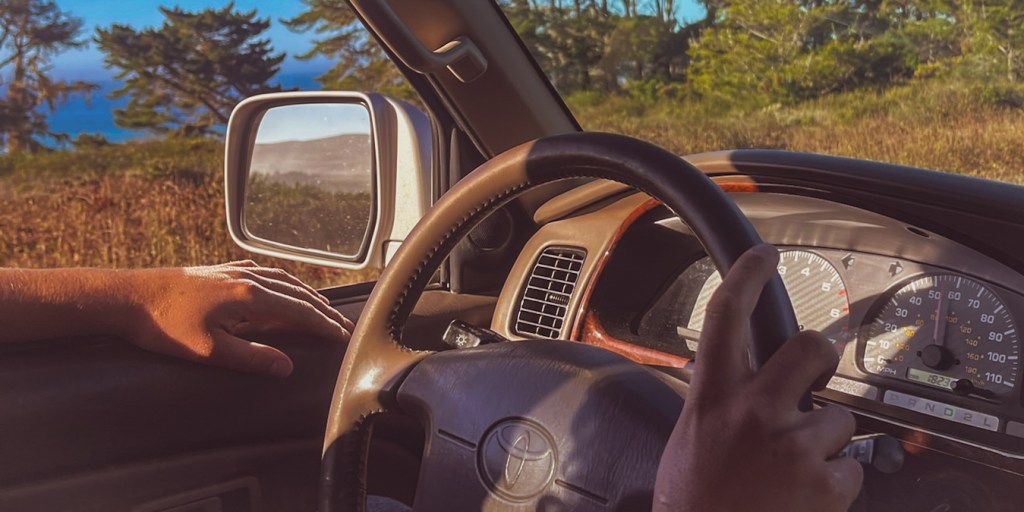
Of course, we went to Big Sur.
First stop, Limekiln State Park. Dani had been long ago; for me, it was all new. Early in the morning, we had the place to ourselves. From the stony beach, we slipped into the redwood forest, where the loam was soft underfoot and small waterfalls threaded through the roots of giants. The air was cool, still, holding a kind of hush that made each step feel like walking through a church.
The trail led us to a clearing where three long-abandoned lime kilns stood, monolithic, rust-cloaked, moss seeping down their sides. Nature was taking it all back: ferns sprouting from cracks in the stone, vines climbing what industry had left behind. It was haunting and beautiful, a quiet reminder that everything is temporary.

We wandered for hours, chasing the sound of falling water, ducking beneath the old growth’s shadow. Eventually, we emerged back onto the beach, blinking in the sun. We sat on the rocky shore and wrote for a while, the pages of our notebooks fluttering in the wind coming off the ocean, before piling back into the truck and heading farther up the coast.
Where a road-closed sign crossed the highway due to a landslide, I pulled into a gravel pullout on the cliff’s edge, popped the tent, and we lay inside, sun streaming through the mesh walls, warming us in a soft, slow way. Below, the Pacific spread out in deep blues and flashes of aquamarine, waves curling and breaking far below. There was nowhere else I wanted to be. Time passed like water through open fingers as we talked about everything and nothing. An old cypress, twisted and salt-worn from decades of storms, leaned out over the cliff. Barefoot, we climbed it, lounging in the crook of its branches, the breeze in our hair, the sea air crisp and clean. There was purity to it — simple fun. The best kind.
When the sun began its descent, we headed south, stopping at places that called our names. We wandered hidden redwood groves, balanced across fallen trunks that bridged silver streams, scrambled up moss-covered boulders, and listened to the songs of brooks in the dappled shade. Big Sur has always felt like that to me, untouched by time, another world entirely.
I didn’t think about how the next day would change everything, breaking the spell. Maybe some part of me felt it anyway, buried beneath the ease of her laughter and the soft cadence of her voice, like a storm building above a lonesome desert. Still, I stayed in the present, reckless in my devotion to it, letting the moments root themselves: the trees, the ocean, the quiet we didn’t have to fill. I knew it was dangerous, letting myself slip into something so uncertain. But love is never just the sunny days, it’s the downpour, the lightning strikes, and the scars that stay.
The sun dropped lower, we drove from the hills of Big Sur. I remembered a break in the fence on the ocean side and found it again. Just like the day before, I took her hand and we ran from the road, across the meadows, down to the edge of the earth. The oat grass swayed in the wind, the ocean thundered below, and the sky was ablaze, gold deepening into pink. The scenery wrapped around us, holding the moment still. I breathed it in, alive, elevated, bliss, one last golden memory before it all shifted.
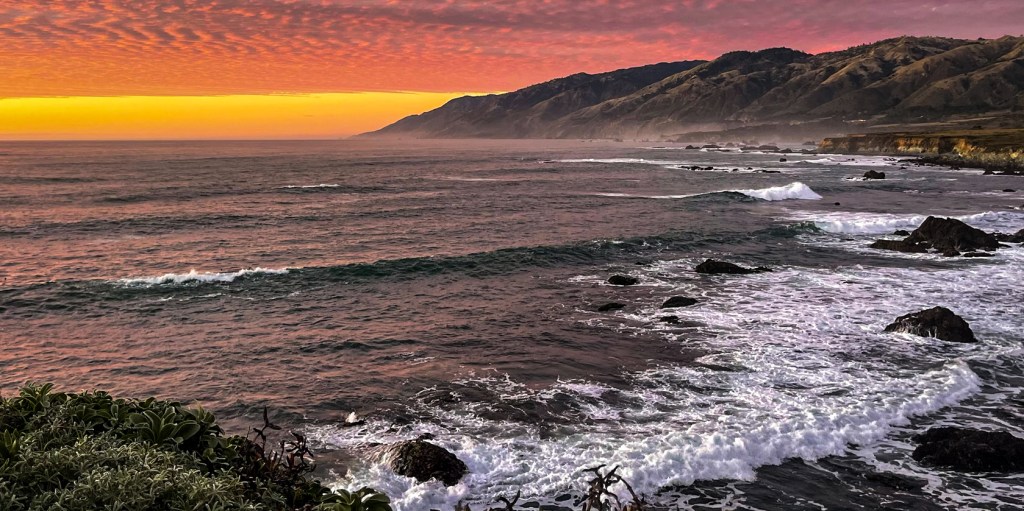
That night, by the side of the road, she looked at me one last time and slipped me a smile.
“Thanks for the adventure,” she said softly.
“Anytime,” I told her, and I meant it.
Then she was gone, once again taillights swallowed by the dark. The night air was cooler now, edged with something I couldn’t name, but would soon understand. It all felt impossibly brief, like waking from a dream where you try, uselessly, to fall back asleep, only to find the dream has already slipped away.
XV. The Valley of Death
January 6th, 2025
It was time to get out, far out. Packing my truck kept my mind busy, kept me from replaying those days with Dani, and the thoughts of seeing her again. With the trunk loaded, the cab humming, I hugged my parents and Marley, said my farewells, and climbed into the driver’s seat, my throne. One twist of the key, one shift into drive, and I was headed east. The desert was calling, and I knew better than to deny it.
I blazed down back roads through the in-between places, the desolate pockets that exist between everything else. I let my mind unwind. Let the guilt of slipping back into Santa Barbara’s old rhythms fade. Let the heaviness of being home slough off. But I couldn’t shake the image of Dani’s taillights disappearing into the night. Maybe I didn’t want to. Maybe I wasn’t ready. Either way, I was hurtling toward something I couldn’t yet name.

The land rolled past in cinematic scraps, abandoned trailers collapsing into graffiti-stained skeletons, rusted barbed wire fences clinging to fenceposts older than memory, ranchland where the water had long since dried up. The road burned through the California valley, orchards stretched for miles. Once the sun set the land had melted into desolate rocky desert, in the distance, a borax plant burned fluorescent in the dark, roof panels missing, siding flapping in the wind. It ran day and night, eating itself alive.
I drove until my mind emptied, until I’d left behind a weight I hadn’t known I was carrying. When exhaustion finally caught me, I stopped at Ballarat, a ghost town I remembered from years ago, weathered wooden buildings slouching into the sand, a graveyard marked with desert stones and a fence stitched from barbed wire and sticks. I didn’t mind sleeping among ghosts, and they didn’t seem to mind me. But that night, the wind howled like a hungry thing, clawing at my tent, testing for a way inside.

January 7th, 2025 — Death Valley NP
At first light I stumbled from the tent, groggy and cold, and only then saw the Panamint Range snow capped and towering in the east, hidden from me in last night’s darkness. Admiring the mountains, I sat in the dirt and made a cup of coffee before pulling back onto the road, climbing toward the pass that would bring me into Death Valley.
In Panamint Springs, I ducked into a weatherworn diner. The windows were fogged and corroded, muting the view of the barren desert outside. I ordered black coffee and biscuits with gravy, holding onto the last familiar comforts before being flung into whatever came next. I finished my plate quick, hadn’t realized how hungry I’d grown, leaving so many miles behind.
“You need anything, honey?” the waitress asked, leaning in with a pot of steaming black coffee.
“Top me off,” I said.
“Oh, sure thing,” she replied, pouring the black silk into my mug.
I needed more than coffee, but for now it would have to do.
Walking out to my truck the wind whipped, bitter, cold, and harsh, my stomach churned, one mountain pass lay between myself and the infamous Death Valley.
When I turned the key to leave, it stuck, just for a moment. A jiggle freed it. Odd, but I didn’t dwell on it. The road ahead was long.
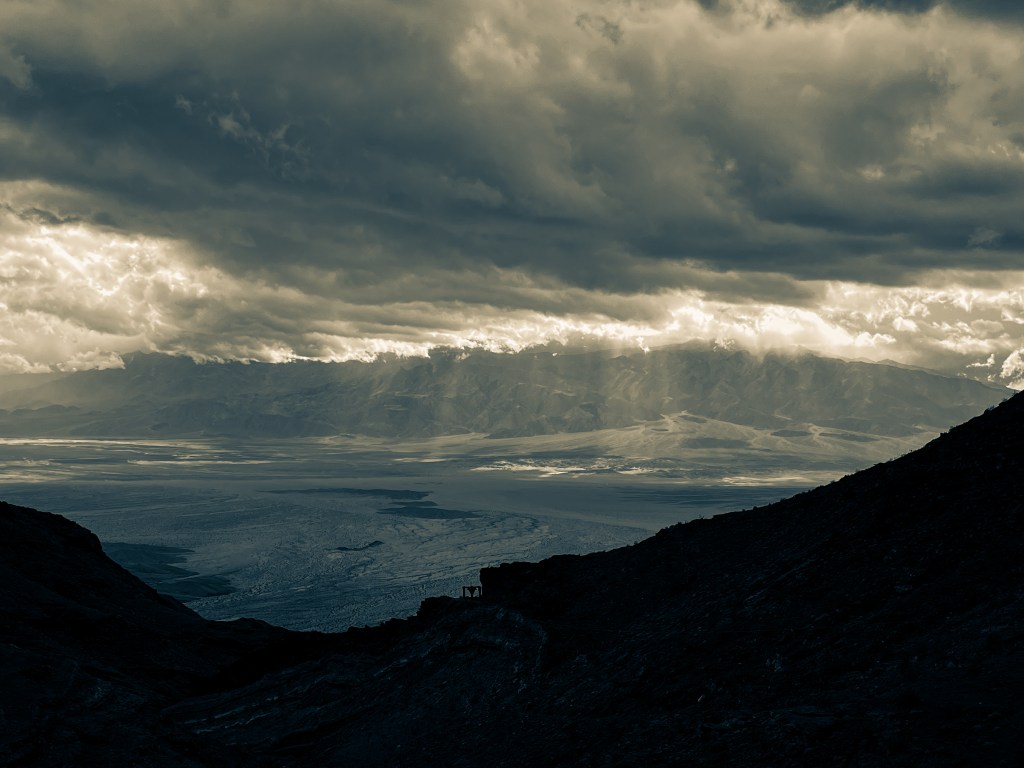
From there, it was a straight climb to Towne Pass, nearly 5,000 feet, jagged peaks crowded on either side before the land opened into a view of Death Valley, shrouded in dust storms. The valley floor was hidden, swallowed in thick, brown, rolling clouds.
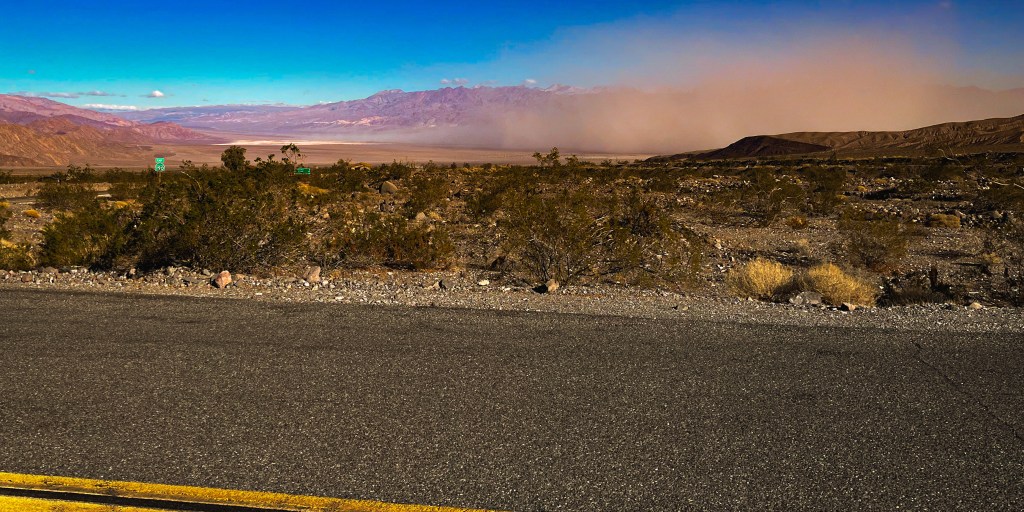
I descended, the road arrow-straight, the air growing hotter and heavier. Dust scoured the windshield. Through the vents, I could smell the earth itself. At a small settlement I stopped for gas, I didn’t know how long it’d be before I’d have another chance to fill up, standing at pump while the wind lashed my face with sand, stinging like glass splinters. Less than two days before I’d been in paradise; now I was stepping into something hellish. The calm, then the storm.
When I turned the key again, it caught once more. Another jiggle, another reprieve.
The dust finally thinned, but still I was dropping lower. Miles ago I’d left the pass; now I was heading for 191 feet below sea level.
My new home, the ranch, appeared like a mirage, gravel streets, sagging mobile homes, a handful of weatherbeaten apartments with tired AC units hanging from the walls. Old-timers and rookies sat smoking at sun-bleached picnic tables under the wind-warped salt cedars, watching me pull in.
I cut the engine. I felt it then, the key caught, wouldn’t turn at all. This time, no amount of jiggling worked. My stomach sank.
The desert had me now, and I wouldn’t be leaving on four wheels anytime soon.
I had come to work in the heart of Death Valley, the beautiful and strange Oasis at Death Valley.
I checked in, filled out the usual stack of paperwork, and was left to it. My room was in an apartment — nicer than the one in Zion — just one roommate this time, and it wasn’t the size of a storage closet. A single window looked out toward the Panamint Range. I didn’t know it yet, but that window would become my favorite part of the room — mornings when the peaks blushed with the first pink light, evenings when the sky burned gold and the mountains faded into shadow.
After unloading the truck, which now sat parked for an indefinite stretch right outside the apartment, I took a walk to see what — or who — I might find. Death Valley had been a last-minute decision, a why-not choice when the map in my head was still blank. Around the ranch, the crowd was mixed: older folks with cigarette-rough voices and faces cut deep from years beneath the desert sun, and younger ones chasing something they couldn’t name.
Then I met Old Man Ben. He passed me a cigarette with a nod, his eyes tired but kind, his weathered face a map of every road he’d walked. Sitting there with him, I learned his rhythm — content in the desert, happy with life, sipping Bud Light from the can, a speaker spilling old rock ‘n’ roll into the dry air. He told me stories: about summer days when the heat climbed over 130 degrees, about almost hitting a bighorn sheep on a lonesome desert highway at two in the morning, about the people who had drifted in and out of this place. I could tell he’d seen a lot from that picnic table, just watching as the world’s hurried ones passed him by.
When we finished our smokes, I shook his hand and wandered toward the fence at the edge of the neighborhood — a sun-beaten chain link, warped by time. I slipped through a jagged hole and stepped into another world. The desert stretched out before me, endless, vast, strangely inviting. The sun was setting, flooding the west with molten orange and red. And in that moment, Death Valley didn’t feel like a bad idea at all.
It felt like a secret.
A home for runaways, black sheep, and the kind of misfits who never quite make it back.
—————————————-
I settled in fast. Within days, I’d found a small circle of friends that fit together in the way only desert rats can manage, a mismatched but perfect puzzle. There was a woman old enough to be my mom, yet we had chosen to live the same type of life, so our conversations seemed to land somewhere in the overlap between our ages. Then there was a guy my age from the East Coast, a westbound drifter with a silver tongue. He could charm a newcomer into a game of poker or talk them into buying a pack of cigarettes from him at a price just under the general store’s outrageous rates, a salesman in the purest form. And of course, there were the transients, the ones who arrived without warning and left just as suddenly, drawn now and then to the picnic bench for a smoke or a story.
My job was at the bottom rung, housekeeping, but the setting made up for it. The hotel was a strange desert gem, built in the 1920s and its age showed in a charming way. There were tunnels and tucked-away rooms, sprawling gardens and palm-shaded ponds, grassy lawns that seemed impossible in this climate, and a deep blue pool where the water caught the sun just right. Inside, Wild West paintings hung on adobe walls, rugs from far-off markets softened the tile, and rustic chandeliers swayed gently in the air-conditioning. The lobby smelled faintly of leather and desert air, with a library corner where sunlight fell through tall windows, framing the oasis and, beyond it, the flats of the valley backed by the towering Panamint Range.
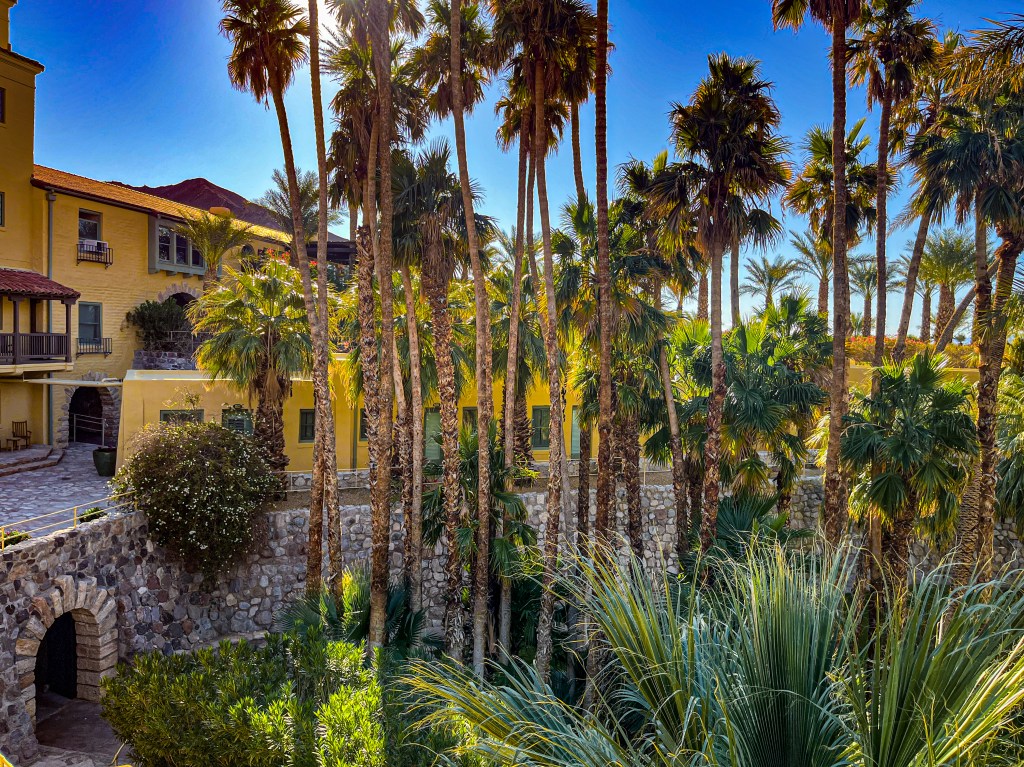
Housekeeping was fast-paced, beds made with military precision, towels folded into exacting shapes, every surface wiped down until not a single speck of dust dared remain. For such a high-end place, perfection wasn’t optional, it was the standard. The work kept my body moving and my mind focused, the hours slipping by in the rhythm of hustle.
Off the clock, the days belonged to the sun. Death Valley in winter was a smart move, seventies by day, sometimes creeping into the eighties, with air so dry it felt like it could preserve you. We’d sit outside for hours, conversations spilling out without end, laughter echoing in the still desert air. No one ever seemed to need much sleep. We worked hard, but made sure every moment we weren’t on the clock was wrung dry.
After a few weeks of being stranded in the valley, I was ready to get my truck running again, to go see the valley and to make a trip to town.
That’s when I met Rob.
He was the kind of older man you could read like a road map — skin tanned and creased, arms inked with tattoos fading from years in the desert, gold teeth flashing when he laughed. There was a rough charm about him, the kind that comes from living fast and paying for it later. He could roll a cigarette in the time it took most people to find their lighter, and he always seemed to have one hanging from his lip, the ember glowing against the afternoon sun.
When I told him I’d finally ordered the parts to fix my truck, he didn’t hesitate. He slipped a key from his pocket, grinned, and let himself into the hotel’s maintenance warehouse like it was his own garage. Moments later he was back, arms loaded with tools I didn’t even know I’d need. Out in the dirt lot, he stood with me every step of the way as I drilled out the old ignition, sliding the new one in like we were swapping organs. He traced the wires for me, explaining which ones talked to the security system and how to fool it into thinking my new key was the one it had always known.
Rob was the perfect kind of desert mechanic — the kind you find exactly once, if you’re lucky. Out here, there wasn’t a single proper auto shop for miles, but I had something better: a man who could coax a half-dead engine back to life with a screwdriver, a cigarette, and a curse. By the end, my truck was humming, and Rob just smiled like it had never been in doubt.
Life in the Valley had its own charm — a dust-coated, sun-baked Wild West. The place felt like it was run by a loose band of outlaws. Law enforcement was scarce, but we had our own code: treat people the way you want to be treated, and if you didn’t, well… you’d get served.
Some nights I’d aim the truck toward nowhere, windows down, the warm desert air rushing in like a tide. The road ran straight as a rifle shot, blacktop stretching into the dark. My headlights carved out a narrow world — two pale beams cutting across the emptiness — while the rest of the valley lay silent and unseen.
The stars out here didn’t just hang in the sky; they poured over it, spilling from horizon to horizon in a silver river. Out under all that space, it felt like the earth itself had loosened its grip. I could press the pedal down, feel the hum of the engine in my bones, and for a moment, that blurred like the yellow lines on the tarmac, I’d feel like a ghost slipping through the night.
The phone sat dark in the cup holder beside me. I didn’t touch it. Didn’t need to. The road was long, and I knew the kind of quiet that followed me out there wasn’t just in the desert air, it was the kind that settles in your chest and stays.
I was running, love casts a long shadow, even at night. Dani’s line had gone quiet. Cut cold. No texts. No calls. Just a sudden absence where a connection used to be. It wasn’t just silence, it was a door slammed on something I wasn’t ready to let go of. Out here in the dark, it followed me, riding shotgun.
I was living hard and fast — the only way to survive out in Death Valley. Long shifts, smoke swirling in the stale air, falling into the valley’s relentless rhythm. Still, I had to keep reminding myself: this was just a stopping point, a place to clear my head, save some cash, and get ready for whatever came next.
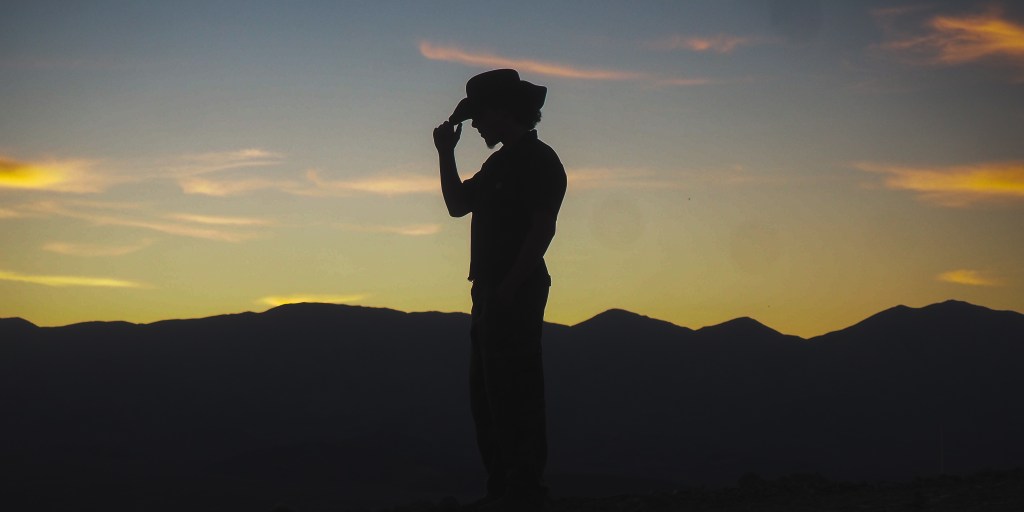
One morning, something clicked. My next job was lined up, the savings stacked enough to bridge the gap. It was time. I packed my truck, tipped my hat to Rob, Old Man Ben, and the ragtag crew I’d come to know.
Before heading back west, I drove out to Badwater Basin, that endless white salt flat where the world feels both vast and strangely intimate. I laid back on the cracked earth, the rough ground pressing into my back, and stared up at the sky, the Milky Way spilling wide above me, stars so bright they looked like a painting. The silence was thick, the kind that fills every space inside you. Out here, under that infinite sky, all the noise and chaos of the valley faded away, leaving just me and the desert’s quiet heartbeat.
That night, lying there in the stillness, I felt the weight of everything I’d lived through since arriving, settle into my bones. Lessons from the valley, the friends, the freedom and the bittersweet ache of leaving it all behind. It was a moment as sharp and clear as the cold desert air, the last taste of a place that had both held me and set me loose. Tomorrow I’d drive away, but for now, I was exactly where I needed to be.

 The Dirtbag Database
Leave a reply to dasha Cancel reply